Wednesday, January 2, 2013

Starbucks is 2012 Mobile Marketer of the Year


Starbucks
Starbucks Corp. is 2012 Mobile Marketer of the Year, the highest accolade in mobile advertising, marketing and media. The honor tops the Mobile Marketer Awards handed out each year for outstanding work that moved the mobile needle for brands and marketers.
There is no doubt Starbucks is a leader and one to watch out for in the mobile space. Instead of following in the steps of competitors, the coffee giant has implemented its own mobile-first strategy that is unlike any other and features the latest technology such as QR codes and augmented reality, as well as traditional channels including SMS, mobile advertising and applications.
“One word sums up Starbucks’ work in mobile: sophistication,” said Mickey Alam Khan, editor in chief of Mobile Marketer, New York.
Sign up to receive Mobile Marketer Daily. The premier mobile marketing publication. Free!
“For Starbucks to be named Mobile Marketer of the Year twice in three years is no mean feat,” he said.
“It shows Starbucks’ understanding that mobile is not just the future of marketing, but also retail.”
The Mobile Marketer of the Year award is the most prestigious honor for smart, strategic and creative mobile marketing. Team Obama won the honor in 2008, Polo Ralph Lauren Corp. in 2009,Starbucks Coffee Co. in 2010 and Macy’s in 2011.
What makes Starbucks a clear winner is the company’s comprehensive, 360-degree mobile marketing strategy that offers a number of different functions and creates an ongoing relationship between the brand and its customers.
Instead of putting its focus on one single channel, Starbucks makes sure it has a presence on each and every one.
Take SMS, for example, which is arguably one of the most effective channels marketers can use to build an ongoing dialogue with consumers and drive brand engagement.
Over the past year, Starbucks has used SMS quite a bit, not only to build its My Starbucks Rewards program, but also to keep opted-in consumers in-the-know about the latest offers and discounts.
SMS is at the heart of the coffee giant’s My Starbucks Rewards. To participate, consumers are encouraged to text the keyword GOLD to the short code 697289. 
Furthermore, to drive as many opt-ins as possible, Starbucks has relied on in-store signage and email to help ramp up its SMS program efforts.
Through the My Starbucks Rewards program, consumers can earn rewards when they pay with their Starbucks Card. Free drinks and refills are one of the perks of the program.
In addition to SMS, Starbucks has used QR codes heavily.
The company’s approach to QR codes is quite different than other marketers. Instead of placing them on anything and everything, Starbucks strategically positioned the mobile bar codes where they would be visible to consumers.
To promote its Blonde, Medium and Dark roasts earlier this year, Starbucks placed QR codes on bookmark fliers that were handed out to consumers.
When scanned, the mobile bar codes took coffee lovers to the company’s mobile-optimized site where they were able to watch a video and learn more about the company’s coffee.
Most recently, Starbucks used QR codes to help spread the word out about its Verismo products, as well as let consumers buy the products via their smartphones after they scanned the mobile bar code.
Instead of simply using one interactive technology, such as QR codes, to drive consumer engagement, Starbucks also dipped its toes in augmented reality.
Last year, Starbucks introduced an augmented reality app to bring its holiday red cups to life.
The company continued its push on Valentine’s Day to once again, bring its limited-edition hot cups to life.
The initiative was a smart move on Starbucks’ part because it let consumers interact with their coffee cups in a new and interesting way.
Another factor that sets Starbucks apart from other marketers is the company’s involvement in mobile payments. The coffee giant is one of the biggest players in mobile commerce.
Starbucks unveiled its mobile payments and loyalty application in 2010.
Using the Starbucks Card mobile app, consumers can check their balance, reload their card and view transactions.
Initially, the program started with 16 select Starbucks stores in Silicon Valley and Seattle and at any U.S. Target Starbucks store and expanded to 6,800 company-operated stores a year later.
As of November, Howard Schultz, president/CEO of Starbucks, announced the company is seeing more than 2 million mobile payment transactions occur every week.
With its integration in Apple’s Passbook, Starbucks has no doubt proved that it is a leader in the mobile payments space and competitors such as Dunkin’ Donuts are following in its footsteps and rolling out their own mobile payments app.
Mobile advertising and mobile apps round out the company’s comprehensive, 360-degree strategy.
For every holiday, occasion and new product, Starbucks uses mobile advertising.
The coffee shop chain realizes the potential of the channel and continues to turn to it to drive in-store traffic, sales and awareness of new products. 
Moreover, the Starbucks has mobile apps on a variety of platforms such as iPhone, iPad and Google Play, which are continuously refreshed to keep consumers up-to-date.
Mobile Advertiser of the Year: McDonald’sWhen it comes to mobile advertising, no one does it better than McDonald’s.
While many marketers think static banner ads, which lack in creative, make a mobile advertising campaign effective, McDonald’s thinks outside the box.
What makes the fast food giant stand out is its ongoing drive to offer consumers something new.
To date, McDonald’s has run six iAd campaigns, as well as several rich media and interactive initiatives.
McDonald’s is a clear winner because it is not afraid to try its hand at something new.
Take its iAd campaigns, for example.
While many marketers test out Apple’s iAd only once, McDonald’s has continually tapped the ad network to promote its products and taken advantage of the device’s capabilities to offer a more interactive experience.
McDonald’s has used mobile advertising to promote a variety of products including its CBO sandwiches, extra-value menu items, McRib sandwich, chicken nuggets and  blueberry banana nut oatmeal.
Each mobile advertising campaign was better than the other.
Many times marketers run the same mobile advertising campaigns, which feature the same creative. But that is what sets McDonald’s apart.
When consumers tap on a McDonald’s mobile ad, the experience is like no other.
Earlier this year, the marketer ran a mobile ad campaign that enticed users to try the company’s dollar menu items by playing a word scramble game.
Consumers were encouraged to unscramble words by dragging their fingers across the screen. Each word was associated with an item off of the McDonald’s dollar menu.
In October, McDonald’s incorporated video into its mobile ad initiative, which promoted its 20th Edition Monopoly campaign.
Most recently, McDonald’s dipped its toes in rich media to help spread the word out about its 20-piece chicken nuggets.
When users tapped on the mobile ad they were redirected to a mobile landing page that featured a football field, the company’s chicken nuggets, as well as a screen that continually blasted different messages including “Grab It,” “Dunk It” and “Score.”
From there, consumers were able to learn more about the company’s products, check out current promotions and browse the McDonald’s menu to check out sandwich, salad, snack and beverage items.
It is evident that McDonald’s understands mobile and by constantly running mobile ads, the fast feeder is showing that it is always one step ahead of the game.
Mobile Publisher of the Year: USA Today USA Today is Mobile Publisher of the Year due to the company’s ongoing investment in the digital and mobile space, as well as a rounded content and media strategy. 
Marketers are continually rolling out mobile sites and apps. However, the mobile strategy stops right there.
It is critical that marketers, especially publishers, continue to refresh content and keep readers on their toes.
This year, USA Today gave its Web site and mobile apps a fresh new look as part of the company’s ongoing effort to make digital and mobile a bigger focus and further solidify its commitment to visual storytelling.
USA Today is Mobile Publisher of the Year because it takes its readers into consideration.
It is important that marketers see what their users are doing on mobile and go from there. And that is exactly what USA Today did.
The publisher redesigned its digital and mobile efforts to include increased color, photos and infographics, as well as new features such as deeper coverage and increased original reporting and video.
Furthermore, USA Today’s Web and tablet products also feature live video coverage, up-to-the second headlines, interactive weather mapping, commentary and user-controls that will let the audience see stories and follow the news the way they want to consume it.
Most recently, the company took its first steps towards building a universal Android app that includes a layout aimed at bolstering readership and increasing engagement.
Moreover, advertiser support is critical for publishers and with the new redesign, USA Today is offering more options for its advertisers.
It is not easy being a publisher in mobile. However, USA Today tackles that gracefully and proves that it is important for publishers to stay up-to-date and constantly refresh content.
Mobile Agency of the Year: R/GAR/GA is Mobile Agency of the Year due to the creative, strategy and marketing results it brings to clients such as Nike, Grey Goose, Johnson & Johnson, Google Wallet and MasterCard.
The ad agency has helped its clients strengthen their mobile campaigns.
Take Grey Goose for example. The company drove awareness for its Cherry Noir vodka by incorporating Instagram and Pinterest.
With the help of R/GA, Grey Goose launched the Hotel Noir campaign, which featured content that spanned across all of its digital channels.
R/GA also helped L’Oréal Paris develop its Colorist app which takes the guesswork out of choosing the right hair color shade.
The ad agency worked with Johnson & Johnson to help the company celebrate its 10-Year anniversary of the Campaign for Nursing’s Future, a critical initiative for helping to recruit and retain more nurses and nurse educators.
R/GA understands mobile and continues to look at new and innovative ways to help its clients branch out and better target new and existing users. 
Mobile Researcher of the Year: Forrester ResearchForrester Research is Mobile Researcher of the Year for the second year in a row.
What sets Forrester apart from others is the company’s nonstop drive to offer strategic insight on the latest mobile marketing data.
The Cambridge, MA-based market researcher focuses on mobile advertising, marketing, mobile commerce, tablets and social media.
The company’s reports are well-versed and highlight the current state of the mobile space, strides that have been made and what lies ahead.
Instead of simply stating facts and numbers, Forrester focuses on best practice and offers solutions to obstacles marketers may face and how to best solve them.
Mobile Program of the Year: Starbucks My Rewards ProgramThe Starbucks My Rewards Program is clearly at the heart of its mobile strategy.
Starbucks is all about loyalty and the My Rewards Program takes that to a whole other level.
The coffee shop chain has enlisted in SMS, email, mobile advertising and in-store signage to get consumers to sign-up for its program.
The initiative is the ideal way for the company to build its database and continue an ongoing dialogue with customers.
The Starbucks My Rewards Program is part of the company’s constant effort to drive consumer engagement.
To sign-up for the program, consumers can either text the keyword GOLD to the short code 697289 or go to the company’s mobile site to sign-in or create an account.
When users register their card they can protect their balance in case their card is stolen, earn rewards with each transaction, set up Auto-Reload for their card, view transaction history and transfer balances between their cards.
Furthermore, consumers can also download the My Rewards iPhone and Android application to keep up with their account.
Mobile Campaign of the Year: Taco Bell “Doritos Locos Tacos”Taco Bell went all out to promote its Doritos Locos Tacos products.
Simply using one channel was not enough for the Yum Brands-owned fast food giant. Taco Bell used mobile advertising, QR codes, augmented reality and Instagram to help spread the word out.
Taco Bell used augmented reality within its mobile app to promote the company’s Doritos Locos Tacos and elevate the user experience through technology.
Consumers were able to connect with the brand through the app’s Buzz Finder.
Consumers were encouraged to hold their mobile device to Taco Bell's soda cups or the Doritos Locos Tacos box and the products were brought to life.
The fast feeder also placed QR codes on its packaging to offer exclusive content from artists that performed at the Hype Hotel.
Those not attending were still able to view performances by scanning the mobile bar codes featured on the Doritos Locos Tacos holsters, which led users to exclusive video content showcasing performances from the Hype Hotel.
Furthermore, Taco Bell used Apple’s iAd network to roll out a campaign that incorporated social media and location-based technology to drive consumer engagement.
The Taco Bell iAd featured several messages including, “A base was stolen in the World Series, so America Gets,” “Stolen=Free Tacos” and “#FreeDoritosTacos.”
When users tapped on the mobile ad, they were encouraged to get a free taco.
Additionally, the ad let consumers set a reminder by adding the event to their device’s calendar.  
Finally, Taco Bell ran an Instagram campaign that let users win prizes by snapping pictures of their favorite meals.
The Taco Bell Instagram campaign was the last piece of its Doritos Locos Tacos piece.
The campaign encouraged consumers to tag their Taco Bell meals with the hashtag, #livemascontest.
To participate in the campaign, users had to register to enter on Taco Bell’s Web or mobile site by filling out contact information and their Instagram username.
Once registering and submitting a tagged photo, consumers were entered to win grand prizes including a trip to the Taco Bell test kitchen, a $5,000 scholarship towards college or trips to either Pacifica, CA, for surfing lessons or Seoul to visit Taco Bell's South Korea location. Daily prizes include a year’s worth of Doritos Locos Tacos, gift cards and T-shirts.
Mobile Web Site of the Year: USA TodayA mobile site is everything for marketers, especially publishers such as USA Today.
The first step is making sure content is optimized for all devices to provide a better reading experience for users.
As part of its ongoing digital push, USA Today redesigned its mobile site, which definitely takes the user experience into consideration.
The mobile site prominently features several key categories such as News, Money, Sports, Life, Tech, Travel, Photos, Video and Weather, with top headlines underneath.
The optimized site offers readers a seamless experience and uses photos, videos and editorial content efficiently.
In addition, the mobile site incorporates social features such as Facebook and Twitter that lets readers share their favorite articles and other content.
USA Today is smart to redesign its content and try to garner new readership through it.
Mobile Application of the Year: TwitterAs of June, 60 percent of Twitter’s 140 million active users accessed the service through mobile.
Consumers are increasingly accessing their favorite social networks through mobile and Twitter is rapidly becoming a go-to for many.
Twitter’s mobile app is essential for brands, marketers and consumers.
The app features an organized stream of tweets that deliver content to users on media, news and events.
Over the past year, Twitter has been ramping up its mobile apps to better service its ever-growing user base.
When Apple rolled out its iPhone 5, Twitter upgraded its application to make the user interface friendlier.
Social and mobile inherently complement each other and Twitter is constantly looking at ways to incorporate new features into its apps to better accommodate users.
Mobile Evangelist of the Year: Mondelēz International’s B. Bonin BoughThere are many industry experts who have had an impact in the emerging mobile space authoring books and reports, and logging frequent flier miles to tout mobile’s virtues at events worldwide.
However, B. Bonin Bough, vice president of global media and consumer engagement at Mondelēz International – formally Kraft Foods Inc. – shines above the rest. He has made an art and science of mobile evangelism, and is a tireless promoter of mobile.
Mr. Bough has taken huge strides to cement Mondelēz International’s position in mobile and expand the company’s reach in the space. His commitment to mobile: put money where his mouth is.
The executive recently announced the company’s Mobile Futures program that aims to collaborate with mobile startups.
Mr. Bough, a former Pepsi Co. executive, is making a commitment to transform Mondelēz International into an innovator in the mobile space.
Furthermore, Mr. Bough has helped in allocating 10 percent of Mondelēz International’s global marketing budget to mobile activations and channels across the entire consumer journey.
Mr. Bough has spoken at many industry events and is continuing to show marketers that mobile is no longer an add-on, but a necessity.

Retail Email Volume Jumps 19% in 2012; Cyber Monday Busiest Day


 by MarketingCharts staff
RetailEmailBlog-Busiest-Email-Marketing-Days-of-2012-Jan201393% of major online retailers sent their subscribers at least one promotional email on Cyber Monday (November 26), making it the busiest email marketing day of 2012, details The Retail Email Blog. In 2011, Cyber Monday was also the most active email marketing day for major online retailers, though relatively fewer (87%) sent emails. Of note, Black Friday did not make the list of top 5 busiest days of 2012, after appearing second on the list in 2011.
In 2012, Free Shipping Day (December 17) came in second with 87% of the more than 100 major retailers tracked sending at least one promotional email. Green Monday (December 10; 84%) followed, ahead of Thanksgiving (November 22; 83%), and December 6 (80%). That means that more retailers sent emails to subscribers on Thanksgiving than on Black Friday.

Retail Email Volume Grows by 19%

The blog post also reveals that the top online retailers sent an average of 210 emails to each of their subscribers over the course of 2012, or 17.5 per month. That’s up 19% from the 2011 average of 177. Not surprisingly, the heaviest months were in November and December, when the retailers tracked sent an average of 23 and 25 emails to each subscriber, respectively. Still, December saw among the slowest volume growth on a year-over-year basis, with January, February, and October seeing the biggest jumps.
The growth in email volume doesn’t appear to be specific to the retail industry. A newMarketingCharts report finds that a subset of insurers tracked by Eloqua with a personal lines element to their business sent a steadily increasing number of emails during the year, from an average of roughly 82,000 in January all the way to an average of 249,000 in October.
All of that emailing leads to clutter. According to a Blue Kangaroo online survey of more than 1,000 US adults aged 18-64, a whopping 43% said that more than half of the new emails in their inbox the week prior to the survey came from marketers(including daily deals, retail newsletters, and sales alerts).

Top 100 free Social Media and Marketing Resources of 2012


  • The Top 100 free Social Media and Marketing Resources of 2012 - Enjoy and share with your friends
Hello, everyone - I hope you are having a WONDERFUL Holiday Season! As we close the year out, here is a mega-list of the Best Social Media and Marketing Resources of the year. They are all free and you can download as many as you like:


1. Social Media: 
http://changetheworld.tradepub.com/category/marketing-advertising-and-promotion-social-media/899/ 

2. Internet Marketing:
http://changetheworld.tradepub.com/category/advertising-and-promotion-internet-marketing/896/

3. Demand and Lead Generation:
http://changetheworld.tradepub.com/category/marketing-advertising-promotion-demand-and-lead-generation/893/ 

4. Email marketing:
http://changetheworld.tradepub.com/category/advertising-and-promotion-email-marketing/895/ 

5. Search Engine Optimization:
http://changetheworld.tradepub.com/category/marketing-advertising-and-promotion-search-engine-optimization/898/ 

Pictures, Links Most Likely To Be Shared, Say Social Media Buffs


 by MarketingCharts staff
SocialToaster-Social-Media-Content-Most-Likely-to-be-Shared-Jan2013When it comes to sharing content on social media, pictures and links get the nod over quotes and videos, according to survey results from SocialToaster. The company surveyed its “Super Fans,” a collection of social media experts and professionals, finding 90% agreeing that pictures were most likely to be shared, and 68% saying the same about links. Quotes (51%) and videos came in next (47%), with studies and statistics (20%) far behind.
The social media experts’ opinions largely align with analysis of Facebook data from Socialbakers, though the Socialbakers data shows that photos are far and away the most engaging content on Facebook. Socialbakers took a sample of approximately 90,000 posts from 24,000 brand pages around the world during the week of November 26-December 2, and analyzed the top 10% most engaging posts. Of those, 89% were photos, with the remainder being links (4%), videos (4%), and status updates (3%).

Close Friends More Influential Than Celebrities

While consumers frequently search for news about celebrities online, they’re less likely to take their advice on important issues. Further results from the SocialToaster survey reveal that 95% of “Super Fans” say that a social media post from a close friend would likely influence them on an important issue. Family members (56%) and well-known bloggers (39%) are relatively less influential, while politicians and athletes were on the bottom rung.
The biggest celebrity influencers on social media? President Barack Obama (50% naming him an influencer), Justin Bieber (38.2%), Lady Gaga (35.2%), and Ashton Kutcher (32.4%).

Other Findings:

  • Humorous content (86%) is more likely to be shared than sports (61%) and politics (49%), according to respondents.
  • The types of content that would most likely cause a “Super Fan” to unfollow someone are: racism (73.2%); sexism (63.4%); pornographic content (53.7%); and repetitive content (51.2%).

How to Think Strategically


If you don’t know where you are going, you will wind up somewhere else.  Yogi Bera
After 20 years of managing marketing teams, I’ve seen hundreds if not thousands of marketers–some classically trained CPG and some with just good instincts.  While 100% of them would proclaim of themselves “I’m a strategic thinker”, in reality only about 15-20% were actually strategic.  Yet, even some of the best implementers I know still want to be strategic.  I don’t get it.  Why?  I want someone to just finally say “I’m a really good tactical thinker and not really that good at strategy”.   I have finally started to ask some of my friends who are great implementers:  ”Why do you want to be strategic?”  I finally got an answer that made sense.  “Strategic people get paid more”.
To me, the difference between a strategic thinker and a non-strategic thinker is whether you see questions first or answers first.  Strategic Thinkers see “what if” questions before they see solutions.  They map out a range of decision trees that intersect and connect by imagining how events will play out.  They reflect and plan before they act.   They are thinkers and planning who can see connections.  Non Strategic Thinkers see answers before questions.   They get to answers quickly, and will get frustrated in the delays of thinking.   They think doing something is better  than doing nothing at all.   They opt for action over thinking.    They are impulsive and doers who see tasks.  They are frustrated by strategic thinkers.  Aren’t we all.
But to be a great marketer, you must be a bit of a chameleon.  While pure strategy people make great consultants, I wouldn’t want them running my brand.   They’d keep analyzing things to death, without ever taking action.  And while tactical people get stuff done, it might not be the stuff we need done.  I want someone running my brand who is both strategic and non-strategic, almost equally so.  You must be able to talk with both types, at one minute debating investment choices and then be at a voice recording deciding on option A or B.  You need to make tough choices but you also have to inspire all those non-strategic thinkers to be great on your brand instead of being great on someone else’s brand.
So Let’s see if there is a model that can help people be better at strategy.   A simple way is to break it down into the 4 elements of a good strategy: there is usually a good Focus of resources on what has the biggest potential return, an Early Win that allows you to confidently keep going, a Leverage point you can twist and turn and finally a Gateway to something even bigger.  Here’s how the 4 stages of thinking works:
  1. FOCUS all your energy to a particular strategic point or purpose.  Match up your brand assets to pressure points you can break through, maximizing your limited resources—either financial resources or effort.  Make tough choices and opt be loved by the few rather than tolerated by the many.
  2. You want that EARLY WIN, to kick start of some momentum. Early Wins are about slicing off parts of the business or population where you can build further.  Without the early win, you’ll likely seek out some new strategy even a sub-optimal one.   Or someone in management will say “it’s not working”.  You don’t want either of those–so the early win helps keep people moving towards the big win.
  3. LEVERAGE everything to gain positional advantage or power that helps exert even greater pressure and gains the tipping point of the business that helps lead to something bigger.  This is where strategy provides that return–you get more than the effort you’re doing from it.
  4. Seeing beyond the early win, there has to be a GATEWAY point, which is the entrance or a means of access to something even bigger.   It could be getting to the masses, changing opinions or behaviours.  Return on Investment or Effort.
Lots of explanations on strategy use war analogies, so let’s look at D-Dayand see how it matches up.  While Germany was fighting a war on two fronts (Russia and Britain), the Allied Forces planned D-Day for 2 years and joined in full force to focus all their attention on one beach, on one day. The surprise attack gave them an early win, and momentum which they could then leverage into a bigger victory then just one beach. Getting on mainland Europe gave the allied forces the gateway they needed to steamroll through on a town by town basis and defeat the Germans.   The allied forces had been on the defensive for years, but landing on D-Day gave them one victory and the tipping point to winning the war.  For those who struggle wtih focus, imagine that if the Allied Forces decided to place one soldier every 15 feet from Denmark all the way around Europe to Greece.   Would it have been successful?   Not a chance.
While war analogies put some heightened sense of intelligence into marketing, let’s look at an example using Avril Lavigne and see if it still works.  If it does, then maybe it’s still a good model.   In 2005, Avril’s career was flat, a normal path for young musicians.  To kick off her album, she did a series of free mall concerts—and was criticized as desperate.  She was desperate and no one really understood the logic.  But think about it:  mall’s are exactly where her target (11-17 female) hangs out, allowing her to focus all her energy on her core target.  She attracted 5k screaming 13 year olds per mall—creating an early win among her most loyal of fans: those who loved and adored her.   She was able to leverage the good will and energy to get these loyal fans to go buy her album in the mall record stores which helped her album debut at #1 on the charts.  And everyone knows the charts are the gateway to the bigger mass audience–more radio play, more itunes downloads and more talk value. The comeback complete. Madonna has done the same strategy, except she seeded her songs into dance clubs for the last 20 years.
Avril Lavigne Wows Thousands At Free Indy Concert
INDIANAPOLIS  — Pop singer Avril Lavigne serenaded more than  2,000 fans during a free concert at a shopping mall.   “You guys are awesome,” the 19-year-old Lavigne told the  enthusiastic crowd Thursday at Glendale Mall.  Some people waited several hours to see the singer perform songs  from her upcoming CD and 2002 hits “Complicated” and “Sk8er  Boi.”   The half-hour acoustic concert was part of a 21-date “Live and  By Surprise Tour” promoting her new CD, “Under My Skin.”   People started lining up at the mall early in the afternoon for a chance to see Avril Lavigne up close and personal.
However, even though all these marketers are saying they are strategic, strategy actually runs counter intuitive to many marketers.  You mean by focusing on something so small, I can get something big.  That makes no sense.  I better keep trying to do everything to everyone.  But that’s exactly how a fulcrum works to give you leverage.   Next time you’re taking off your tire on your car, try getting 6 really strong guys to lift your car or just get a tiny little car jack.  This is the same model for brand strategy.   Focus on your strengths, focus on those consumers who will most love you and focus on the one potential action point you can actually get them to do.
Many marketers always struggle with the idea of focus and always try to do it all.  And for everyone.   They worry they’ll pick a potential target too tight and alienate others, focus on one message and forget to tell all they know and miss a crucial fact or focus too tight on one part of the business and forget the others.  I saw a brief describe their target was “18-65, current customers, potential customers and employees”.  I said “all you’ve eliminated is prisoners and tourists.”  I get it that it can feel scary to focus.  But it should feel even more scary not focusing, just in case you’re wrong.  You always operate with limited resources no matter how big of a brand:  financial, people, partnering, time.  Trying to do everything spreads your limited resources and your message  so that everything you do is “ok” and nothing is “great”.   In a crowded and fast economy, “ok” never breaks through so you’ll never get the early win to gain that tipping point that opens up the gateway.  When you focus, three things happen: 1) you actually become very good at what you do 2) people perceive you to be very good at what you do since that is the only thing you do 3) you can defend the positioning territory
Many times, Marketers fall in love with the best ideas—not always the best strategies.  This is where they tactical and they end up chasing down a path with ahollow gateway.  It’s crucial you always start with the best strategies and then find the best ideas that fit with those strategies, not the other way around. What you need to do is try to map out all the potential wins, try to understand what’s behind that win, and if there is something bigger then go for it, but if there isn’t, then you should reject this path.  There has to be a large gateway behind those cool ideas, so you love what the idea does more so than just loving the idea.
How it matches up to Beloved Brands is where you can narrow down to the action point of where you want to move the consumer.  Assess honestly where you stand on the Brand Love Curve–indifferent, like it, love it or brand for life.  Focus all your energy on moving your brand along the curve.   You can leverage the point on the Love Curve to help you narrow down your focus–it can even help you pick the strategies you should use for each stage.  See below for how it can help you pick a strategy.
If you are at the Indiferent Stage, you should try to move to the Like It stage by getting consumers to be aware of you and become more familiar which means a focus on the head to establish your brand in the mind, whether it is strategic options such as offering a mind share, a mind shift or some type of new news.   As you move to the LIke It stage, you should focus on the feet and push consumers to take action by driving acquisition or penetration, pushing for consolidation and cross sell.  You gotta believe you have the right offering that will help consumers once they use you.  And to reach for the Love It stage, try strategies that focus on the heart, to deepen the relationship, offer new reasons to love or even maintain and re-enforce the love they have for the brand.
With a focus on just one stage of the Love Curve, you can start to see movement down the curve which will be an early win, usually with a sales lift.  From there you’ll begin to leverage the tighter connection with the consumer that can lead to a gatewayof bigger wins such as increased sales, higher share and in the end more profitability.
To read more on How to Think Strategically, follow this presentation:

I run Brand Leader Training programs on this very subject as well as a variety of others that are all designed to make better Brand Leaders.  Click on any of the topics below:

How to Write a Brand Positioning Statement


Brand Positioning statements provide the most useful function of taking everything you know about your brand, everything that could be said about the consumer and making choices about what one target that you’ll serve and one brand promise you will stand behind.  
The key is to find a unique selling proposition for your brand. And yes, it has to be unique, but it may or may not have to be functionally unique.  There is room to be emotionally unique.  Map out everything your consumer wants–all the possible need states.  Then map out all the benefits that you and your competitors can do better than anyone else–both functional and emotional zones.  You want to find that intersecting zone where what you can do best matches up to a need state of the consumer.  Then find a way to serve that need state to the best of your ability and transform it in an even bigger deal than first meets the eye.   Avoid the intersecting zone where your competitor is better than you and please avoid that zone where you and your competition foolishly battle in an area that no one cares about.   The battle ground (?) zone is where both you and your competition can satisfy at an equal rate.  Get creative here, find ways to out-execute or better yet, find some emotional space that changes the game and makes you the clear winner.  But equally, be careful in those space because you could get crushed.
A best in class positioning statement has four key elements:  1) target Market 2) definition of the market you play in 3) brand promise (emotional or rational benefit) and 4) the reason to belive that brand promise.  The more focused your decisions, the more successful you will be: decide on one target, one promise and maybe  one or two reasons to believe that help to directly back up your promise.  But the target can’t be everyone 18-65, and you can’t throw your 8 best features at the wall and hopefully something sticks.  And the reason to believe has to back up your promise, not be a whole new promise.
Everything starts and ends with the customer in mind.  Beloved Brands know who their customer is and who is not.  Spreading your limited resources across an entire population is cost prohibitive–low return on investment and low return on effort.  While targeting everyone “just in case” might feel safe at first, it’s actually less safe because you never get to see the full impact.  Realizing not everyone can like you is the first step to focusing all your attention on those that can love you.  It becomes all about choices and you will be much more effective at convincing a segment of the population to choose your brand because of the assets and promise that you have that match up perfectly to what they want.
To demonstrate knowledge of that target, defining consumer insights help to crystallize and bring to life the consumer you are targeting. The dictionary definition of the word Insight is “seeing below the surface”.   Too many people think data, trends and facts are insights.  Facts are merely on the surface—so they miss out on the depth–you need to bring those facts to life by going below the surface and transforming the facts into insights.
Insights can be sorted into three types:  1) Life Insights 2) Brand Insights and 3) Specific product or category Insights.  Life Insights are a powerful way to connect with the consumer, where your brand fits into their life, and your relationship becomes much more powerful.   Being able to twist the facts into real meaning about how the consumer feels, lives or behaves.  It speaks to their emotions, their odd behaviours in key circumstances in life.  To get deeper and deeper, keep asking yourself “so what does that mean for the consumer” until you have an “AHA moment”.  Inspire yourself by thinking like Jerry Seinfeld:  how would he see your consumer? 
The next decision is the main benefit you want to focus on.  From there, doing aCustomer Value Proposition (CVP) helps to organize your thinking.   Hold a brainstorming session with everyone who works on the brand so you can get all of the consumer insights you have, matched up against the key features the brand offers.  Once you get there, put yourself in the shoes of the consumer and see the brand from their eyes: start asking yourself over and over again “so if I’m the consumer, what do I get from that?”.   For instance, no consumer cares that a golf club gives them 5.7% more torque–that’s what you do.  They do care that their drives go 10 yards farther–that’s what they get. They also care that they’ll feel more confident on the tee–that’s the emotion they feel from your brand. Some CVPs can end up very cluttered, but the more focused you can make it the easier it will be for you to choose which one you will stand behind, and which one benefit you’ll communicate.  That’s right: JUST ONE BENEFIT! 
Agencies use so many tricks to get it down to the ONE THING.  And whatever works for them or you, the better.  If it’s a postcard or a bumper sticker, “what would you say to get someone to marry you”….find your own way to think about one thing.  My favourite seems to be the “SHOUT FROM THE MOUNTAIN”.  It forces you to want to scream just ONE THING about your brand—keep it simple.  You can’t scream a long sentence.  And a third way to look at this is through a simple function, where the probability of success (P) is directly linked to the inverse of the numbers of messages (M) you have in your ad:   P = 1 divided by 1 to the power of M.  My guess is that if you find this last formula motivating, maybe marketing isn’t for you.
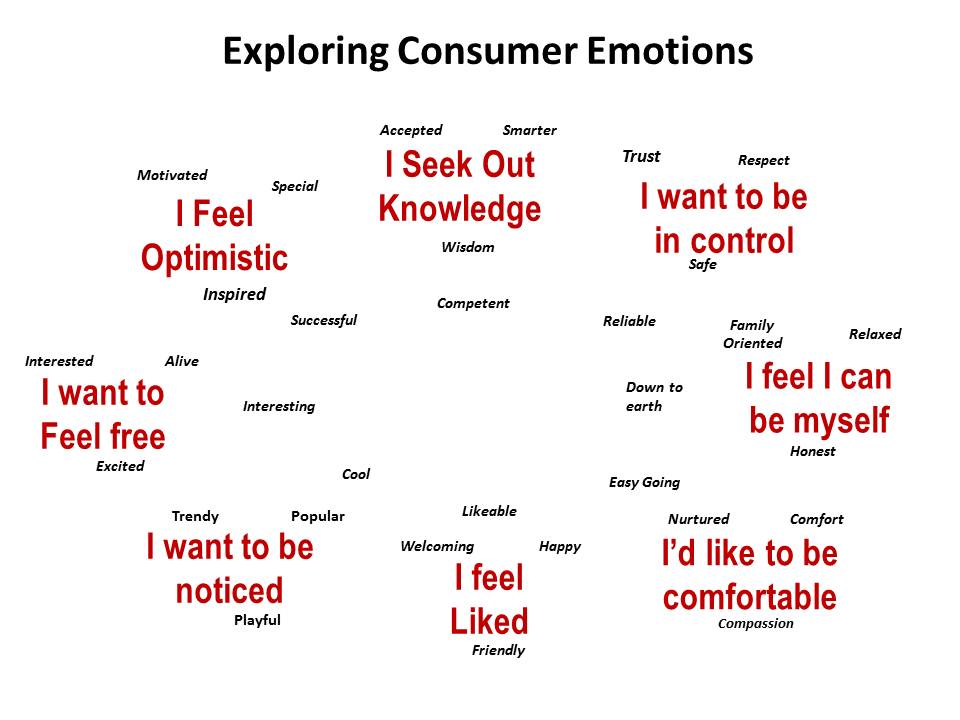
People tend to get stuck when trying to figure out the emotional benefits.  I swear every brand out there thinks it is trusted, reliable and yet likeable.  It seems that not only do consumers have a hard time expressing their emotions about a brand, but so do Brand Managers.   Companies like Hotspex have mapped out all the emotional zones for consumers.   Leverage this type of research and build your story around the emotions that best fit your consumer needs.  Leveraging hotspex, I’ve mapped out 8 zones that are a cheat sheet for brand manager.
The eight emotional zones mapped above include
  1. I feel liked
  2. I want to be noticed
  3. I want to be free
  4. I feel optimistic
  5. I seek out knowledge
  6. I want to be in control
  7. I feel I can be myself
  8. I’d like to be comfortable
Within each of the 8 zones, you can find emotional words that closely align to the need state of the consumer and begin building the emotional benefits within your CVP.
Now the toughest part is to narrow down your benefit list to the 1 or 2 best choices.   One consideration is where does your brand stand on the Love Curve. Consumers move along a curve going from Indifferent to Like It to Love It and all the way to a Brand for Life.  As a new brand into the market, you’re unknown and anInfrastructure type positioning where you talk about what you have would help to establish the brand.  As you move towards Liking It, aProcess positioning about how you do what you do or a Product and Servicespositioning would fit.  Moving beyond the Like It stage requires you to exhibit morePersonality type positioning of who you are or even taking that further to a Purposedriven positioning of why you do it.  Finally, to move to the My Brand for Life, focusing on the Experience of the brand will help tighten that connection with consumers.   There is no hard and fast rule though–I do believe you have to earn your emotional space with the consumer.  But the spectrum becomes a judgement call on which positioning style you want to choose.  The style can be one of the influencing factors around which benefit you will focus on–the degree of emotion you think you’ve earned with the consumer.
Looking at the example above for Listerine Mouthwash, the target is proactive preventers, who want to do everything for their mouth, and in fact everything for their overall health.  That’s all about a consumer that wants control. The main benefit is confidence, but it has to be rooted in control emotions such as trust and respect.  It needs to earn the trust by demonstrating reliability–having an authority figure like a dentist may help.
The biggest thing you have to do is make tough decisions.  Find the target of those you can get to love you, rather than trying to sell to everyone that might one day like you.   Match up your benefits to the need states of the consumer.  And leverage where you are on the Love Curve to determine how much emotion you are able to build into your Brand Positioning Statement.
Keep it simple, keep it focused and keep it unique.

Eight Digital Trends to Watch in 2013


 Look for Amazon to pounce, two-screen viewing to take hold and Pinterest to be bought 
Advertisement
Making predictions in digital media can be a dangerous game. Conjecture such as "2006 is going to be the year of mobile" come to mind. How many of us this time last year even knew what Pinterest was, let alone predicted its popularity explosion? With that being said, Adweek is attempting to make some educated guesses about where this industry might be headed. Here are eight trends to watch for as 2013 unfolds:

Amazon Gets Serious
Amazon has cornered the e-commerce market, so like Bo Jackson, it's been on the hunt for hobbies it can be really good at: a cloud computing platform, a streaming video service, an app store, a tablet, an advertising platform. With all those pieces in place, expect Amazon to begin to tie them together in 2013. The crown jewel is Amazon Web Services, which would allow the company to pipe content and ads to just about any digital platform, including connected TVs.

Ad Tech Shakeout?
Remember how last year was supposed to be the year of ad tech consolidation? Outside of a few ad tech outfits buying mobile ad firms, that didn't really happen. But it could in 2013. Marissa Mayer, who's making a big programmatic push at Yahoo, has reportedly kicked the tires on Turn and Mediaocean, among others. Facebook's already said to be in talks to buy Atlas Solutions from Microsoft; the company might need to stitch together some more platforms. Facebook's Exchange's beta program could prove to be an elaborate beauty pageant via which the company decides which demand-side platform to purchase (breaking the hearts of the rest of the participants). Google and Adobe have already each built out end-to-end ad tech stacks but might want to pile on some more pieces to keep ahead of the competition.

Regulation Gets Tighter
The online advertising community has been waiting over two years for the Federal Trade Commission to follow through on its call for a universal Do Not Track mechanism. That could happen in 2013. After launching an investigation of data brokers and updating Coppa, the regulatory body has made some advances in its online privacy probes. The question is whether the departure of the FTC's consumer protection head, David Vladeck, will slow any moves and what those moves would be. FTC chairman Jon Leibowitz has publicly applauded the industry's self-regulatory efforts and said it should partner with Web browsers on Do Not Track.

Gaming Drives Second-Screen Viewing, Maybe Ads
Second screening has largely meant checking Twitter while watching The Real Housewives. That term will expand in 2013 as more consumers switch off their cable boxes and turn to connected devices like Xbox. Microsoft has rolled out a second-screen companion appSmartGlass for its gaming console, which should get people familiar with using their smartphones or tablets in tandem with their TV. And with Nintendo's Wii U selling strong in the holiday lead-up, more families should wrap their heads around the idea of cruising the Internet on the big screen. If conjoined consumption experiences get traction, conjoined ads should soon follow.

Big Acquisitions
All eyes are on Pinterest to be the Instagram of 2013, and it wouldn't be a stretch to imagine the social scrapbooking service selling to Facebook. The social network has already shown an interest in image-centric companies, and Facebook Gifts underscores its e-commerce ambitions. Folding in Pinterest's product-littered pinboards and adding a Facebook-operated buy button could realize that goal and position Facebook as Amazon's biggest rival yet.

Yahoo's Future
Tech or media company? New CEO Marissa Mayer sure seems to be leaning toward the former, as she looks to get Silicon Valley engineers to fall back in love with the beleaguered portal. But she still needs to convince the New York ad world that Yahoo knows what it is and what it wants to be. She's starting at CES.

Brands as Publishers
Content marketing became all the rage this year as brands from IBM to Amazon to Unilever started thinking more like publishers. Most of the conversations centered on embedding companies within digital consumer experiences by way of visual or text-based content. Paul Polman, Unilever chief exec, planted his firm’s flag in the movement by saying it "is reallocating budgets to enable us to make content in an always-on world. Agencies need to organize themselves around the consumer, not the client."

Mobile Payments Take Off?
Starbucks shook the digital landscape in November by partnering with mobile payments service Square, allowing customers for 7,000 retail locations to pay for cups of java with the Square Wallet app. It underscored a year where the digital wallet continued to develop as a force in modern marketing. In another example, Apple’s Passbook feature for the iPhone 5 lets consumers save coupons, redeem them and buy products all in one app. But early reaction to Passbook has been indifference, showing how far the mobile payment dream still has to go.