Wednesday, May 5, 2021

Backable: The Surprising Truth Behind What Makes People Take a Chance on You

 Backable: The Surprising Truth Behind What Makes People Take a Chance on You

Book Bites Entrepreneurship Technology
Backable: The Surprising Truth Behind What Makes People Take a Chance on You

Suneel Gupta
22 February, 2021
Suneel Gupta is on faculty at Harvard University where he teaches students how to be Backable. Named the “New Face of Innovation” by the New York Stock Exchange, he has invested in startups including Airbnb, Calm, and SpaceX, and his ideas have been backed by firms like Greylock and Google Ventures. Suneel also serves as an emissary for Gross National Happiness between the United States and the Kingdom of Bhutan.

Below, Suneel shares 5 key insights from his new book, Backable: The Surprising Truth Behind What Makes People Take a Chance on You. Download the Next Big Idea App to enjoy more audio “Book Bites,” plus Ideas of the Day, ad-free podcast episodes, and more.


Next Big Idea Club · Backable: The Surprising Truth Behind What Makes People Take a Chance on You
1. Steer into the objections.
Before walking into a room with a potential backer, whether for an interview or a pitch, put yourself in the shoes of that person and anticipate three key objections to your idea. If you avoid the concerns, they’ll only nag at your audience, and your backer might tune out the rest of your pitch. Instead, steer into those objections. Be sure to do it sooner rather than later, because you tend to have the highest level of attention from investors in the first five minutes. If you can show them proactively that you understand their concerns, then you earn their attention for the rest of your pitch.

2. Find an earned secret.
Great ideas tend to stem from an insight that you learned through firsthand experience, something that not a lot of other people know. Ben Horowitz is a venture capitalist who invested in Airbnb, and he said that one of the things that stood out to him wasn’t just the idea, but how the founders arrived at the idea. As recent graduates from the Rhode Island School of Design, they had just moved to San Francisco and didn’t have jobs. When their landlord raised the rent, they needed a way to raise some cash fast. That’s when they came up with the idea to start renting out space in their apartment. At the time, hotels in the city were booked up for an industrial design conference, so they bought a few air mattresses and charged guests $80 to crash on the floor. Not only did people pay to sleep on an air mattress, but nearly 500 people responded to the advertisement.

“Don’t just show people how your idea is exciting—show them how your idea is inevitable.”
So when the co-founder pitched his idea to investors, he wasn’t simply sketching out a high-level market analysis—he was sharing that story. So go beyond Google, get out from behind your desk, and find an earned secret, something that you could only know through firsthand experience.

3. Neutralize the fear.
As human beings, we generally dislike risk. Even venture capitalists, who look for risky investments, turn down the overwhelming majority of new ideas they hear. Even Instagram, Facebook, and Amazon were rejected by multiple investors. A well-respected investor once told me, “If I said no to 100% of the ideas I hear, I’d be right 99% of the time.” That’s the mentality of most investors, so keep that in mind when you’re pitching an idea that has some risk. Don’t just show people how your idea is exciting—show them how your idea is inevitable. One of the strongest arguments you can make to a backer is, “This idea is inevitably going to exist, and we want to get there first.” Making that argument well can neutralize somebody’s fear of risk.

“You really have to fall in love with your idea in order to invest the effort that it requires.”
4. Convince yourself first.
The thing that backable people have in common is that they take “incubation time” to convince themselves first. Then, when it’s time to present the idea publicly, they’re so convinced by what they’re saying that their conviction wins people over. So instead of rushing out to share a new idea, keep it to yourself for a little while, nurture it, incubate it. Don’t tell a soul, not even close friends. New ideas are fragile, and so are we when we share them—even a well-intentioned “huh?” can make us feel bad and deflate our energy. Indeed, most ideas don’t get killed inside conference rooms; they get killed in hallways, through casual conversations, where we don’t get the reaction we want. So take a little bit of incubation time to convince yourself first, then go out and share your idea with others.

5. Don’t just figure out if an idea fits the market—figure out if it fits you.
Intellectual interest is important, but it’s rarely enough; you need to be emotionally invested in your idea. Bringing something new into the world requires a tremendous amount of stamina, because you’re on the receiving end of doubts, conflicts, and deadlines. And conviction can only be replenished by your own passion for the idea. Lin-Manuel Miranda, the creator of Hamilton, said that it takes years to create something like that. So you really have to fall in love with your idea in order to invest the effort that it requires.

Band Strategy documents


Brand Workshops

Wednesday, April 28, 2021

Article

3 ways top brands are using connected TV to increase reach and drive results

Matt McDonald/April 2021

Watching TV has always been a guilty pleasure of mine. Growing up, it was a regular pastime to gather with friends and watch our favorite weekly show. Nowadays, I unwind by watching where and when I want, which usually means catching up on “The Real Housewives of Atlanta” on YouTube TV, or youtwoTV on YouTube. While the way I watch TV has evolved a lot over the course of my life, the delight it brings is constant.

In the past year particularly, we’ve seen video streaming emerge as people’s preferred way to enjoy content. During 2021, nearly 83% of households will have at least one connected TV, used by at least one person every month. CTV is now mainstream viewing behavior in the U.S.1

During 2021, nearly 83% of households will have at least one connected TV, used by at least one person every month.

Advertisers have been creating for the TV screen for decades, but the CTV screen presents new opportunities for engagement. By pairing the precision of digital with the scale of linear TV, CTV gives brands the best of both worlds. In December 2020, for example, over 120 million people in the U.S. streamed YouTube or YouTube TV on their TV screens.2

Why are people choosing to experience their favorite YouTube content on TV? In large part, because they want to experience it with others. A recent study we commissioned with Nielsen, for instance, found that 26% of the time, multiple viewers ages 18 and over are watching YouTube together on the TV screen, compared to 22% who watch together on linear TV.3

Already, we’re seeing marketers across verticals, including some of our own teams at Google, reap the benefits of CTV’s immersive screen. Here are three specific ways you can use YouTube CTV Ads to go beyond linear TV and improve the impact of your video campaigns.

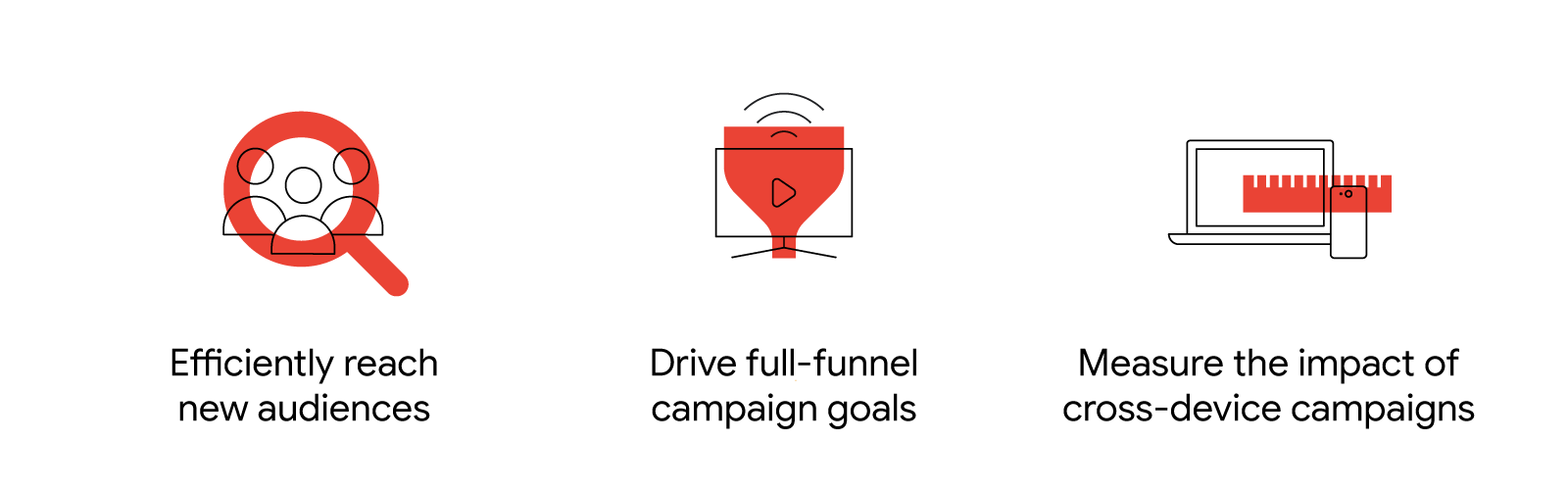
Efficiently reach new audiences. Drive full-funnel campaign goals. Measure the impact of cross-device campaigns.

Efficiently reach new audiences

As the linear TV audience continues to shift, advertisers are finding it increasingly difficult to reach the people they care about and make their media dollars stretch. Planning CTV to complement or replace linear TV can help ensure you’re reaching your target audience and entirely new audiences as well.

Global brand Kellogg is no stranger to innovation, as it continues to embrace new ways of approaching video, both creatively and in its media plans. Recently, the company’s marketing team began adding YouTube CTV to its video mix for brands like Special K to reach new customers.

Planning CTV to complement or replace linear TV can help ensure you’re reaching your target audience and entirely new audiences as well.

Early in the new year, Special K ran a video campaign highlighting healthy habits. The team used YouTube’s Reach Planner tool to determine the right media mix, which included YouTube CTV Ads. This approach paid off: More than a third of the audience reached by YouTube CTV was incremental to television.

Special K’s campaign also reinforced the momentum of coviewing. Results showed that 31% of the time the YouTube ad ran on CTV, multiple viewers ages 18 and over were watching it together.4 As a brand for the whole family, Kellogg finds value in reaching everyone who influence purchase decisions.

Drive full-funnel campaign goals

As viewers spend more time at home and in situations where they are watching with others, CTV screens can help achieve multiple marketing goals. Beyond efficiently reaching large audiences, YouTube CTV Ads have also shown a positive influence on mid-funnel metrics, like consideration.

With online shopping booming, beauty company Coty knew it would have to take a new approach for its 2020 holiday campaigns. To capitalize on YouTube’s growing watch time on CTV and build on past success with YouTube, Coty leveraged CTV for its fragrance, Gucci Guilty Pour Homme, by repurposing existing video creative and leaning into new formats, like YouTube Masthead on TV screens.

According to Fred Arbel, SVP and Chief Marketing Officer for U.S. Luxury at Coty, “We knew YouTube would play a key role in the campaign as our customers continue to shift attention from TV to streaming platforms.”

Coty’s strategy was a success, as CTV made up 63% of its total campaign reach. It also contributed to brand growth. Last year, Gucci Guilty Pour Homme became one of the fastest growing parent brands in the men’s fragrance top ten, increasing its rank to No. 4 overall.5

“YouTube CTV Ads were a key driver of campaign impact, helping us connect with new audiences beyond the viewers we were already reaching on linear TV and on YouTube’s mobile and desktop experiences,” says Arbel. “It also drove the most efficient lifts in purchase consideration and video view-through rate."

Measure the impact of cross-device campaigns

If you are relatively new to advertising on CTV, gauging your effectiveness can feel challenging. Fortunately, new solutions are underway to help. For example, starting this year, U.S.-based advertisers can measure their YouTube CTV campaigns through third-party provider, Nielsen.

Another readily available tool is Brand Lift, which measures the effectiveness of YouTube CTV Ads across brand metrics, such as awareness, recall, and consideration.

Starting this year, U.S.-based advertisers can measure their YouTube CTV campaigns through third-party provider, Nielsen.

Google’s in-house media team, Media Lab, routinely uses Brand Lift to assess the impact of CTV on our own brand marketing. After analyzing results from dozens of Brand Lift studies of CTV campaigns across products like Chromebook, Nest, and Pixel, the team found that CTV screens showed statistically significant brand lift as often as mobile screens. Recent Chromebook campaign results have also shown that CTV consistently drove lifts in consideration. Based on these findings, Media Lab is continuing to invest in and test YouTube CTV Ads as part of video plans.

As you continue to look for ways to maximize the impact of video, I hope these successful CTV approaches inspire your plans and help you drive powerful results.

Tuesday, March 23, 2021

Why You Should Always Start Your Speech Or Presentation With A Story

Original Article

March 22, 2021 9 min read

This article was translated from our Spanish edition using AI technologies. Errors may exist due to this process.

Opinions expressed by Entrepreneur contributors are their own.

We've all had to perform in front of an audience for one reason or another: to give a speech, offer a toast, or present a business . If you are an entrepreneur, then you will have to persuade partners and investors and, of course, sell your product or service.


Speaking in public is one of the most persistent fears and phobias, and not without reason: the survival instinct takes control of our body and our mind when we feel insecure, threatened or under stress, and the threat of social cost is one of the more pressing. Just as we know that almost everyone suffers from some level of stage fright, we also know that it can be educated and controlled to deliver powerful, effective, and humane speeches.


One of the most prevalent questions in public speaking and communication courses and trainings is this: How should I start a speech?


It is an important question, because the first seconds of a speech establish its style and its rhythm and, above all, forge an emotional relationship between the participants. At the end of the day, remember that the audience will not be able to “connect” with your product or your proposal if they have not previously connected with you on a personal level: we listen to those we trust, and we trust those with whom we have a relationship.


To find out more: Why 'Follow your passion!' it may be the worst advice they give you

There are many ways to start a speech. One of the most used is to use a phrase from a famous person (Benito Juárez, Mahatma Gandhi or Martin Luther King, Jr., etc.) to give “seriousness” and impact to the presentation. In my opinion, this option is ideal in a school contest, but it rarely works in a business presentation. At least not like this.


Another very helpful is to tell a joke, joke or make a funny comment, because if the audience laughs, that means we are doing well. It is a way of connecting. This is correct! Two people laughing together connect almost immediately, aligning their neurons, and almost automatically placing themselves on the same side of the equation. The problem with this approach is that it is extremely risky, since a joke well told is just as valuable ... as a badly told one is disastrous. As a communication consultant, I recommend humor as a weapon of attack only for those who are excellent joke-tellers, or who already have a prior relationship with the audience. Nothing is more uncomfortable than the silence that follows a missed joke. Avoid it at all costs.


ADVERTISEMENT

The option that seems safe, and that I find in most presentations, is simply to introduce the topic and start talking. "Hello, thanks for having me, today we are going to talk about the versatility of our solar panels ..." and that's it. It is a low risk option, but also very low impact, because it favors the argument over the relationship . It is simply mediocre communication.


But there is another option that, although it is not the only one, it is the most effective in almost all cases; It's relatively straightforward, high-impact, and one of the best ways to control stage fright while building a real relationship - by telling a story.


In a country far, far away ...

We've talked about the science of storytelling before in interpersonal communication. Our brains evolved to tell stories long before they learned to write or describe abstract processes. The stories were forged around campfires in the caves of primitive men.


The stories work. It's that simple. And they do it for several reasons:


1. Stories stir emotions.


Human beings are, in truth, emotional machines rather than rational: almost 90% of our decisions are made from the emotional center of the brain. Stories have elements that connect the neural structures that organize our feelings: they have characters, challenges, surprises, solutions.

Stories not only inform, they inspire and move you to action . It is of little use to "convince" with arguments if the audience does not do something about it.


To know more: Extended image: 8 elements to project your style

2. The stories are identified with the listener


Two people who hear the same story do not hear the exact same thing. When we hear or see history, each of us connects and identifies with what is most lacking. Telling stories is, in a sense, like “speaking in tongues”, since each one takes from the story what they need.


When we listen to a good story we can say "this is just what I needed to hear", because our brain fills in the parts it takes to make the story "ours", as if it was made for us specifically. It is what we feel about a good book or a good movie: it speaks to us directly, moves us and changes us.


3. Stories release relational hormones


The stories connect. When two people share stories, the brain releases dopamine and oxytocin (the hormones of love and pleasure), which make it easier for both people to connect with each other, begin to think similarly, and feel good in each other's company.


This, in turn, makes it easy for the stories to be memorable and repeatable. Almost anyone can tell the story of Noah's Ark, but few can recite the Ten Commandments. The Commandments are probably more important, but the story of the flood is more exciting. In the end, we remember the things that made us feel.


4. Stories hold attention


Stories hold the audience's attention, not only because they are funny or exciting in themselves (although it helps), but because our brains are designed to search for complete cycles. That is, if they start to tell us a story, we need to know what it ends up in . When we start a speech with a story and save the denouement for last, the audience will make an unconscious effort to wait for the full arc.


Stories also create their own tension, because at each step they present new emotional demands: they satisfy the "rational" brain and the "emotional" brain like nothing else, since they are the most natural form of social communication. We love hearing stories - it's in our DNA.


5. Stories open the door of argument


Stories are a sure step toward persuasion, because they facilitate emotional connection before downloading facts, numbers, and arguments. Stories prepare the space for a discussion where everyone is on the same team: they humanize and connect people and, therefore, in a sense, they bring them to the same table; they destroy the barrier of distance or mistrust; defenses and resistances are lowered.


It is to our friends that we tell our stories. For this reason, when we tell someone a story we are saying: you are my friend, I trust you. You can trust me.


To find out more: Don't look for 'a good deal'. Search 'your' business.

What story do I choose?

Generally speaking, any story creates the relationship we seek when starting a speech. However, not all stories are the same.


1. The best are your own and real stories: stories and anecdotes from your own life and experience, even if they do not seem so important or amazing.


You can start by saying “I ran into a lady in the elevator yesterday. I remember her wearing a gigantic hairstyle… ”and elaborating on the subject that concerns you. This phrase is a great start, because it raises your curiosity, humanizes you and opens the door to the deepest matter. Of course, more emotion equals more impact: "I want to tell you what my father told me on his deathbed ..." is a story of its own, real and highly emotionally charged that can soon place you in a great place to give your speech .


2. Other possible stories are true, but foreign : stories about well-known people, famous people or human history. You can talk about Christopher Columbus, or Steve Jobs, and choose an anecdote that speaks of his character or his genius. Make it entertaining and, if possible, fun: immerse yourself in the inflection, as if you were telling a story to a seven-year-old. Even if you want to start with your Benito Juárez or Gandhi phrase, do so by including the phrase within a story about Juárez or Gandhi. Then it will not be a phrase floating in the middle of nowhere, but the sail that loads its own ship.


3. Finally, you can choose a fictional story that allegorically conveys the point you want to get to. A story, a fable, a character from the Brothers Grimm or Aesop: these are great ways of talking about something without doing it directly. Insofar as they are stories, they maintain all the cognitive and social properties of these.


Choose the story you want, but give it a try. The next time it's your turn to take the microphone, start with a story and unleash the power of storytelling in your favor. You will see how easy it is to take control of your style and your audience if you learn to tell stories. Luck!

Thursday, February 25, 2021

What is Clubhouse? - Should Marketers Care?

Article

Written by Pamela Bump @PamelaBump


A woman Googles 

In 2020, you might have heard your favorite influencers talking about a mysterious new social media app called Clubhouse.


But, unless you had a huge online following of your own, you might just be getting access to the app now.


Until a few months ago, Clubhouse was a platform where big-name celebrities, company leaders, Silicon Valley investors, and some of the web's top global influencers could have uncensored audio group chats about their lives, hobbies, work, or industries.


Now, as the invite-only Clubhouse continues to gain media coverage and a growing pool of non-celebrity users, you might be wondering, “What the heck is it? And, how do I get in on the action?”


Below, we’ll explain where Clubhouse came from, what it actually is, and the pros and cons of using it in your marketing strategy.


Download Now: Social Media Trends in 2021 [Free Report]

What is Clubhouse?

Clubhouse is an invite-only social media app that allows users to launch or drop in on “Rooms” -- or audio-only chat rooms with friends, followers, or the general public. To join the app, users must have an iPhone and receive an invitation from a Clubhouse member.


Clubhouse was launched in March 2020 by Paul Davison, who previously worked at companies including Pinterest and Google, and Rohan Seth, a former Google engineer. According to a post from Davison and Seth, Clubhouse was created after a handful of social media app experiments.


"After a lot of iteration in the audio space, we launched Clubhouse in March of last year," the co-founders wrote. "Our goal was to build a social experience that felt more human—where instead of posting, you could gather with other people and talk. Our north star was to create something where you could close the app at the end of the session feeling better than you did when you opened it, because you had deepened friendships, met new people, and learned."


Initially, Clubhouse was marketed to top-tier influencers, celebrities, Silicon Valley investors, and industry thought leaders, but recently opened to more general audiences. A few of the app's first high-profile users include Drake, Daymond John, Elon Musk, and Oprah Winfrey. Early on, these notable users were heard chatting in Rooms related to their interests, hobbies, causes, or industries.


Despite Clubhouse's exclusivity, it was valued at $100 million and received a $12 million investment from Andreessen Horowitz within a year of its launch.


Most recently, Clubhouse has begun to give access to a larger pool of users by allowing each new member to invite two friends of their own. This has caused the user base to jump from 600,000 active users in December 2020 to more than 2 million today.


"This past week, two million people around the world—musicians, scientists, creators, athletes, comedians, parents, entrepreneurs, stock traders, non-profit leaders, authors, artists, real estate agents, sports fans, and more—came to Clubhouse to talk, learn, laugh, be entertained, meet and connect. It’s the most exciting thing we’ve ever been a part of," wrote the Clubhouse team in a Jan. 24 blog post.


Why Most of Us are Just Learning About Clubhouse

Just hearing about Clubhouse now? You aren’t alone.

As mentioned, Clubhouse was initially targeted to high-profile industry "elites," such as celebrities, CEOs, and top online influencers. For a while, these types of users were the only ones who could send and receive Clubhouse invites. On top of the app’s invite-only nature, it's only available to iPhone users.


While Clubhouse's early exclusivity made it interesting and alluring to the every-day social media user, it caused the app's awareness and user-base to grow at a slow but steady pace.


Now that the app's become more accessible to social media users, it's been getting more awareness online and across news media. At this time, marketers are also starting to wonder if and how they could use Clubhouse -- or something like it -- in their strategy.


In fact, many professionals, business leaders, and non-profit members can already be heard speaking in Rooms that discuss a topic related to their brand, industry, or mission.


For example, a recent Room I dropped in on featured a group of lawyers aiming to offer education around patent protection. While this content was intriguing to listeners, it also could have brought each lawyer’s firm more awareness:


Lawyer Room on Clubhouse


Aside from marketers, major social media companies are also trying to take advantage of Clubhouse's audio social media trends.


Shortly after Facebook CEO Mark Zuckerberg spoke in a Clubhouse Room, the New York Times reported that his social media company was allegedly building a similar audio platform. Meanwhile, Twitter just began rolling out Twitter Spaces -- a drop-in audio feature with its app -- to a small group of beta testers.


At the moment, Clubhouse seems like a promising way to network and build a community online, and its audio social format is already being adopted by competitors. However, in a time where we see a handful of new online platforms each year, is Clubhouse really a game-changer in the social media space? Or is it just another over-hyped app you shouldn't waste your marketing efforts on?


Below, I'll give a brief description of how the platform works and then weigh the pros and cons of using Clubhouse for marketing.


How Clubhouse Works

While we'll be publishing a detailed how-to guide for the Clubhouse platform, which we'll link to in this post later, here's a quick description of how some of the major features work.


Clubhouse's Main Tabs

When entering Clubhouse, users will find a homepage that highlights ongoing Rooms related to their interests or followers. They’ll also find search, message inbox, calendar, and notification icons in the upper navigation.


Clubhouse homepage


When tapping the search or "Explore" tab, users can scroll through a feed of suggested Rooms, Clubs, or people to follow. They can also use the search bar to find specific individuals or Clubs. However, it does not seem like users can search for specific Rooms yet.


Clubhouse Explore tab


If users can’t attend a Room when they're surfing the Clubhouse app but would like to drop into one later, they can tap the calendar icon.to see or create their scheduled Rooms.


Clubhouse scheduled room tab


Clubhouse Rooms

Entering a Room is essentially like attending a webinar or Zoom meeting with no video and a partially muted audience.


Attendees, who can join or leave a Room at any time, enter (or drop-in) as automatically muted listeners. If they'd like to speak or ask questions, they can tap the "Raise Hand" icon in the lower right corner of the Room page. Room moderators will then be notified of the hand raise request and can ignore it or unmute the attendee.


Below is a look at what Clubhouse Rooms look like:


Clubhouse Room


Visually, attendees of the Room can see only the profile photos and names of current participants, with moderators and speakers appearing at the top of the screen.


Users and moderators can also add people they follow to a Room by tapping the "+" button in the lower navigation. This gives their friends a notification that they've been invited to a Room and enables them to open the app and join it directly.


Starting a Room

At the bottom of the homepage, users can also tap "Start a Room" to launch either a "Closed" chat open to specific people only, a "Social" chat open to all of a user's following, or an "Open" chat that anyone on Clubhouse can drop into.


Starting a clubhouse room


Users can also tap the nine-dot icon on the lower homepage navigation to have a private audio chat with specific followers who are online.


clubhouse lower navigation


Room moderators, who either launched the Room or were assigned to a moderator role after the Room launched, see a similar page that attendees see. However, they also get notifications of new Room attendees and a list of attendees who have raised their hand requesting to speak.


One interesting thing to note is that a Room only ends when a moderator ends it or when the final moderator leaves it. Additionally, moderators who want to leave a Room without ending it can assign someone else to become a moderator. This means that a Room with multiple moderators can go on for hours or even days.


Because of how long Rooms last, and the fact that attendees can join or exit whenever they want, you might regularly hear more seasoned Room moderators re-introduce themselves, what they’re discussing, and who else is speaking throughout a Room event.


Clubs and Networking

Aside from creating Rooms, users can also follow individual profiles of friends, influencers, or thought leaders in their industry.


They can also join or create Clubs, which are groups of users with interest in specific topics, hobbies, or industries. Take a look at some of the Clubs that appeared when I searched, "growth marketing."


Growth Marketing Clubs


Once users join a Club, they can be notified if a Club's manager launches a Room related to its core topic. For example, if I were to join one of the Growth Marketing Clubs shown above, I'd be instantly notified if they hosted a Room on a growth marketing tactic.


The Pros and Cons of Clubhouse.

Pros of Using Clubhouse

1. Clubhouse could help brands build trust and community.

In 2020, consumers began to favor companies with authentic, trustworthy messaging over big-name companies with decades of brand loyalty. This shift will likely continue through 2021.


Why? In a time of financial uncertainty and constant news events, consumers want to know that brands care about their customers and share values with them. While creating a live, uncensored, unscripted Room related to your brand's industry might sound nerve-wracking, it could help some brands seem more authentic and trustworthy.


"Clubhouse offers a lot of opportunities for connection with celebrities, a vast variety of people in different industries, and even close friends," says Krystal Wu, HubSpot's social media community manager. "It opens the door for live conversations allowing people to be vulnerable within a community space. This type of connection is unique to deliver audio content with small to large groups of people. Its unscripted content that anyone can be a part of.”


Brands that use Clubhouse could earn credibility by discussing topics they're experts on. But, they could also earn trust because they've made themselves available to listen and talk candidly with their audiences.


2. The app's content is always evolving.

While the app initially hosted conversations related to entertainment, business, and technology due to its initial target audience, the audio content on the platform has broadened and evolved


In fact, CNBC recently reported that some of Clubhouse's most engaging Rooms have been launched by innovative Black creatives who've done heavy experimentation on the platform.


For example, instead of hosting a chat or discussion, one group of Black performers hosted an audio-only production of Disney's "The Lion King." 


While there isn't a recording of the Clubhouse performance, led by Noelle Chesnut Whitmore, Kam DeLa and Bomani X, here's a screenshot from the event, which shows each Room moderator as the character they played:


The Lion King Room on Clubhouse


Image Source


"What started as a random conversation on Clubhouse has scaled to something much greater. We have so many talented people contributing their time and energy to this performance," Whitmore said in a press release. "Our goal is just to spread some joy to people through these events. I never imagined this would get such a huge response."


In another example, a cocktail brand called Loop hosted a Room that encouraged participants to have a cocktail and join a casual conversation with no specific topic. While this strategy is less structured, it enables people who want to learn more about the brand or just want to chat with other cocktail drinkers to connect.


Because Clubhouse is fairly new, there aren't major content-related expectations just yet. This means that anyone from any group, industry, non-profit, or brand can experiment with it and learn what's truly engaging to the app's growing audience.


3. The app is primed for thought leadership.

Clubhouse's user base was built around influencers and thought leaders. This means that users are likely coming to the app to hear the latest tips, exclusive information, or discussions straight from industry experts.


For example, the scheduled Room shown below features Coinbase Co-Founder and CEO Brian Armstrong.


Coinbase founder interview


In a Clubhouse Room like the one shown above, users could learn more about a brand like Coinbase and ask its leader questions about the company or its industry. Through Rooms like this, Coinbase and other brands could boost both company awareness and credibility with audiences who listen.


4. Audiences want online communities and audio content.

In the last year, people who were stuck at home turned to webinars, virtual events, and other online experiences to learn more about their interests, hear from others in their industry, or just feel a sense of connection to people outside of their households.


But, while virtual events were beneficial for many, most of us eventually dealt with screen fatigue.


Because too much screentime can be mentally draining, consumers also checked out podcasts or camera-free webinars. Now, these audiences could be primed for Clubhouse's audio-only nature.


"Clubhouse’s most appealing quality is that it's a break from the nonstop screen time we all exist in," says Kelly Hendrickson, HubSpot social media marketing manager. "Clubhouse is also a wonderful place to have conversations among niche communities and topics."


And, while consumers are craving personal connections and live content more than ever, many brands are trying to build stronger online communities and launch effective digital event strategies.


Ultimately, Clubhouse's audio-only layout could help brands meet and build an engaged community of fans on an interactive, authentic, and live platform.


Cons of Clubhouse

1. The app still has limited audiences.

Ultimately, one of Clubhouse's biggest brand marketing flaws is also what makes it so intriguing: exclusivity.


"I am generally against anything that is invite-only as it creates a culture of 'others'," Hendrickson says. "Any time you need to be 'in the know' to have a seat at the table, how can you also be inclusive?"


While Clubhouse might pose unique group chat opportunities for community marketers when more people join, the audiences might still be too limited for some marketers at the moment. On top of this, the app is still unavailable to Android users.


“Clubhouse actually hinders its capabilities because there are many talented potential users out there that are missing out all because they are on Android,” Wu says.


If you're looking to only create content for the largest audiences possible, you might want to hold off on building a Clubhouse strategy right now. However, if you're only looking to experiment and see if you can reach the audiences it already has, it might be an interesting platform for your team to try.


2. Clubhouse could have strong audio-app competition.

Facebook and Twitter could be just the first platforms to create a similar audio drop-in experience. And, while this hints that Clubhouse creators have stumbled upon a platform many social media users want, the big-name competition could also pose concerns about the platform's future.


For example, if Facebook or another major competitor can create something similar that's less exclusive and allows iPhone and Android users, people might leave Clubhouse for a platform with a larger audience or more credibility in the social media world. If this happens, marketers who invest heavily in a Clubhouse strategy might need to do a sudden pivot.


While this shouldn't scare you away from testing the platform if you think it's right for your brand, the competition is still important to keep in mind. If you are considering Clubhouse, continue to follow its competitors and determine how you could pivot your strategy to those platforms if your audiences start to flock there instead.


3. Clubhouse can feel like an "unedited podcast."

"Another challenge I think brands and individuals will have with Clubhouse is how it feels like an unedited podcast," says Hendrickson. "That means you’re hearing all the great meat, but you also have to listen to the trimmings. It will be interesting to see if long term, people are okay with that in their content."


If you're planning to experiment on Clubhouse, consider practicing a few conversation starters, how you'll enter the call, and determine what you'll do if you run into dead air, boring conversation, or off-topic discussion that draws attention away from your Room's goal.


Although Rooms are live and unscripted, having a gameplan will help you moderate an effective, higher-quality conversation than users might find in other Rooms.


4. Brands could be too vulnerable.

Certain generations, like Gen Z, crave authenticity from people and brands they follow on social media. With an app like Clubhouse, brands could create Rooms or Clubs related to their industry that include thought leaders, prospects, and even clients that want to talk with them in a live, unfiltered way.


However, while Clubhouse's high level of unscripted authenticity has intrigued both marketers and prospective users, it also could put brands in vulnerable positions. Wu describes this as “a balance between good and evil.”


Within a year of its launch, Clubhouse's live nature has already led to brand-related controversies.


For example, in February, Elon Musk, CEO of Tesla and SpaceX, dropped into a Room with Robinhood Markets CEO Vlad Tenev and raised his hand. When he was invited to speak by the Room's moderators, Musk began intensely questioning Tenev and asked him to explain why his stock-trading company stopped its users from buying and selling GameStop and other manipulated stocks. You can hear the line of questioning in the video below:


While Robinhood's CEO remained calm and collected throughout the chat, some brands might not have well-trained speakers who would react as calmly or professionally to this surprising scenario.


Additionally, although Clubhouse doesn't allow users to record, many either downloaded screen-recording apps or filmed their phones with another video recording device. Because of this, Musk and Tenev's conversation was covered by the media within hours.


Even though conversations cannot be replayed or recorded in the Clubhouse app itself, marketers on the app must remember that they're live and anything they say could easily be streamed or quoted in seconds. Because of this, Room hosts should prepare themselves so that they can answer both easy and challenging questions from audience members. Moderators should also determine what they'll do or how they'll react if an unmuted audience member says something controversial or unexpected.


Is Clubhouse right for you?

In its current state, Clubhouse could offer some major awareness and community-building benefits to brands. But, because of how new it is, it also poses some challenges and cons to companies that want to reach the largest audiences possible. Ultimately, while some companies might thrive on it, others might realize that it isn't the best platform for their goals just yet.


As with any new social media platform, you'll want to spend some time on Clubhouse and see what the app has to offer before putting time and effort into using it.


At this point, it could be wise to see if one of your friends or colleagues can send you a Clubhouse invite so you can familiarize yourself with the app. If you can't log on, be sure to continue following the news around it.


As you surf through the app or read Clubhouse news coverage, ask yourself questions like these:


Are topics related to your product or industry widely discussed on the platform?

Are there any thought leaders or company experts you could host a panel or two with to boost your awareness or credibility on Clubhouse?

Are our competitors using Clubhouse? And, if so, can we create stronger Room experiences than they can?

Do you already use marketing strategies that could be adapted to an audio-only platform, such as live video Q&As, webinars, or virtual events?

With questions like those above, you can determine if you'll be able to create scalable and engaging content for this social media platform.


Can't get access to Clubhouse just yet? Don't worry. We'll continue to cover it on the HubSpot Blog so you'll be ready when you do.

Monday, February 15, 2021

Social Media Marketing Success: Building a Sound Strategy

http://feedproxy.google.com/~r/B2CMarketingInsider/~3/j8fsu4tVteE/social-media-marketing-success-building-a-sound-strategy-02386192

To achieve social media marketing success, you must build a sound marketing strategy, which is a complex task composed of many different facets. Today’s post is designed as a comprehensive summary of elements necessary to plan for social media marketing success.

roi of social media

Your first task, if you’ve never built a marketing strategic plan before, is to review what goes into a good marketing plan, then adapt that for the digital marketing world. You’ll find some guidance for building a marketing plan here.

Next, let’s dive into our topic for today.

Why social media?

Social networks are like word of mouth on steroids. Done well, social media amplifies your message and generates market returns, as you can see in the enhanced reach reflected in the image at the start of this post.

However, social media is a two-edged sword as likely to spread the word about your failures and your successes. In fact, studies suggest negative word of mouth spreads 5 times faster than positive. This means your failures quickly reach your market and competitors are only too willing to aid this transmission. And fancy advertising campaigns and reputation management are unlikely to bury these conversations.

So, how do you manage social media marketing to deliver results? Read on.

What you don’t know about social media marketing hurts your brand

So, let’s take a look at the 10 things you don’t know about social media marketing (using the successful guide from Letterman’s top 10, here they are in reverse order of importance):

10. Gurus spending BIG money

Yeah, you got it. All those gurus out there telling you how wonderful social media marketing is and how it’s the great equalizer for small businesses are telling you big, fat LIES.

I’m sure you’ve seen boasts about getting 1 million likes in a few weeks or driving massive traffic with a few easy steps.

Most of these are lies — or at least half-truths. These folks are getting the results they claim, but they’re not telling you they’re spending big bucks. Their results are not organic. Now, the advice might be sound, but don’t feel bad that you’re not getting the same results.

I fell into that trap early on. I was doing everything right, but not seeing the kind of massive returns I was reading about. For instance, one guru got 250,000 email subscribers. I did all the recommended tactics and only got a few thousand. What I didn’t know is this guru was PAYING folks like Guy Kawasaki and other big names some hefty fees to guest blog on his site and create ebooks. He was also paying serious money for PPC ads to promote email subscriptions.

9. Content is king

OK, so maybe you DID know this one. But, did you know what KIND of content is KING? The kind that visitors find VALUABLE. I recently worked with a client whose previous agency was creating content — which consisted of a single blog post that was entirely promotional. Epic FAIL.

Content must be valuable to readers, meaning it’s well researched, over 900 words, contain related images, authoritative external links, detailed information or entertainment, and is snackable. Avoid keyword stuffing and be sure to share your content ubiquitously.

8. Quantity does matter

Don’t get me wrong. I’m clearly on the quality side of this debate, but you still have to produce content consistently. I strive for 3X per week, but there’s not much difference between 2-5 times per week in terms of conversion. Less than that and you won’t see the results you’re looking for, according to a study by Hubspot.

blog post frequency

Image courtesy of Hubspot

Crappy content still gets you in lots of trouble with Google — and who wants that? Duplicate content also gets you in trouble, so avoid it.

What’s a marketer to do?

Create a content marketing calendar to ease the burden of creating high-quality content on a consistent basis. Period. There are no shortcuts. Here’s a post showing how long you should dedicate to producing valuable content across types of content.

Creating good content is only 1/2 the battle. You need to curate content from other great folks. Not only is it a nice thing to do (and ensures you stay up-to-date with cutting-edge conversations around your niche), but curating content creates a tit-for-tat relationship that encourages others to share your content.

7. Social media marketing in 30 minutes a day

This is my favorite LIE about social media marketing. If you’ve read any of the earlier items on this list, you see that social media marketing takes time. Lots of time. My guess is a small business needs about 10-15 hours a week and a midsized business probably about 80-100 hours a week of dedicated social media marketing time.

And, don’t hire someone to manage your social media marketing without a clear understanding of what you need and their abilities. Having someone with a vibrant Facebook profile or a large Twitter following doesn’t mean the prospective employee knows what they’re doing. Scroll down toward the bottom of this post to see which digital marketing skills are in the highest demand.

And, that leads me to my next point.

6. Social media marketing takes cross-functional skills

Here are just a few of the many skills to look for in whoever manages your social media marketing:

  1. Strong BI (business intelligence) and A/B testing
  2. Strong writing
  3. Marketing background
  4. Technical — graphics and web design fundamentals, along with some coding and lots of online social media management
  5. Drupal, WordPress, etc.

I would look for someone who’s a generalist in these areas, with strong marketing and writing skills.

5. Social media marketing IS marketing!

There’s a reason we call it social media marketing — its marketing. Sure, you can hire that English major, but it won’t work as well. Face it. Marketing students spend 4 years learning marketing — consumer behavior, market research, market strategy, etc. WHY would you think you could hire an English major?

Your English major might be a good writer, but does he/she understand the tools of influence? Segmentation? How to construct a market survey?

“Nough said.

4. Subtle differences in implementation generate huge differences in results.

For instance, writing well is good, but using the tools of influence within your writing is critical for results. Influence allows you to create content that motivates the reader toward the actions you need without being spammy or using the hard sell.

For instance, a client created a landing page to capture email addresses for an upcoming launch. He invited folks to sign up. Well, I’m gonna rush right out and do that!

I convinced him to change the language. The landing page now reads:

Shhhhhhhh. Can you keep a secret? We need a few good geeks to polish our gem!

This uses 2 tools of influence. 1 is the law of scarcity — people want what they can’t have and 1 is tit-for-tat by giving them something no one else has.

3. Only buyer personas matter

It really doesn’t matter how BIG your social network is, it’s how many in your network fit your buyer persona. That’s because only these folks will actually buy your brand and you’re in business to make money, right?

Here’s a great example of a rich buyer persona. You need these for every type of consumer targeted by your brand. Then, create content and strategies to convert consumers based on identified characteristics.

market persona

Image courtesy of Dribble

2. Engagement matters

Having lots of followers/ friends/ fans … doesn’t mean anything — even if they fit your buyer persona. Engagement is the fuel for message amplification and ultimately may result in viral messaging. I know we mention this several more times, but engagement is that important.

Engagement doesn’t happen if you’re not creating value, being a real person with a strong voice, encouraging folks to engage, etc. Engagement also requires analytics to understand how your network responds and capitalizing on what’s working.

1. Social media marketing is SOCIAL

Social media marketing isn’t just another channel for blasting out advertising messages. It isn’t traditional marketing. Spend time (and money) understanding them. Put yourself in the shoes of folks comprising your buyer personas and give them things you’d want.

Social media marketing is marketing

This is the corollary to the notion that social media marketing is social. These 2 principles underscore everything else in achieving social media marketing success.

I think this is our strategic competency over other sites focusing on social media or digital media if you prefer the more general term. We stress how existing theories from marketing and sociology (social) are used and combined in creating effective social media. Otherwise, managers and other social media enthusiasts stumble around trying to find the right path to success. Why re-create the wheel when you can just use the one already created.

So, this site is chock full of advice on how to adapt marketing on social platforms and how to make your business more social. We also include references to published work in social media, sociology, psychology, and related social sciences.

Rather than focusing on tactics that worked once or may work in a single platform at a single point in time, we focus on skills that translate across platforms and serve you well as these platforms develop, go out of fashion (ie. MySpace), or disappear. And, because these concepts underscore helping people find what they want, they never conflict with the Google search algorithm in whatever permutation they create in the future. These tactics bring you both organic traffic from search engines (SEO) and social media, as you see in the graphic below.

create content for social media

Image courtesy of SEM Rush

Building relationships

Strong relationships with consumers was always a good strategy. Social media simply enhances your ability to connect to a larger audience but, without an emphasis on building relationships, social media marketing doesn’t work.

In a recent article, I discussed the role of brand obsessives (people who are committed to a particular brand) in improving company performance. This article highlights some important aspects of building customer relationships in computer-mediated communities. These include:

  • They are resistant to criticism of their favorite brand and even fight negative brand comments made by others
  • They help outsiders get more from their experiences with the brand
  • Obsessives provide valuable feedback regarding customer needs and perceptions of the brand to company management allowing them to improve their product offerings

We must consider these issues as online relationships move into social media. So, let’s look at the factors that encourage these relationships in social media.

  • Provide valuable content based on the needs of your community
  • Be consistent – post regularly and don’t mix valuable content with items your community is likely to find useless
  • Encourage two-way conversations – increasingly community members don’t like being talked to but want to have a meaningful influence on the conversation
  • Be culturally sensitive – the web is truly a worldwide phenomenon and community members come from around the world (this means not only avoiding cultural insensitivity and language imprecision but remember that people are in different time zones and have different values)
  • As a correlate, remember that online communities are often unidimensional – missing important visual and auditory cues which means it’s easy for readers to misinterpret what you’re saying
  • Building trust takes time and relies on scrupulous honesty

Elements of social media marketing success

1. ROI

ROI (return on investment) requires you to bring more traffic to your website and convert the traffic generated [check out the graphic below to see the interrelationship between elements of your digital marketing strategy]. Bringing more traffic to your site, without being able to close that traffic, may boost your ego, but it won’t improve your ROI.

digital marketing strategy

Of course, the notion of digital as integration between a number of tactics belies common misconceptions about social media – that generating huge numbers is enough to improve your bottom line. The fact is that social media marketing success requires conversion of the traffic, not just building it. So what if your YouTube video had a million hits or you have 100,000 fans. You have to convert. Let’s look at an example using a Facebook example:

Number of fans: 100,000 10,000

Conversion rate: 1% 10%

Sales 1000 1000

See, increasing your conversion rate generates the same ROI with only 10% of the fans. So, let everyone else brag about how many fans or followers they have. You’ll be too busy cashing checks.

2. Integration

Social media marketing success requires efforts that bring more traffic to your website and everything MUST work together – thus SEO (search engine optimization) and SMO (Social media optimization) work with online and offline advertising to bring traffic to your site. Sacrificing one element, like SMO, to get better SEO won’t maximize your ROI and recent updates to the Google search algorithm reinforce the importance of integrating these elements. So, folks who keyword load their sites to get good SERPs (Search Engine Results Page positioning) may initially drive more traffic, but visitors are disappointed with low-quality content designed around keywords rather than solving problems for visitors. Google now penalizes this content in rankings and the increased bounce rate resulting from poor content further reduces your rank.

Affiliate marketing and Google Ads can bring visitors to your site. Affiliate marketing offers the advantage that you only pay for advertising when someone buys your products, thus working toward conversion, while Adwords requires you to pay every time someone selects your link – even if they aren’t prospects for your products.

And, don’t forget offline advertising in your social media marketing success. This may involve traditional advertising in print and broadcast media and public relations. Consider offline marketing efforts involving networking at local and national events in your industry as a low-cost means to improve your performance.

Walking the walk in your social media marketing

Social media marketing only works when done properly. Here are some aspects to consider when crafting your social media marketing for success.

  1. Keep your promises – if you promise something, whether in social or traditional media, keep your promise. Otherwise, consumers develop a poor opinion of your brand and spread that negativity very quickly.

I see this happen all the time, both online and off. For instance, I commonly hear community managers promise a rapid response to customer service posts. I tested this and the response time was more like 60 hours, which doesn’t seem rapid to me. I’m OK with 60 hours, just don’t promise me 24 when it commonly takes 60. Using Chatbots reduces response time, often to just a few minutes.

In the image below, you see ways to transform your organization into a customer-centric one focused on keeping promises.

customer promiseImage courtesy of Customer Think

Be careful about implied promises – those things consumers expect even if you don’t actually make a promise. If other businesses in your area commonly stay open until 9 pm, you should probably do the same. Or if similar businesses allow returns without a receipt, you should, as well. A recent study found that 75% of consumers abandon their cart when they discover you don’t offer free shipping.

2. Ensure quality products – actually, this is really an implied promise – people expect value for their money. If your product fails, the restaurant serves lousy food, or the business is dirty, good social media won’t do much but help you fail faster.

In fact, you get a big boost if you give customers more than they expect. Give them a little bonus or be a lot better than what customers expect and they’ll rush to their Facebook wall to tell their friends what a great deal they got.

3. Provide continuity – your message and voice must be authentic and similar across social platforms. If you’re upbeat and helpful in social media, but offer little support and are surly in person, the difference creates a less favorable opinion than if the consumer only encountered the in-person demeanor.

Also, think about your website. Does it use the same voice as in social media? Are products presented the same way and at the same prices as in your Facebook store?

4. Stay current – this means adapting to changing needs both in terms of offering new products to satisfy your customers as well as staying up-to-date with your online presence. Ask yourself these questions:

    • As social platforms change are you changing with them?
    • Do you produce content appropriate to capitalize on the unique aspects of different platforms?
    • Are you on the social platforms your customers and prospects currently use?
    • Have you adapted your website to the changing ways consumers look for information?

5. Open lines of communication – listen all the time and respond as appropriate. If interesting things are going on behind the scenes, let consumers know

Capitalize on social media for the long haul

Last night I went to the Lynyrd Skynyrd concert at Wolf Trap and realized part of the reason they’re still selling out concerts is they’ve mastered techniques I promote in support of your social media marketing strategy even though they use them in the physical world rather than a virtual one. Take a look around at successful businesses and you’ll likely find they employ similar strategies in social media and their physical business.

social media lessons from Lynyrd Skynyrd

Lynyrd Skynyrd survived over 35 years despite a fatal plane crash in 1977 that took the lives of 2 members, including lead singer Ronnie Van Zant, the loss of 3 other members over time, and the recent deaths of founding member Billy Powell and their bassist in the middle of recording their new album. Lynyrd Skynyrd is true to their Southern roots and still performs without extensive staging, light shows, and fireworks, which meets the expectations of their fans.

Social media marketing strategy secrets from Lynyrd Skynyrd

  1. Find a niche – avoid head-to-head competition where ever possible. Part of the secret to Lynyrd Skynyrd’s survival is they found a niche and owned it. Of course, their niche is southern rednecks, so they play it up with a mic draped in the rebel flag and studied appearance that’s endemic southern frump. Digitally, that means finding a niche you can own, then branding yourself with that niche through your theme and logo, but also through the topics you discuss online, how you approach the topic, even the language used in social media.
  2. Providing value, of course, goes without saying. But just giving people what they expect, may not be enough. People figure — hey, I just got what I paid for so they’re satisfied. However, to really get folks committed to your brand, give them more than they expect (build customer delight). And that extra value doesn’t have to cost much. For instance, I once ordered a top from Chico’s because my local store didn’t have my size. Not only did the top arrive quickly and without shipping charges, which I expected, but came with a handwritten note thanking me for my order and wishing me joy in wearing it. Similarly, Lynyrd Skynyrd threw out some cheap beads like the ones common at Mardi Gras. The beads didn’t cost much, but those lucky enough to get one had a nice souvenir from the concert. In social media that might mean giving a little extra. For instance, yesterday Mari Smith had a few minutes so she invited anyone who wanted to a hangout. About 15 of us spent 20 minutes or so getting her insights on Facebook, sharing perspectives, and building a relationship. We all got something extra that builds a connection with Mari.
  3. Image courtesy of Hubspot
  4. Stay close to customers – Lynyrd Skynyrd takes time before, during, and after the concert to shake hands with fans. In a virtual world, closeness must come from how you interact with consumers verbally. Being close requires transparency and self-disclosure — sharing what goes on behind the curtain. Closeness also requires listening, empathy, and caring. For instance, I posted about the social media marketing strategy employed by California Tortilla where the community manager shares aspects of her personal life
  5. Give customers what they want — this means knowing your target audience so you give them what they want. Last night, Lynyrd Skynyrd recognized not only were we in the south, but we’re in a military town. So, one song was a tribute to the troops. In social media, you have the advantage that listening should provide clues on what customers want. Analytics also show what resonates with consumers. Or you can ask folks in your social networks what they want.
  6. Engage customers – Lynyrd Skynyrd encouraged the audience to sing along with them, shout, or other types of physical engagement. They even had us sing part of one song, just playing along with us. Encourage folks in your social networks to comment, respond, share, and give feedback by asking for it as well as engaging them and celebrate them. Be a cheerleader for engaged consumers.

Build social media skills for the future

As social media marketing matures, it’s becoming evident that the way you do business must change. Brands are spending a lot of money, with little notion of what’s working and what isn’t. Chief among the changes required are marketers with the necessary skills. So, what are the skills necessary to be successful in social media marketing?

Needed marketing skills

According to Forrester Research (2010):

the days of everyone hanging up a single as a social media strategist are over. Too often these individuals had no expertise selecting and piloting new tools, integrating social widgets and analytics, helping to educate the organization, and integrating social-based thinking into the organization’s process and culture. Process design, stakeholder management, strategic planning, and the ability to manage large projects within complex environments will all be required.

I think we can add some other skills to this list, especially when talking about the folks who implement your social media strategy based on some interviews conducted as part of my research.

  • Social – you have to be willing to share — even overshare. That doesn’t mean you should talk about what you had for breakfast, but your personality needs to show through what you’re doing on social networks.
  • Organized – you have to be able to post consistently so being organized and having a schedule seem critical for success.
  • Patient – success takes time so you need to be able to work without immediate rewards, just keep doing what you know is right
  • Analytical – this is a caveat to the above — you need to be intuitive and interpret analytics to maximize success in social networks.
  • Thick-skinned – no one likes people complaining, but that’s much of what you’ll find happening on your Facebook Fan Page and Twitter Feeds. Be polite and express your apologies, even when it’s not your fault.
  • Creative – it goes without saying that social media managers need to be good writers, use graphics expertly, and think a little outside the box.
  • Strong grounding – not only is some knowledge of computers required but an understanding of changing social platforms and a good marketing toolbox.

So, yes. The days of every out-of-work person thinking they can do social media marketing just because they take a good picture, can write a little, or know PHP is GONE. In fact, it may be impossible to find a single person with the necessary skills to run your entire social media campaign — you may need a strategist who can think strategically to put together the campaign and 1 or more tactical people who can implement the strategy.

Skills gap

Don’t believe me? Here’s a graphic based on results from surveying CMOs about the gap in needed skills to achieve social media marketing success.

digital marketing skills

Top 5 reasons why social media marketing fails

5. Misunderstanding how social media works

Several sub-elements exist here including:

  1. Thinking social media is just another form of advertising and PR. So, you only push messages about your company.
  2. Not understanding how platforms differ — Facebook is different from Instagram, which is different from Twitter not only in functional ways but in the way consumers use them and expectations.
  3. Not considering your target market in determining which social media to use. Folks seem to think they HAVE to use Facebook and certainly, with over 2.7 billion users, overlooking Facebook in developing your social media marketing strategy requires justification, such as the fact that younger users abandoned the platform once their parents started joining.
  4. Or firms use outdated ideas to determine where to build social media marketing strategies. For instance, companies think they can’t reach baby boomers on social networks while statistics show this one of the fastest-growing groups of users on social network sites.
  5. Especially on Twitter, certain language conventions help condense messages into 280 characters. You need to know these to communicate effectively. Also, some platforms favor hashtags while others make you look like you don’t understand conventions.
  6. Not understanding SEO (Search Engine Optimization) strategies rounds out the list of things firms don’t understand and leads to social media marketing failures.

4. Not being realistic

Businesses are unrealistic about the resources required for social media marketing success — they don’t realize the amount of time and money necessary.

There’s the old saying you can have it fast, free, or effective; you can’t have all 3 at once and you’re lucky if you can get 2 of the 3.

Sure, social media marketing is MUCH less expensive than traditional media, but you still have to pay for some elements. While social media platforms are mostly free, you must spend a little on creating attractive and effective pages, as well as consistent content updates. You need professional images and video, which cost money. And, you need people to run your social media marketing. Trying to run social media marketing in your spare time around running your business is not effective.

That’s why many businesses find it more economical to hire an agency rather than doing social media marketing themselves. The graphic below offers a comparison of the two options.

in-house versus agency costsImage courtesy of Alfredo Media

3. Not measuring and monitoring

Folks using social media underestimate the importance of metrics in developing social media marketing success. Firms don’t install analytics, don’t look at their analytics often enough, and don’t track trends across their metrics.

Developing a social media dashboard is as important as the dashboard in your car.

It tells you what’s working and what’s not. Incorporating a listening post into your dashboard is essential. It allows you instant access to sentiments about your firm across the ‘net.

2. Not building engagement

NOTHING happens in social media without engagement, as we mentioned earlier, and, if building engagement isn’t an integral part of your social media marketing strategy, you won’t achieve the results you want.

Engagement is really the fuel behind spreading your message on social media.

1. Fear of social media

By far, the leading cause of social media failure is FEAR. That’s why businesses set up camp on social networks, but then don’t do anything there. Businesses feel this paralyzing fear that they’ll do something wrong and it’ll hurt their brand. What they don’t realize is that NOT DOING anything is MUCH worse than anything they actually do as part of their social media strategy.

Best case, being afraid keeps you from benefiting from social media — which is an incredibly effective, low-cost option for building your business.

Worst case, you damage your brand. If you’ve set up pages on social networks and don’t post or don’t respond to customers’ comments on these pages, you’re committing social media suicide. Not responding to customer questions or complaints escalates dissatisfaction and damages your brand. It also gives dissatisfied customers something else to rally supporters against your brand. Not rewarding folks to engage with you (by responding to them) withers future engagement.

Saying something, unless it’s truly vulgar or insensitive, is better than saying nothing.

Conclusion

I know this is a huge post. The goal was to build a comprehensive set of considerations critical for social media marketing success. I hope we succeeded. I’d love to hear your comments, especially if you think we missed major aspects of social media marketing we should include.

Also, share this with your connections who might find this post valuable as they build or work to improve their social media marketing.