Don is the award-winning business coach and CEO of Accountability Now, now helping clients increase revenue on average 35% in 90 days.
Digital transformation is an exciting journey, and as we navigate its rapid currents, it's vital to acknowledge the stalwart that has been with us all along: email. With 4.1 billion projected users in 2021 and predicted to hit 4.5 billion users by 2025, according to the Radicati Group, email's persistent presence cannot be overlooked.
Regulation Revolution: A New Norm For Data Privacy
In an age where data privacy concerns are at the forefront, the regulatory environment of email marketing is on a constant, quicksilver evolution. GDPR was merely the first ripple in this wave of change that emphasizes consent and ethical data handling as a legal imperative. By the time we step into 2030, email marketers will likely need to be as skilled in navigating these laws as they are in creating engaging content.
PROMOTED
Channel Champions: Where Does Email Stand?
With the advent of instant messaging and social media platforms, the narrative of personal communication is being rewritten. However, when it comes to professional communication, especially in B2B interactions, emails don't just survive; they thrive. In 2020, 81% of B2B marketers leveraged email newsletters as one of their primary content marketing tools.
AI's Role In The Future Marketing
Artificial intelligence (AI) has the potential to redefine email marketing, infusing it with a new level of engagement and accuracy. By 2030, AI could become an indispensable tool for marketers, mining through consumer behavior data to craft content that not only attracts attention but incites action.
MORE FOR YOU
Crypto Now Braced For A $15.5 Trillion September Wall Street Earthquake After Shock Bitcoin, Ethereum, XRP And Crypto Price Crash
Tropical Storm Hilary Crosses Into Southern California As Los Angeles Braces For Flooding
Today’s ‘Connections’ Answers And Hints For Monday, August 21
Tapping Into The Power Of Email Marketing
Despite the constellation of emerging communication tools, email marketing continues to stand its ground, showing resilience and relevance. Its potency lies in the intimacy and specificity of its conversations, uncluttered by the cacophony of social media platforms. Additionally, a Litmus guide revealed that for every dollar invested in email marketing, the return was $36.
From my perspective, a future-thinking approach to email marketing lies in three crucial aspects: an ever-growing database, the utilization of effective email marketing tools and the application of AI to improve content.
1. Actively expand your database.
In email marketing, quantity matters just as much as quality. The bigger your database, the larger your potential reach. To keep your email marketing strategy thriving, continually look for opportunities to expand your database.
This could be through offering valuable content in exchange for email addresses, hosting webinars or even running email referral programs. For example, I use AI to create lead magnets, email copy and social posts. This speeds up the entire process and gets more content out faster.
2. Evaluate your current email marketing tools.
Using the right tools for your specific business can be instrumental in managing and optimizing your email campaigns. These tools can make the process more efficient, freeing you up to focus on crafting compelling content. Data is everything, so make sure your current tools can help you get there. Platforms like Constant Contact, GetResponse and ActiveCampaign offer a multitude of features such as email templates, automation, analytics and more.
3. Consider applications of AI for content improvement.
Artificial intelligence is no longer just a buzzword. It's a practical tool that can aid your email marketing strategy when applied with human supervision. AI can analyze user behavior and use those insights to craft highly personalized and engaging content. Moreover, it can automate the delivery of these emails at optimal times, maximizing the chances of them being read. For example, I use AI to review content, articles or even posts before sending them to make them more effective and optimal.
Challenges To Anticipate
The biggest challenge comes in learning how to manipulate and operate your AI tool of choice. Learn to master prompt engineering. Prompt engineering is the concept of giving the AI tool the right commands and direction to get the best AI-populated output.
That said, human supervision and involvement are necessary when using AI. Don't adopt a "set it and forget it" mindset. Review the outputs you're receiving and use this to inform your strategy but don't neglect the human element that is so crucial to marketing.
Evolving And Adapting
By adopting the right strategies and tools, business leaders can ensure that this communication channel continues to deliver results, proving its enduring relevance in the ever-evolving marketing landscape. In the realm of B2B relationships, where buying decisions are complex and the sales cycle lengthy, emails offer an ideal medium to convey intricate, valuable information—a task not always suited to social media and SMS.
As communication trends evolve and regulations secure the process, email marketing remains a unique tool in our digital toolkits. As marketers, our mission is clear: Adapt, innovate and continue to harness the power of email marketing.
It’s easy to get caught up in all of the social media growth hacks and content strategy tips out there on the internet (looking at you, LinkedIn carousel creators). I’m guilty of it too.
What nobody tells you?
The best content presences are usually supported by a strong foundation of a top-tier product.
The brands that have to do all the ‘tricks’ to get their audience to care on social media are usually compensating for something (like a guy driving an obnoxiously lifted pickup truck).
Iconic brands with elite products don’t need to play these games.
Just look at Ferrari’s Instagram grid.
What do you notice?
Cars. Lots of cars.
The product is front and center. No weird trends.
They barely even use Reels (there’s this narrative that you have to post Reels to grow on Instagram).
My point? Having a strong product gives you flexibility in how you adhere to social ‘best practices.’
And I know.
Not every brand is a Ferrari. Or McDonald’s. Or Barbie.
Not every brand has the decades of brand recognition to prop up social content. So we do need to get creative and find ways to better-engage our audience. Even those legacy brands need to evolve and find ways to stand out on the timeline (McDonald’s is crushing this right now).
But even for startups and companies without the decade of brand legacy, nail your product first. Get happy customers that want to talk about you. And then find ways to amplify it on social media.
Play the long game here. You won’t pick up steam as quickly as the brand that built their audience of of only trends, but you will likely be in the game for longer.
It will make your life as a marketer a hell of a lot easier.
There’s an obvious and simple piece of marketing advice that we’ve given at least once a week for the past five years. And marketers still get it wrong so often!
We even gave this advice to Mailchimp recently because they’re sponsoring our Stacked Marketer newsletter (by the way, if you want to sponsor Psychology of Marketing or Stacked Marketer, just reply to this email).
The time to acquire a target is a function of the distance to and the size of the target.
That’s the gist of what psychologist Paul Fitts showed in 1954. And it’s something that applies to UX (user experience), UI (user interface), and marketing.
Let’s dig into three tactics that use Fitts’s Law, starting with the advice we’ve been giving for the past 5 years…
Three Tactics Using Fitts’s Law
1) CTA and form should go above the fold—on all screens
Yes, believe it or not, putting calls to action (CTAs) above the fold on mobile screens is the most common advice we’re still giving years later.
Here’s our experience when it comes to forms:
With a CTA below the fold, the conversion rate is around 20–30%. Not bad you say?
With the CTA and form above the fold, the CR is 50%+.
And it makes sense, because it follows Ftts’s Law. An easy-to-see and easy-to-reach form with a call to action makes it easy for users to fill in the info and hit submit.
Popular newsletters do this the best. Now if only more lead-generation landing pages should follow Fitts’s Law, too…
2) Take up more space with your most-desired option
In other words, if there’s more than one option that people can take, out of which one of the options is clearly the most desirable, make sure it’s the closest to their point of focus—and make sure it’s bigger than the less desirable options.
Amazon does this constantly.
Just have a look at this example from their app:
The CTA for subscribing is a full-width yellow button, right in the middle of the screen. Meanwhile, the one-time purchase switch is a small, barely visible radio button.
You can also apply this principle to your pricing pages.
3) Decrease the frequency of undesirable actions
Based on the same principle, if you have undesirable actions that you must present to users, you can discourage them.
When was the last time you were able to close a pop-up ad on your mobile device on the first try?
Yep, that small, barely visible, and impossible-to-tap “X” button uses Fitts’s Law, too.
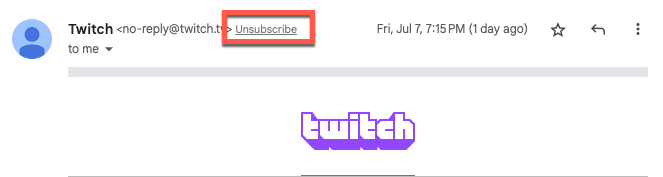
Another common example is the email unsubscribe link.
You generally find it in the footer and in smaller text, so it’s almost impossible to hit by mistake… and hard to hit on purpose, too.
Gmail uses Fitts’s Law too. Even though Gmail pulls the unsubscribe link at the top of an email from known senders, it’s in a small light gray font that’s not easy to read or click.
It doesn’t seem right that most of the industry uses a template built on three layers which are each mostly wrong and not strongly supported by marketing science.
The sales funnel is nearly a hundred years old, but despite frequent reports of its death and surprisingly little evidence that it reflects how advertising actually works, it’s never been more alive. The cockroach of marketing concepts, it just seems to keep going and going, adapting to the environment it finds itself in.
This is not one of those ‘X is dead! Long live Y!’ articles deploying the ‘kill and switch’ tactic to launch a totally new thing like, for example, The Roach Rhombus. But the sales funnel needs to be adapted to today’s media environment, to fit more of the actual evidence from marketing science on how advertising works, so maybe marketing’s workhorse can keep going a few decades more.
The origin story
The now ubiquitous sales funnel started out as the linear and hierarchical ‘AIDA’ model (Attention, Interest, Desire, Action) which first gained traction in the personal, door-to-door sales era of the late 19th century as a way to teach salespeople how to push buyers towards a sale in a single conversation.
ADVERTISING
It was in 1924 that a book called ‘Bond Salesmanship’ by William Townsend first overlaid the funnel metaphor on top of the AIDA model, again as a way to push people towards a sale, but presumably this time in the context of the then-new telephone network. So its roots are as a sales aid for salespeople in the direct sales business.
Source: ‘Bond Salesmanship’, William Townsend
Note in the extract above that originally the metaphor was more about facts being forced down the funnel than people, as in most modern interpretations. And it was originally about leading people towards a sale in a single engagement, whereas today we assume multiple phases over longer time scales, with different audiences and across different platforms.
It’s become less about individuals being taken on a journey and more about nudging large pools of different people forward stage by stage.
It then seems to have remained in relatively low level use for the rest of the 20th century, only becoming as omnipresent as it is today over the last decade or so.
Recent rise
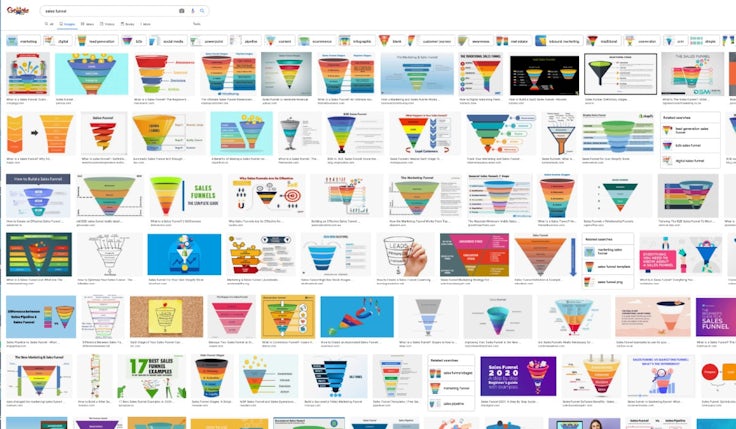
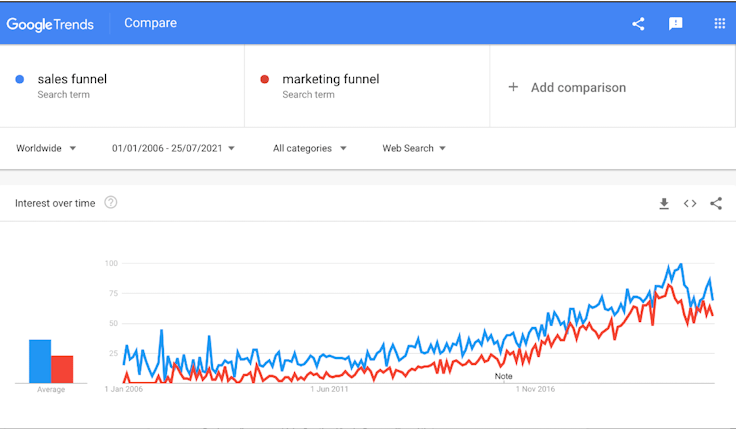
A Google image search for ‘sales funnel’ instantly shows you just how prevalent it’s become. A sure sign of how useful people find it and that it’s not going anywhere anytime soon.
It’s easy to assume it’s been in constant use throughout its century of existence, but its current popularity appears to be relatively recent. During a recent conversation I had with Les Binet, he said he first became aware of the funnel in the mid-1990s in a Volkswagen strategy presentation, and that it was so little known then that the planner was assumed to have invented it.
Other conversations with people working in adland around that time suggest the funnel’s use started to ramp up in the 2000s and 2010s. So what caused its rise? My theory is that it was the growth of the adtech platforms, which needed an intuitive and simple framework to help explain how digital advertising works.
The funnel is now the menu used by the platforms to sell us their wares, helping them to explain the roles their ad formats play along the customer journey. It’s become the go-to tool for digital marketing training courses (including ours at Jellyfish) to organise and simplify the vast and ever-expanding complexity of the digital marketing universe. Media agencies use it to organise media proposals. Creative agencies use it to organise the assets they want to make.
So the funnel is, essentially, a sales tool. It is not a customer, data or science-led framework. In fact, as I’ll show, it is actually a surprisingly inaccurate model of how advertising actually works.
Who’d have thought a concept invented to teach salespeople in the late 19th and early 20th centuries would be even more powerful as a tool to help digital advertising people sell to each other in the 21st?
Common criticisms explained
There are lots of common criticisms you can throw at the standard funnel. To start, it doesn’t encompass post-purchase or loyalty.
This is usually easily fixed by adding a couple of stages, such as loyalty and advocacy, and a loop back to earlier stages. McKinsey’s loyalty loop fixed this (illustrated below), but in doing so created a sort of Kafkaesque nightmare, where everyone is permanently considering, evaluating, purchasing or repurchasing, and ignoring the fact that in the real world people are mostly passively filtering out any kind of brand or communications most of the time.
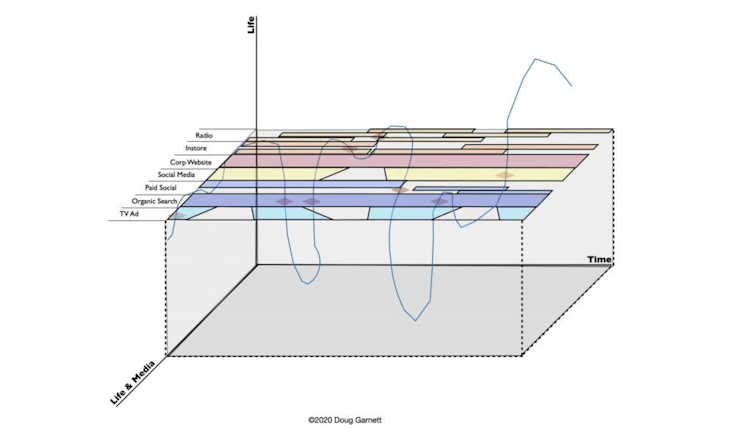
Another criticism is that funnels are too linear – that in the real world, people tend to meander around, occasionally and randomly bumping into different touchpoints on their entirely unpredictable and personal journey in time towards a sale. I love this visualisation of that chaos in Doug Garnett’s critique of a related concept, the customer journey map.
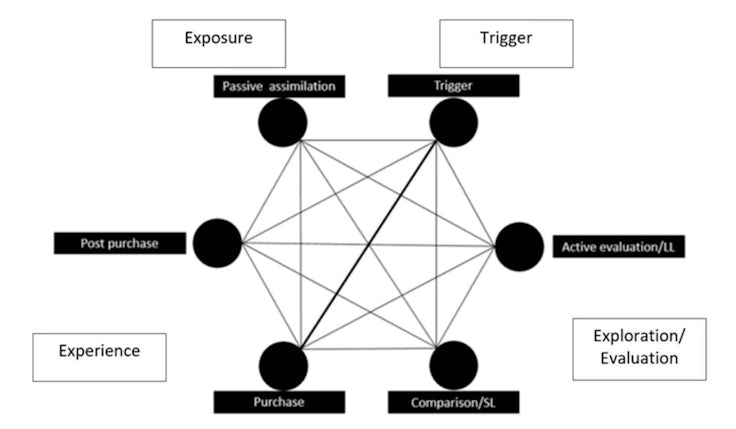
This kind of non-linear pinballing effect is touched on in James Hankins’ recent hexagon model. It’s a brilliant bit of theory, which (rare for these models) acknowledges that people start out passively, subconsciously assimilating stuff about brands, are triggered in some way, and then go on a journey which can vary in time, stages, and linearity.
Importantly it also acknowledges that this journey will vary from brand to brand and individual to individual.
In practice you’d need to identify what your core journey is for your brand, and for each stage work out what the role of communications is, and what the messaging and channels would be at each stage.
In other words, you’d end up creating your own bespoke funnel. It’s possible this model may require a little too much personalisation for most marketing people to work with.
Problems with ‘Awareness→Consideration→Conversion’
Most versions of the standard funnel are built around three basic layers – awareness, consideration and conversion. Three concepts that are all sort of wrong, but in different ways.
Few would argue with the need to make a large number of people aware of your brand. But its inclusion at the top of the funnel is a bit blunt and can lead to lazy thinking. The standard funnel almost never encompasses a concept that’s arguably more important: mental availability, or the chance of your brand coming to a buyer’s mind at key decision-making or buying moments.
Mental availability encompasses awareness, but is really a composite of spontaneous awareness, salience, distinctiveness, associations with category cues, being noticed and remembered. It rules over everything. People being aware of your brand obviously isn’t enough; people remembering it for relevant things at critical decision-making moments is what you need.
Meanwhile, almost all funnels include at their heart a period of rational, system 2 evaluation, which is usually labelled ‘consideration’. Most funnels skew somewhat to a more rational view of the world, rather than one where people’s decisions are subconscious, emotionally-driven, even irrational.
So today’s sales funnel is heavily influenced by a school of advertising thought, dominant through the early-to-mid 20th century and later adopted by most of the digital platforms, that advertising must persuade people with facts in order to get them to actively appraise and consider a product or service.
What we now know about the brain suggests this is usually not how buying decisions work. This type of evaluation is more common in low frequency, high value categories where people may want to spend more time researching options. But even then their final decisions will be primarily ‘emotional’ or subconscious.
In fact, the concept of brand consideration often doesn’t actually stand up to much scrutiny or data analysis. One major financial services client of mine, which has more analytical resources than any other company I’ve ever worked with, couldn’t find any real evidence for a causal, chronological link between brand consideration and customer acquisition.
The sales funnel needs to be adapted to today’s media environment, to fit more of the actual evidence from marketing science on how advertising works.
Its analysis identified three key metrics that mattered for its brands: 1) spontaneous ad awareness, 2) relevant brand associations, leading to 3) conversion.
It identified two roles for communications: a) simultaneously building mental availability & creating brand associations and b) triggering those associations closer to purchase. A philosophy closer to Byron Sharp’s thinking than the usual funnel.
And conversion too has issues as a label, echoing the ‘strong force’ theory of advertising, when advertising is usually only a weak force on people’s behaviour. The average clickthrough rate on digital display ads being approximately 0.07% is just one small piece of modern evidence for this, so naming a whole layer of a funnel ‘conversion’ when 99.03% of the time it’s playing some other role (e.g. refreshing brand memories) is probably over-playing advertising’s hand.
Bringing this all together
I like the funnel’s flexibility and utility. Its shape reflects the need to target broadly, to cast the net wide for prospects, to build the brand with as many category buyers as possible, creating mental availability with them, so that at the point at which they fall into the market, whether today, tomorrow or in the future, it has a greater chance of being chosen by them.
The tapering suggests deploying more targeted means to refresh mental availability and to trigger sales more directly when a smaller proportion of prospects fall into the market.
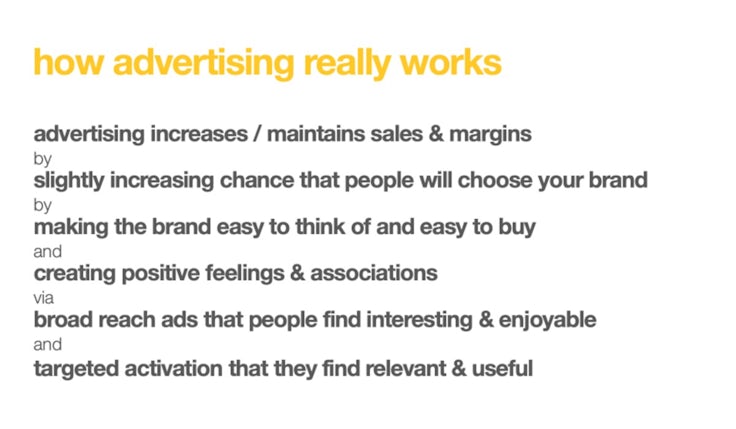
This mirrors Les Binet’s own beautifully precise articulation of how advertising really works (pictured below), which has a two-tiered funnel hidden within it: “broad reach ads that people find interesting & enjoyable and targeted activation that they find relevant and useful”. Plainly forcing people through a process or journey isn’t possible – mostly people will do things at their own speed and volition. Nudging people is more realistic.
Source: Les Binet
And the unthinking application of the funnel can lead to people planning campaigns on automatic pilot, an acceptance that ‘awareness’ work can be separate, that ‘consideration’ work is essential, and that ‘conversion’ activity could be from a completely different planet.
It can lead to overly layered and fragmented campaigns with budgets being spread too thinly across multiple platforms and formats, rather than being concentrated on activity that will actually get your audience’s neural circuitry firing and creating brand memories.
And it doesn’t seem right that most of the industry uses a template built on three layers which are each kind of wrong and not strongly supported by marketing science. Awareness is insufficient as a descriptor. Consideration is not true for most people’s purchases. Conversion suggests advertising is a strong force on people’s behaviour.
The language of ‘upper’ and ‘lower’ funnel can also reinforce the value-destroying division between ‘brand’ and ‘performance’.
Some people seem to think the upper funnel is the only place where brand-building can happen, or worse, the only place where ‘creativity’ is allowed. Which can lead to people assuming that these two things are luxuries, optional extras that you only need to deploy if you’ve got the money.
The standard funnel also doesn’t tend to emphasize a key role played by much digital marketing today. Not its role in helping brands to come to mind more easily, but in helping brands that have already come to mind to be found more easily. A role less akin to driving mental availability, and more akin to helping aid physical and digital availability.
Econometrician Grace Kite puts it like this: “It’s the role of online ads as signposts…this task is the online equivalent of the name above the high street front door, the lights that stay on inside, the shelf-space and even the entry in the Yellow Pages. The task is to help people who are already on their way to a website arrive safely.”
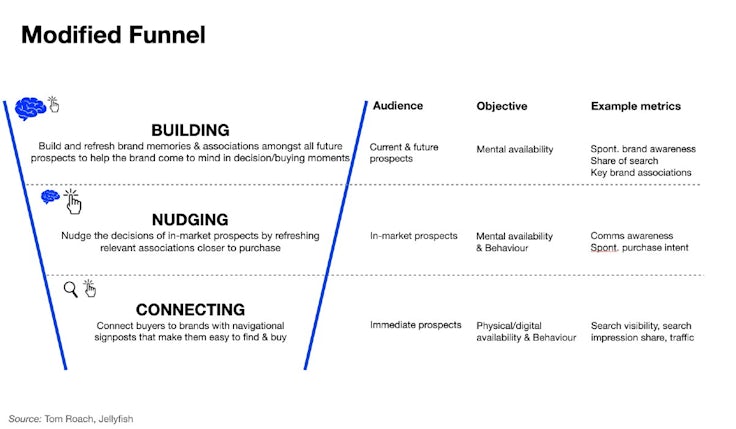
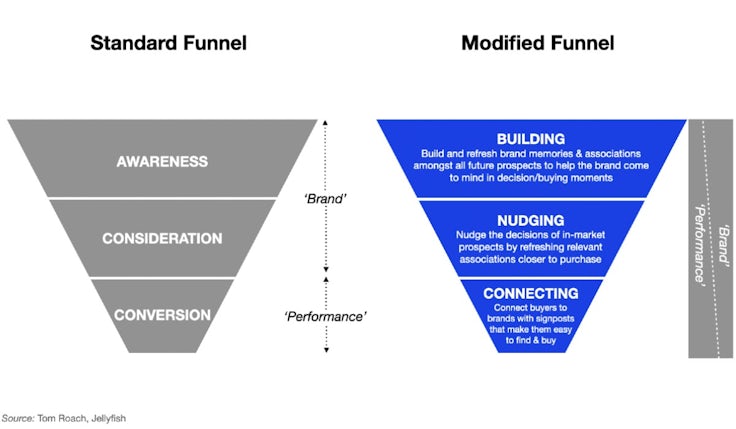
So rather than invent a totally new thing, here are some suggestions of simple modifications to the funnel to keep it up to date and in line with more of the evidence about how advertising works:
Where building mental availability, not just awareness, is the basic role for advertising.
Where everything is seen as contributing to brand-building and performance.
Where advertising’s ‘emotional’ role is primary but not separate from any ‘rational’ role.
Where an evaluation stage could be added if necessary but isn’t assumed to be needed.
Where nudging brand memories is used as a way to trigger short-term sales.
Where the connecting role of paid search and SEO in helping make brands be easy to find is highlighted as an important and distinct role for communication today.
The modified funnel would look something like this:
As they say, all models are wrong and some are useful. But perhaps this simple adaptation of the standard funnel could be a little less wrong and a little more useful.
But whichever version of the funnel you use, don’t allow any version of it to let you do your planning on auto-pilot. Determine the actual path to purchase for your brand, the best role for communications at each stage, the metrics that matter at each, deploy the best media mix and make the very best creative you can to shift them.
The sales funnel has been in use for nearly a hundred years by adapting to the media environment of the day. If we continue to adapt it to what marketing science tells us about how advertising works, perhaps it could be in use for the next hundred.
Take a page from the creators of 'South Park' and 'Book of Mormon.'
Most great leaders are great communicators. No matter how great your ideas, your technical skills, and your decision-making skills, if you can't convince other people your idea makes sense, if you can't convey how a project or initiative will generate a return, if you can't explain the logic and benefits of a decision, then you're unlikely to harness the power of the people around you.
But don't just take it from me: As Warren Buffett says, "If you can't communicate and talk to other people and get across your ideas, you're giving up your potential."
Science backs him up. According to a 2011 study published in NeuroImage, the better the communication -- the better the story you tell -- the more mentally, emotionally, and (oddly enough) physically engaged people will be.
In short, great verbal and written communication "lights" people up.
Compass Founder Robert Reffkin on How to Bounce Back From Failure
So how can you become a better communicator? Start by telling better stories, not just with traditional stories, but by communicating in a way that draws people in.
And how do you do that?
The Rule of But and Therefore
Simple: Take a page from Matt Stone and Trey Parker, the creators of South Park and The Book of Mormon:
Avoid these two words: "and then."
And focus on two other words: "but" and "therefore."
For example, imagine you're creating a pitch deck. You'll naturally break your "story" down into bullets or chunks. Now pretend each is a scene in a show or movie.
And consider the connective tissue between those "scenes."
"We can take these beats [scenes]," Stone says, "which are basically the beats of your outline, and if the words 'and then' belong between those beats, you're [screwed.] You have something pretty boring."
Why? The words "and then" turn your story into a list.
Consider your pitch. Your groundbreaking new product does this. And then this. And then this. And then this.
And then, people tune you out. There's nothing to draw your audience in. There's no story. Just, in effect, bullet points -- making it just like every other presentation.
So, therefore, what should you do instead?
"What should happen between those beats," Stone says, "is either the word 'therefore' or 'but.' So if you come up with an idea, this happens, 'and then' this happens. No. No. It should be this happens, and therefore this happens. But, this happens. Therefore, this happens."
The result? For Stone and Parker, a story with twists. With complications. With resolutions. With momentum. With connective tissue that creates a narrative arc.
Thinking in terms of "but" and "therefore," Parker says, "gives you the causation between each beat -- and that's a story."
Try it. The next time you map out what you want to say or write, think in terms of "therefore" and "but."
Say you hope to persuade potential customers to try your new fitness app.
The market is huge: Nearly everyone wants to be fit. But people rarely stick with new fitness routines. Therefore, you developed a series of routines to keep it fresh. But still: One size, no matter how flexible that size, never fits all. Therefore, you've incorporated A.I. to better tailor routines to each individual's goals and preferences ...
Framing your message using "but" and "therefore" lets you raise and then overcome objections. Lets you identify and then solve pain points. Makes it easier to frame your message in a clear, coherent, and memorable way.
Turns what would be a recitation into a story.
One that, as science says, helps you light people up.
Which is always the goal when you try to communicate something -- anything -- that matters.
The elimination of the third-party cookie will profoundly impact e-commerce. This shouldn’t be a shock. We were headed down this path long before Google announced that it would deprecate the cookie in Chrome in 2022. Perhaps more than any arrow in the marketer’s quiver, e-commerce’s targeting accuracy has traditionally been built around the cookie. However, Happy Cog’s Lee Goldberg says instead of viewing this scenario as dire, e-commerce players should view this inflection point in data-driven marketing as an opportunity to rethink it all.
During the era of the third-party cookie, the e-commerce community has fallen prey to the fixation on short-term sales conversions. As tempting as this paradigm is, over the long haul it can actually stunt long-term consumer engagement and limit lifetime customer value. The opportunity and challenge in 2022 and beyond is to flip this script – and get customers and prospects to voluntarily opt in. Yes, emphasizing lead gen over sales in the short-term doesn’t sound particularly sexy, but over the long haul it will actually increase ROI.
A more methodical, incremental approach will bear greater results. Instead of driving hard for a purchase, perhaps appeal to your customer base through softer engagement promotional activity that targets an email address or an account creation instead of a purchase. Facebook, LinkedIn and Google (through Discovery campaigns) all offer lead generation opportunities. By deploying a robust CRM platform (such as MailChimp, Klaviyo or Salesforce) to organize these emails for dynamic ad targeting, e-commerce brands can focus on establishing ongoing, positive relationships with both prospects and customers. If you have a compelling offer or value proposition, customers are generally willing to opt in.
By rewiring your priorities to place demand generation over sales, your brand will forge deeper connections with consumers. E-commerce marketers tend to get hung up on quick conversion metrics while losing sight of the RFM model (recency, frequency and monetary value). RFM modeling is an under-used marketing analysis tool to help companies better predict which customers are more likely to make future purchases, as well as to glean insights to turn occasional buyers into habitual ones.
Interestingly, there has already been growing pressure on e-commerce retailers to re-orient around first-party cookies, built by the collection of data from their own domains like user log-ins, passwords and shopping cart data. Google and Facebook have both been pushing this with their evolving product suites. Before third-party cookie deprecation picked up steam over the past few years, it had become readily apparent to anyone paying attention that dynamic retargeting through networks like Criteo and AdRoll were not long for this world. Both of these retargeting pioneers have now adapted and repositioned themselves for a post-cookie world.
The winners of the post-cookie world
While most of our industry was retargeting customers with abandon, Amazon was quietly off to the side for years amassing an enormous amount of first-party data. Amazon’s dominance in the paid search world will now pay off by orders of magnitude. It wouldn’t be at all shocking to see Amazon sunset its relatively nascent demand-side platform (DSP) despite the heavy investment. With the growing marketer interest in other formats such as connected TV (CTV) and connected audio, expect Amazon to reshape its DSP to meet these opportunities – much as players such as The Trade Desk have already done.
In a post-cookie world, the push towards first-party data will make it easier for brands to do their own attribution rather than relying on Facebook and Google. While true multi-touch attribution remains elusive, e-commerce folks will be able to attain a deeper, more nuanced understanding of full-funnel consumer behavior.
Life beyond the third-party cookie will be complex and there will be many new twists and turns, but a new paradigm will coalesce around stronger customer engagement. Privacy regulations like the General Data Protection Regulation (GDPR) and the California Consumer Privacy Act (CCPA) have been the catalysts for change. While compliance may be a big motivator, ultimately an ability to maintain the big picture by putting engagement – not targeting – first is the secret to long-term success.
That lesson may not be resonating at scale yet, as evidenced by the continuing obsession with targeting within the context of new identity solutions like Google’s Privacy Sandbox, as well as in the conversations around first-party data utilization and contextual targeting 2.0. Unless we flip the script and focus on engagement first, the mistakes of the past will likely be repeated.


 The sales funnel is nearly a hundred years old, but despite frequent reports of its death and surprisingly little evidence that it reflects how advertising actually works, it’s never been more alive. The cockroach of marketing concepts, it just seems to keep going and going, adapting to the environment it finds itself in.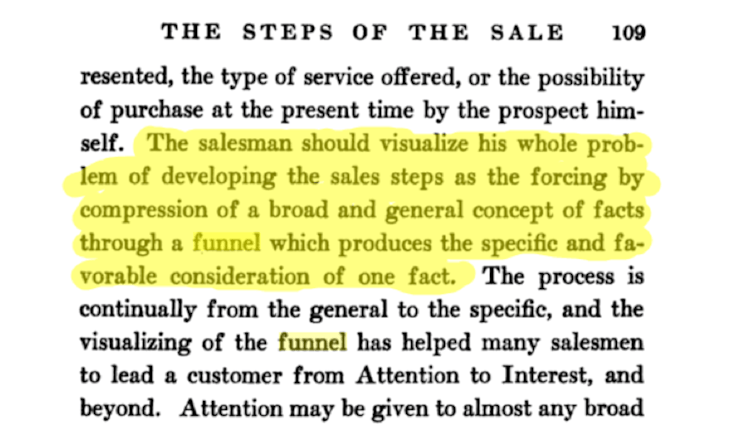
 It’s easy to assume it’s been in constant use throughout its century of existence, but its current popularity appears to be relatively recent. During a recent conversation I had with Les Binet, he said he first became aware of the funnel in the mid-1990s in a Volkswagen strategy presentation, and that it was so little known then that the planner was assumed to have invented it.
 The funnel is now the menu used by the platforms to sell us their wares, helping them to explain the roles their ad formats play along the customer journey. It’s become the go-to tool for digital marketing training courses (including ours at Jellyfish) to organise and simplify the vast and ever-expanding complexity of the digital marketing universe. Media agencies use it to organise media proposals. Creative agencies use it to organise the assets they want to make.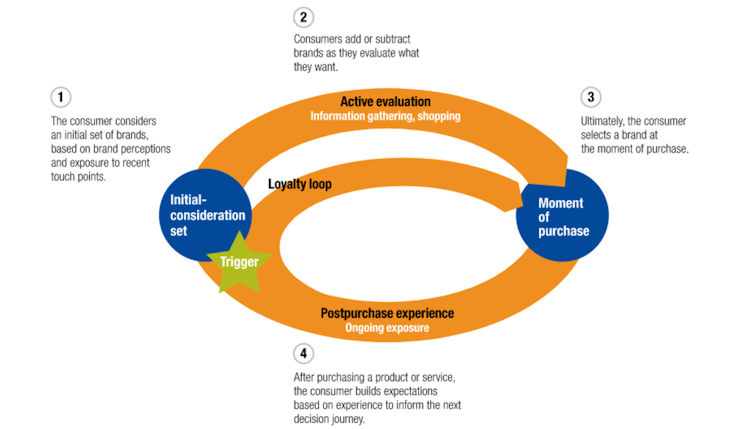
 As they say, all models are wrong and some are useful. But perhaps this simple adaptation of the standard funnel could be a little less wrong and a little more useful.