Showing posts with label Consumer Journey. Show all posts

Tuesday, May 11, 2021

Designing Customer Journeys for the Post-Pandemic World


by Gene Cornfield

May 06, 2021


Sean Gladwell/Getty Images

Summary.   While using customer journeys to guide what teams build and how they operate is common practice, small differences in approach produce vastly different results. But today, as we enter a new stage of profound change, those differences will be more important than...more


As vaccinated millions step tentatively back into an in-person economy poised for growth, the relationships they had with companies they preferred before will resume — but on a trial basis. Spending loyalties will be cemented (or potentially lost to others) based on how well companies understand customers’ new priorities that were forged by the degree of uncertainty, fear, strife, or loss each individual experienced. These considerations will influence not only what customers choose but also how they go about choosing. Your customer journeys must change to reflect your customers’ new preferences and behaviors.


While using customer journeys to guide what teams build and how they operate is common practice, small differences in approach produce vastly different results. But today, as we enter a new stage of profound change, those differences will be more important than ever to business performance. Companies that have adopted different approaches to customer journey and experience practices have seen more than six times greater growth in year-on-year profitability.


Regardless of one’s industry, whether B2C or B2B, the following three simple but critical factors will determine whether your post-pandemic customer journeys will help amplify or impede business growth.


Customer-Centric, Not Company-Centric

Customers happily serve as the engine of business outcomes when doing so is a byproduct of achieving their own intended outcomes. Every time a customer achieves their purpose, the company that enabled them to do so receives revenue or some other value (loyalty, advocacy, etc.).


Insight Center Collection

Opportunities for Midsize Businesses in 2021

Set yourself up to thrive.

But the vast majority of customer journeys I see focus on company outcomes. They guide marketing or sales or service teams, perhaps inadvertently, to manipulate customers toward a business outcome. This practice is so engrained that we have a name for it: The funnel.


The least customer-centric companies often have a single customer journey that is essentially the vertical funnel turned on its side, like a livestock chute through which customers are prodded toward a fate of the company’s choosing. The corralling pens customers pass through — awareness, interest, evaluation, intent, purchase, loyalty — are all in the context of a product and what the company wants, not what customers want.


Many other companies have recognized that customers engage in multiple journeys over the lifetime of their relationship; however, those different journeys are typically aligned to and named for specific outcomes, such as acquisition, retention, or upsell. The question for these companies is: Which customer segments wake up with a burning desire to be acquired? Which think their lives would be so much better if only they could be retained or upsold? These journeys, too, are entirely company-centric. Customer-centric journeys start and end with the outcome customers are trying to achieve: Their intended purpose.


For example, the pandemic has spurred many people to relocate from cities to suburbs. Many are first-time homeowners, unsure what tools they might need for planned improvements or unplanned repairs. Some might want to build a treehouse with their kids but don’t yet have a specific model chosen or the plans, instructions, or tools to realize it. What new offerings, journeys, or experiences might manufacturers of power tools create to enable customers to achieve this purpose?


A traditional journey might start with ads or emails with images of a family building a treehouse that link to the company home page, and then expect the customer to discern what tools or other things they need. Without further guidance, customers will likely leave the company’s site (and the company-designed journey) for a search engine, which provides links to numerous articles, blogs, or competitor sites — any of which might better help the customer achieve their purpose and, as a result, prompt them to purchase elsewhere. The company-designed journey might include stalking customers around the web with retargeting ads. But not only is this practice being phased out, it squanders marketing spend by trying to bring customers back to a site that doesn’t address key needs in their journey.


A more customer-centric journey might start with the ads or emails described above, but link to a section of the company website organized by types of projects, from decks to sheds to treehouses. They might show multiple treehouse designs, filterable by size or the type of trees for which each is suitable. The detail page for each treehouse might show a video of the project from start to finish to build confidence in the customer and excitement among the family. All the tools and parts required might be listed, with options to buy them a la carte or as a full package. Each purchase might include assembly plans with illustrated instructions, and a mobile device–optimized step-by-step version, with guidance on what age child can handle each task so all family members can participate safely. Options for contactless delivery or curbside pickup at a local retail partner could be presented. The company might include an offer from a partner like DoorDash or Grubhub for lunch/refreshment delivery, to address that part of the journey.


Companies can better drive growth by creating journeys that align with their customers’ purposes, then develop and operate experiences that enable customers to achieve them. This isn’t to say companies shouldn’t be trying to influence customer decisions along the way. Influence can be more effective when journeys and experiences are customer-centric, designed not as a path to purchase, but as a path to purpose.


The tool company above influences purchases by designing an offer, journey, and experience that addresses customer purpose. They could influence future purchases by triggering an email a few weeks later asking customers how the treehouse project went or if they need help. Doing so demonstrates commitment to the customer’s purpose, which can influence loyalty and future purchases. If the email also encourages customers to post finished treehouse photos on Instagram (which can also appear on the webpage for that treehouse), the company aligns with customers’ desire to share family accomplishments, which might influence others to buy.


This customer-centric, purpose-led approach is even more important for B2B companies. Longer buying cycles mean keeping prospects engaged in longer journeys with more interaction points. It’s also more challenging when decisions involve multiple people, each on their own journey, with varying purposes depending on their role. Marketing and sales teams can increase win rates by aligning individual journeys to each person’s purpose, while managing the group’s purposes collectively in a multi-buyer journey.


Flexible Journeys Based on Need-Points, Not Touchpoints

Customers have greater choice than ever before in terms of how and where they engage. And being forced in the last year to interact only via phone, websites, apps, chats, text, or social channels means customers are more comfortable with these methods than before.


This democratization of new interaction channels has made it more important that customer journeys not be rigidly tied to specific touchpoints. For example, a customer journey that portrays a linear series of interactions — customer sees offline ad, then goes to search engine, then is directed to landing page on website, then is retargeted on Facebook, then comes back to website and provides email address, after which an email to customer is triggered, etc. — is only useful as an example of what could happen if all the stars aligned — or if customers were willing to follow the script.


But customers don’t follow scripts. They follow impulses, urges, whims, and preferences, often in unplanned moments of opportunity. So it’s important that journeys are not aligned to specific touchpoints according to what the company wants to happen. Rather, the company should seek to understand the series of need-points customers traverse in order to make decisions that achieve whatever outcome they ultimately intend.


For example, a person whose purpose is to quit smoking might traverse a journey of need-points, from understanding the easiest way to quit, which method is best for them, how fast it will work, where they can buy it, how quickly they can get it, and (once received) how they use it. Each customer might choose from a variety of touchpoints at each moment of need, depending on their preferences or context at that moment.


It’s your job to be present with the content, expert, recommendation, answer, or product relevant to the customer need at that point, in any and all of the channels a customer might choose, including any operated by the company (website, app, chatbot, call center, salespeople, stores, branches, etc.) or by third parties (search engines, review sites, blogs, retail partners, etc.).


The company that successively addresses these needs most relevantly, clearly, and quickly at any potential touchpoint is likely to maintain engagement and influence throughout each customer’s journey until each achieves their ultimate purpose — and generates value for the business.


Measuring (and Optimizing) Customer Journeys and Experiences

Company outcomes depend on the number of customers who successfully achieve their intended purpose. The better a company measures and manages how well they’re enabling customers to progress across need-points, the stronger the resulting business outcomes.


Teams can measure the effectiveness of their customer journeys — and the experiences based on them — using Customer Performance Indicators (CPIs), which I’ve written about before. This method measures how well a company is performing for customers at each need-point. The better a company performs on outcomes important to customers (CPIs), the better it will perform on outcomes important to the company (KPIs). And because certain need-points in the journey will influence customer decisions more than others, companies should prioritize performing well on CPIs in these moments that matter.


You may find that some need-points are specific to certain customer segments. So, while revising journeys and experiences for your largest or most valuable customer segments is advisable, catering to the unique needs or preferences of other segments should be added over time. Do this by creating off-ramps and on-ramps to and from your main journeys, as a map would depict side roads merging onto a major thoroughfare.


For example, the simplified insurance journey from my previous article reflects three key need-points: Fast Quote, Best Price, and Payments That Fit My Budget. Some customers may need to understand the benefits of bundling home, auto, or other insurance policies before looking for a fast quote.


So another need-point (and CPI) for Understanding Bundling Benefits might be added with an on-ramp to the main journey. This helps marketers ensure they have relevant content for the new need-point (at all touchpoints), and designers can ensure a more relevant and seamless experience for more customers, which results in more customers won.


Looking Ahead

If your company has already adopted these practices, you’re well-positioned to thrive. Simply refine your customer journeys and experiences for how customer needs and values have evolved. For those still using company-centric, linear journeys rigidly tied to specific touchpoints or measuring only business outcomes, now is the time a change in approach will pay off the most.


Small and midsize businesses have a window of advantage here. While larger companies might have greater resources and reach and some have recognized the need to pivot their customer journeys, experiences, and operations for new realities, for many, forward progress will be mitigated by operational, organizational, and cultural inertia. So, until larger or slower players ultimately get there, opportunities abound for more nimble companies to better align with customers’ new purposes and forge new relationships that accelerate growth and strengthen loyalty by providing them with greater confidence in a still-uncertain world.


Tuesday, January 23, 2018

The consumer decision journey - 2009

Consumers are moving outside the marketing funnel by changing the way they research and buy products. Here's how marketers should respond to the new customer journey.
If marketing has one goal, it’s to reach consumers at the moments that most influence their decisions. That’s why consumer electronics companies make sure not only that customers see their televisions in stores but also that those televisions display vivid high-definition pictures. It’s why Amazon.com, a decade ago, began offering targeted product recommendations to consumers already logged in and ready to buy. And it explains P&G’s decision, long ago, to produce radio and then TV programs to reach the audiences most likely to buy its products—hence, the term “soap opera.”
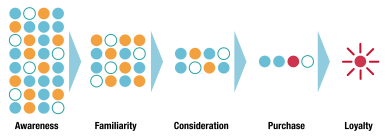
Marketing has always sought those moments, or touch points, when consumers are open to influence. For years, touch points have been understood through the metaphor of a “funnel”—consumers start with a number of potential brands in mind (the wide end of the funnel), marketing is then directed at them as they methodically reduce that number and move through the funnel, and at the end they emerge with the one brand they chose to purchase (Exhibit 1). But today, the funnel concept fails to capture all the touch points and key buying factors resulting from the explosion of product choices and digital channels, coupled with the emergence of an increasingly discerning, well-informed consumer. A more sophisticated approach is required to help marketers navigate this environment, which is less linear and more complicated than the funnel suggests. We call this approach the consumer decision journey. Our thinking is applicable to any geographic market that has different kinds of media, Internet access, and wide product choice, including big cities in emerging markets such as China and India.
Open interactive popupThe consumer decision journey—an interactive
Traditional marketing funnel: Consumers' considerations in their paths to purchase
We developed this approach by examining the purchase decisions of almost 20,000 consumers across five industries and three continents. Our research showed that the proliferation of media and products requires marketers to find new ways to get their brands included in the initial-consideration set that consumers develop as they begin their decision journey. We also found that because of the shift away from one-way communication—from marketers to consumers—toward a two-way conversation, marketers need a more systematic way to satisfy customer demands and manage word-of-mouth. In addition, the research identified two different types of customer loyalty, challenging companies to reinvigorate their loyalty programs and the way they manage the customer experience.
Finally, the research reinforced our belief in the importance not only of aligning all elements of marketing—strategy, spending, channel management, and message—with the journey that consumers undertake when they make purchasing decisions but also of integrating those elements across the organization. When marketers understand this journey and direct their spending and messaging to the moments of maximum influence, they stand a much greater chance of reaching consumers in the right place at the right time with the right message.

How consumers make decisions

Every day, people form impressions of brands from touch points such as advertisements, news reports, conversations with family and friends, and product experiences. Unless consumers are actively shopping, much of that exposure appears wasted. But what happens when something triggers the impulse to buy? Those accumulated impressions then become crucial because they shape the initial-consideration set: the small number of brands consumers regard at the outset as potential purchasing options.
The funnel analogy suggests that consumers systematically narrow the initial-consideration set as they weigh options, make decisions, and buy products. Then, the postsale phase becomes a trial period determining consumer loyalty to brands and the likelihood of buying their products again. Marketers have been taught to “push” marketing toward consumers at each stage of the funnel process to influence their behavior. But our qualitative and quantitative research in the automobile, skin care, insurance, consumer electronics, and mobile-telecom industries shows that something quite different now occurs.
Actually, the decision-making process is a more circular journey, with four primary phases representing potential battlegrounds where marketers can win or lose: initial consideration; active evaluation, or the process of researching potential purchases; closure, when consumers buy brands; and postpurchase, when consumers experience them (Exhibit 2). The funnel metaphor does help a good deal—for example, by providing a way to understand the strength of a brand compared with its competitors at different stages, highlighting the bottlenecks that stall adoption, and making it possible to focus on different aspects of the marketing challenge. Nonetheless, we found that in three areas profound changes in the way consumers make buying decisions called for a new approach.
Alternative to the marketing funnel: The consumer decision-making process is now a circular journey

Brand consideration

Imagine that a consumer has decided to buy a car. As with most kinds of products, the consumer will immediately be able to name an initial-consideration set of brands to purchase. In our qualitative research, consumers told us that the fragmenting of media and the proliferation of products have actually made them reduce the number of brands they consider at the outset. Faced with a plethora of choices and communications, consumers tend to fall back on the limited set of brands that have made it through the wilderness of messages. Brand awareness matters: brands in the initial-consideration set can be up to three times more likely to be purchased eventually than brands that aren’t in it.
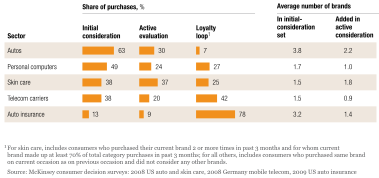
Not all is lost for brands excluded from this first stage, however. Contrary to the funnel metaphor, the number of brands under consideration during the active-evaluation phase may now actually expand rather than narrow as consumers seek information and shop a category. Brands may “interrupt” the decision-making process by entering into consideration and even force the exit of rivals. The number of brands added in later stages differs by industry: our research showed that people actively evaluating personal computers added an average of 1 brand to their initial-consideration set of 1.7, while automobile shoppers added 2.2 to their initial set of 3.8 (Exhibit 3). This change in behavior creates opportunities for marketers by adding touch points when brands can make an impact. Brands already under consideration can no longer take that status for granted.
Brand consideration behavior, by industry

Empowered consumers

The second profound change is that outreach of consumers to marketers has become dramatically more important than marketers’ outreach to consumers. Marketing used to be driven by companies; “pushed” on consumers through traditional advertising, direct marketing, sponsorships, and other channels. At each point in the funnel, as consumers whittled down their brand options, marketers would attempt to sway their decisions. This imprecise approach often failed to reach the right consumers at the right time.
In today’s decision journey, consumer-driven marketing is increasingly important as customers seize control of the process and actively “pull” information helpful to them. Our research found that two-thirds of the touch points during the active-evaluation phase involve consumer-driven marketing activities, such as Internet reviews and word-of-mouth recommendations from friends and family, as well as in-store interactions and recollections of past experiences. A third of the touch points involve company-driven marketing (Exhibit 4). Traditional marketing remains important, but the change in the way consumers make decisions means that marketers must move aggressively beyond purely push-style communication and learn to influence consumer-driven touch points, such as word-of-mouth and Internet information sites.
Influential touch points by stage of consumer decision journey
The experience of US automobile manufacturers shows why marketers must master these new touch points. Companies like Chrysler and GM have long focused on using strong sales incentives and in-dealer programs to win during the active-evaluation and moment-of-purchase phases. These companies have been fighting the wrong battle: the real challenges for them are the initial-consideration and postpurchase phases, which Asian brands such as Toyota Motor and Honda dominate with their brand strength and product quality. Positive experiences with Asian vehicles have made purchasers loyal to them, and that in turn generates positive word-of-mouth that increases the likelihood of their making it into the initial-consideration set. Not even constant sales incentives by US manufacturers can overcome this virtuous cycle.

Two types of loyalty

When consumers reach a decision at the moment of purchase, the marketer’s work has just begun: the postpurchase experience shapes their opinion for every subsequent decision in the category, so the journey is an ongoing cycle. More than 60 percent of consumers of facial skin care products, for example, go online to conduct further research after the purchase—a touch point unimaginable when the funnel was conceived.
Although the need to provide an after-sales experience that inspires loyalty and therefore repeat purchases isn’t new, not all loyalty is equal in today’s increasingly competitive, complex world. Of consumers who profess loyalty to a brand, some are active loyalists, who not only stick with it but also recommend it. Others are passive loyalists who, whether from laziness or confusion caused by the dizzying array of choices, stay with a brand without being committed to it. Despite their claims of allegiance, passive consumers are open to messages from competitors who give them a reason to switch.
Take the automotive-insurance industry, in which most companies have a large base of seemingly loyal customers who renew every year. Our research found as much as a sixfold difference in the ratio of active to passive loyalists among major brands, so companies have opportunities to interrupt the loyalty loop. The US insurers GEICO and Progressive are doing just that, snaring the passively loyal customers of other companies by making comparison shopping and switching easy. They are giving consumers reasons to leave, not excuses to stay.
All marketers should make expanding the base of active loyalists a priority, and to do so they must focus their spending on the new touch points. That will require entirely new marketing efforts, not just investments in Internet sites and efforts to drive word-of-mouth or a renewed commitment to customer satisfaction.

Aligning marketing with the consumer decision journey

Developing a deep knowledge of how consumers make decisions is the first step. For most marketers, the difficult part is focusing strategies and spending on the most influential touch points. In some cases, the marketing effort’s direction must change, perhaps from focusing brand advertising on the initial-consideration phase to developing Internet properties that help consumers gain a better understanding of the brand when they actively evaluate it. Other marketers may need to retool their loyalty programs by focusing on active rather than passive loyalists or to spend money on in-store activities or word-of-mouth programs. The increasing complexity of the consumer decision journey will force virtually all companies to adopt new ways of measuring consumer attitudes, brand performance, and the effectiveness of marketing expenditures across the whole process.
Without such a realignment of spending, marketers face two risks. First, they could waste money: at a time when revenue growth is critical and funding tight, advertising and other investments will be less effective because consumers aren’t getting the right information at the right time. Second, marketers could seem out of touch—for instance, by trying to push products on customers rather than providing them with the information, support, and experience they want to reach decisions themselves.
Four kinds of activities can help marketers address the new realities of the consumer decision journey.

Prioritize objectives and spending

In the past, most marketers consciously chose to focus on either end of the marketing funnel—building awareness or generating loyalty among current customers. Our research reveals a need to be much more specific about the touch points used to influence consumers as they move through initial consideration to active evaluation to closure. By looking just at the traditional marketing funnel’s front or back end, companies could miss exciting opportunities not only to focus investments on the most important points of the decision journey but also to target the right customers.
In the skin care industry, for example, we found that some brands are much stronger in the initial-consideration phase than in active evaluation or closure. For them, our research suggests a need to shift focus from overall brand positioning—already powerful enough to ensure that they get considered—to efforts that make consumers act or to investments in packaging and in-store activities targeted at the moment of purchase.

Tailor messaging

For some companies, new messaging is required to win in whatever part of the consumer journey offers the greatest revenue opportunity. A general message cutting across all stages may have to be replaced by one addressing weaknesses at a specific point, such as initial consideration or active evaluation.
Take the automotive industry. A number of brands in it could grow if consumers took them into consideration. Hyundai, the South Korean car manufacturer, tackled precisely this problem by adopting a marketing campaign built around protecting consumers financially by allowing them to return their vehicles if they lose their jobs. This provocative message, tied to something very real for Americans, became a major factor in helping Hyundai break into the initial-consideration set of many new consumers. In a poor automotive market, the company’s market share is growing.

Invest in consumer-driven marketing

To look beyond funnel-inspired push marketing, companies must invest in vehicles that let marketers interact with consumers as they learn about brands. The epicenter of consumer-driven marketing is the Internet, crucial during the active-evaluation phase as consumers seek information, reviews, and recommendations. Strong performance at this point in the decision journey requires a mind-set shift from buying media to developing properties that attract consumers: digital assets such as Web sites about products, programs to foster word-of-mouth, and systems that customize advertising by viewing the context and the consumer. Many organizations face the difficult and, at times, risky venture of shifting money to fundamentally new properties, much as P&G invested to gain radio exposure in the 1930s and television exposure in the 1950s.
Broadband connectivity, for example, lets marketers provide rich applications to consumers learning about products. Simple, dynamic tools that help consumers decide which products make sense for them are now essential elements of an online arsenal. American Express’s card finder and Ford’s car configurator, for example, rapidly and visually sort options with each click, making life easier for consumers at every stage of the decision journey. Marketers can influence online word-of-mouth by using tools that spot online conversations about brands, analyze what’s being said, and allow marketers to post their own comments.
Finally, content-management systems and online targeting engines let marketers create hundreds of variations on an advertisement, taking into account the context where it appears, the past behavior of viewers, and a real-time inventory of what an organization needs to promote. For instance, many airlines manage and relentlessly optimize thousands of combinations of offers, prices, creative content, and formats to ensure that potential travelers see the most relevant opportunities. Digital marketing has long promised this kind of targeting. Now we finally have the tools to make it more accurate and to manage it cost effectively.

Win the in-store battle

Our research found that one consequence of the new world of marketing complexity is that more consumers hold off their final purchase decision until they’re in a store. Merchandising and packaging have therefore become very important selling factors, a point that’s not widely understood. Consumers want to look at a product in action and are highly influenced by the visual dimension: up to 40 percent of them change their minds because of something they see, learn, or do at this point—say, packaging, placement, or interactions with salespeople.
In skin care, for example, some brands that are fairly unlikely to be in a consumer’s initial-consideration set nonetheless win at the point of purchase with attractive packages and on-shelf messaging. Such elements have now become essential selling tools because consumers of these products are still in play when they enter a store. That’s also true in some consumer electronics segments, which explains those impressive rows of high-definition TVs in stores.
Sometimes it takes a combination of approaches—great packaging, a favorable shelf position, forceful fixtures, informative signage—to attract consumers who enter a store with a strong attachment to their initial-consideration set. Our research shows that in-store touch points provide a significant opportunity for other brands.

Integrating all customer-facing activities

In many companies, different parts of the organization undertake specific customer-facing activities—including informational Web sites, PR, and loyalty programs. Funding is opaque. A number of executives are responsible for each element, and they don’t coordinate their work or even communicate. These activities must be integrated and given appropriate leadership.
The necessary changes are profound. A comprehensive view of all customer-facing activities is as important for business unit heads as for CEOs and chief marketing officers. But the full scope of the consumer decision journey goes beyond the traditional role of CMOs, who in many companies focus on brand building, advertisements, and perhaps market research. These responsibilities aren’t going away. What’s now required of CMOs is a broader role that realigns marketing with the current realities of consumer decision making, intensifies efforts to shape the public profiles of companies, and builds new marketing capabilities.
Consider the range of skills needed to manage the customer experience in the automotive-insurance industry, in which some companies have many passive loyalists who can be pried away by rivals. Increasing the percentage of active loyalists requires not only integrating customer-facing activities into the marketing organization but also more subtle forms of organizational cooperation. These include identifying active loyalists through customer research, as well as understanding what drives that loyalty and how to harness it with word-of-mouth programs. Companies need an integrated, organization-wide “voice of the customer,” with skills from advertising to public relations, product development, market research, and data management. It’s hard but necessary to unify these activities, and the CMO is the natural candidate to do so.

Marketers have long been aware of profound changes in the way consumers research and buy products. Yet a failure to change the focus of marketing to match that evolution has undermined the core goal of reaching customers at the moments that most influence their purchases. The shift in consumer decision making means that marketers need to adjust their spending and to view the change not as a loss of power over consumers but as an opportunity to be in the right place at the right time, giving them the information and support they need to make the right decisions.

Thursday, August 18, 2016

Five ways marketers can win in mobile-first micro-moments


Everyone wants to achieve mobile success, but how do you go about it? Contributor Brian Solis shares analysis of Google's advice on how marketers can take advantage of micro-moments.

best-mobile-shopping-apps
Mobile has changed the game, and marketers have to change with it. Consumers aren’t just mobile-first, they’re pushing to become mobile-only. And as they do, their expectations, behaviors and preferences change. But that’s not all. How they find information and make decisions hacks traditional customer journeys and sets the stage for innovation in marketing that will shift engagement from selling to telling.
Marketers get that mobile is important. But it’s still largely an additive strategy that’s part of an overall digital initiative. Mobile apps, responsive sites and mobile ads are all bringing brands to the smaller screen.
But to mobile users, it’s all about the lifestyle, not the device. They’re learning how to get around existing customer journeys to find and get what they want. And now, the combination of smartphone and tablet traffic exceeds desktop for many brands. This has opened small windows of consumer engagement that Google calls micro-moments. These moments are driven by intent and happen when someone reaches for their smartphone to know, go, do and buy.
Micro-moments create countless opportunities for marketers. But what are these moments, and how do marketers better engage consumers when people turn to mobile?
To help, Google put together a list of five ways to learn from micro-moments. Following, my recap and analysis of the search giant’s suggestions:

1. Find the top mobile-centric searches

Look at consumer demand by search topic and device type. Then, examine mobile-centric searches for your brand or category. These searches reveal powerful consumer insights about what your audience wants when smartphones are their device of choice.

2. Learn more about your customers’ most common questions

Find out what’s most important to customers by learning what they ask of your brand (or your competitors). What are the most popular or common questions?
People don’t just search using keywords — they ask questions as if that search bar was a human being. Talk to your agency or SEO team to get help figuring out what people are asking when it comes to your product, brand or industry. Many customers ask questions that begin with  “what,” “when” and “how” (in fact, one of the fastest-growing question types starts with “how to”).
By understanding the questions people are asking, you can learn how to create content that can serve as useful answers.

3. Reframe consumer surveys

Sometimes you just have to ask consumers what they’re doing and why. Online surveys still work, and with the right questions, you can uncover useful micro-moment insights.

4. Go through the customer journey with your entire team

Consumers demand a fast and seamless experience as they move between devices and channels. As they jump from micro-moment to micro-moment, they expect everything to connect and be efficient.
If only part of the journey is optimized for micro-moments, you risk losing customers along the way. You have to meet customer expectations based on their behaviors and needs, not just based upon a touch point you’re pushing on them.
You have to get everyone involved in the end-to-end journey to work together. If you don’t, customers have a broken or outdated experience. Start by figuring out where to be and how to be useful in everyday moments.
Collectively, examine existing customer journey data from campaigns, journey maps and research studies. Role play examples of the four types of micro-moments: I-want-to-know, I-want-to-go, I-want-to-do and I-want-to-buy moments. Your job is to design meaningful, productive and delightful mobile-first experiences within each of these scenarios.
Additionally, find where you’re missing opportunities for engagement, and prioritize those efforts to increase conversions. Then, find additional, value-added ways to increase engagement based on mobile customer behavior and expectations.

5. Experiment with customer interviews

Like with surveys, you can benefit by having real conversations with consumers to see how and why mobile is used in real-world scenarios, like retail, hospitality, entertainment or automotive.
Talk to people — ideally when they’re naturally using their smartphones — to learn what they were seeking in those moments, how satisfied they were with the results they received and what happened next.
As consumerism shifts to mobile, you must understand intent signals for micro-moments across the journey. It helps to also look at what similar companies are doing and analyze how existing content is performing. (Ask your agency to help or, if you’re in an agency, offer this service to brands.)
The goal is to build, moment by moment, an effective and agile mobile traffic and engagement framework to optimize your customer’s journey, both now and as times and behavior change.

Monday, May 16, 2016

Five Ways Marketers Can Rev the Consumer Engagement Engine

To understand how consumers learn about and take actions related to brands, for more than a century marketers have relied on the Attention-Interest-Desire-Action (AIDA) model, developed by Elias St. Elmo Lewis in 1902.
However, the growing influence of the consumer's voice in an always-on digital environment has made obsolete many of the assumptions that underlie that funnel-based view of how consumers and brands engage with each other.
Among the obsolete assumptions about the funnel are the following:
  • Engagement is a linear process with a distinct beginning and end.
  • Communications are initiated and controlled by the brand.
  • The only communications that influence the purchase are between the consumer and the brand.
If consumer engagement can no longer be explained by the brand-managed funnel, what construct accurately depicts the way that engagement occurs? And what types of engagement has the biggest impact on customer lifetime value?
Northwestern University's Spiegel Research Center set out to answer those questions, and the findings of its study have powerful implications for marketers.

Introducing the Consumer Engagement Engine
Northwestern's research showed that engagement in today's digital communications ecosystem works not like a funnel but like an engine where brands and consumers are synergistically interacting with each other in new ways that can have a powerful impact on customer value.
Although the Consumer Engagement Engine differs from the traditional funnel in many ways, these five characteristics are particularly important to marketers looking to engage with consumers in relevant and valuable ways:
  • The engine is elegant. It's made of five interlocking components: brand actions, customer motivations, purchase behaviors, brand consumption, and brand dialogue behaviors. Consumers are constantly being influenced by messages from friends, social networks, strangers, the media, and intermediaries—messages that are sent and delivered across numerous platforms and devices.
  • There is no on/off switch. Unlike the funnel, which represents engagement as a linear process with a beginning and an end, the engine reflects the always-on state of engagement. Unlike the funnel's "end," the purchase is often the catalyst for the start of new and enhanced levels of engagement. The engagement engine is in perpetual motion.
  • Brand actions are just one of the cogs. The brand no longer controls when and how consumer engagement occurs. Today, customers and other actors are just as likely as marketers are to initiate brand-related communication. Brands are moving from being broadcasters to being listener-responders.
  • Users of the brand are vital. Buyers' brand consumption experiences—good or bad—are fuel for sharing. The good ones positively power the engine.
  • Brand dialogue behavior is the biggest cog. Our research found that nonpurchase behaviors, or "brand dialogue behaviors" (BDBs), have the greatest impact on future engagement. We uncovered powerful insights about how BDBs are driving customer lifetime value.
Understanding and Ranking Brand Dialogue Behaviors
The research found that the types of engagement that frequently had the greatest impact on consumers were brand dialogue behaviors (BDBs), which can involve consumers, other purchasers, nonpurchasers, and the brand itself.
The research also found that these BDBs currently lack a categorization, taxonomy, or ranking according to the value they create for the brand. Marketers need to better understand the opportunity presented by BDBs, as well as the brand's role in BDBs—a role that involves enhancing the customer experience and listening and responding to the engagements.
BDBs can be categorized into three distinct types, all of which have an increasing degree of interactivity and value for the brand:
  1. Observation: "Lean back" behavior, when the consumer takes a passive role, such as reading a tweet or looking at a retargeting ad
  2. Participation: The consumer takes an active role in engaging with the content, such as retweeting or looking up a consumer review of a product
  3. Co-creation: The consumer creates original content that is relevant to the brand, such as participating in a contest to create a new flavor of potato chips, writing a blog post, or voting in a reality TV show
Northwestern's research found that as consumers engage more actively and in ways that involve relevant interaction with the brand, there is a strong correlation to increasing levels of customer lifetime value.
Revving the Engine
Here are five things that that marketers can do to engage with customers in ways that drive customer lifetime value in today's digital ecosystem:
  1. Adopt the engine: Use the engine framework to better engage and drive value for your brand.
  2. Map your engagement: Identify where your engagement efforts lie on the brand dialogue behavior hierarchy.
  3. Invest in your customers: Invest heavily in customer experiences and help this audience become your advertisers.
  4. Drive relevant engagement only: Stimulate only the types of engagement that creates a relevant connection to the brand.
  5. Listen and respond: Use social media to be a responder, not just a broadcaster.
As marketers continue to adapt to the opportunities and challenges presented by today's rapidly evolving communications landscape, the Consumer Engagement Engine will be a valuable tool for helping marketers engage with existing customers, prospects, intermediaries, and other actors in ways that create value for the brand.
See this video in which I discuss the findings of the research that led to the development of the Consumer Engagement Engine:


Read more: http://www.marketingprofs.com/articles/2016/29927/five-ways-marketers-can-rev-the-consumer-engagement-engine#ixzz48pa78fUR