You are an expert customer experience strategist and conversion consultant.
I'm going to give you:

- My business goal
- My customer journey map
- The key touchpoints in each stage

Your job is to audit the journey and determine where the biggest opportunities or failures exist in relation to my goal.

Business goal:
[e.g. reduce churn, increase upsells, improve trial-to-paid conversion]

Customer journey:
- Stage 1: [name + touchpoints]
- Stage 2: [name + touchpoints]
- Stage 3: [name + touchpoints]
...

For each stage:

1. Assess how likely it is that this stage contributes to the problem (High / Medium / Low)
2. Explain why you reached that conclusion
3. Identify friction, confusion, missing expectations, or missed opportunities
4. Suggest one practical improvement with the highest potential impact
5. Explain how that change would influence the overall business goal

Then rank every stage from most critical to least critical.

Finally, tell me:

- Which single improvement would likely have the biggest ROI
- Which assumptions you're making because information is missing
- What additional data or metrics would help validate your recommendations

Challenge my assumptions rather than agreeing with them. If the problem is probably happening somewhere other than where I think, say so.
Your customers are stalling at checkout. They’re getting confused by your onboarding, losing interest after too many steps, or simply forgetting why they wanted your product in the first place. They click away and never return, and you're losing sales to businesses that make buying effortless. How big would your business be if every single person who found it actually bought from you?
Turn your customer experience from questionable to inevitable with a buying journey that converts window shoppers into loyal customers. Copy, paste and edit the square brackets in ChatGPT, and keep the same chat window open so the context carries through.
Create your winning customer journey: ChatGPT prompts for more sales
Map the journey
Business owners think they understand their customer journey, but they're missing crucial touchpoints. You have to know every step your customer takes, from first click to final purchase. Put yourself in their shoes. Track everything. Because every interaction matters. Spot the gaps and smooth them out before another customer slips through.
"Based on what you know about my business, help me map my complete customer journey. First, ask me specific questions about each stage: awareness, consideration, decision, purchase, and post-purchase. For each stage, identify the exact touchpoints, potential drop-off points, and customer emotions. Create a visual representation showing where customers get stuck and where they flow smoothly. Include specific metrics I should track at each stage to measure success."
Make it easy
Remove friction. Your revenue depends on getting this right. People buy from businesses that respect their time. Fewer clicks, clear options, fast checkout means more completed purchases. Every extra step costs you money. Every confusing moment sends customers to someone else. Don't make them think. Make buying from you the easiest decision they'll make today.
"Analyze my current buying process based on what you know about my products and services. Identify every point of friction that could stop a customer from purchasing. For each friction point, suggest a specific solution to streamline the experience. Focus on reducing steps, clarifying options, and speeding up checkout. Create a prioritized action list showing which changes will have the biggest impact on conversion rates. Ask for more detail if required."
Communicate clearly
Confusion kills conversions. So tell customers what's happening at every stage. Use simple language, set expectations, confirm next steps. They should never wonder what happens next. They should never question if their order went through. Clear communication builds trust. Trust builds sales. Make every message count.
By signing up, you agree to receive this newsletter, other updates about Forbes and its affiliates’ offerings, our Terms of Service (including resolving disputes on an individual basis via arbitration), and you acknowledge our Privacy Statement. Forbes is protected by reCAPTCHA, and the Google Privacy Policy and Terms of Service apply.
"Review my customer communication touchpoints based on our previous conversations. For each stage of the buying journey, create clear, simple messaging that tells customers exactly what's happening. Where applicable, include order confirmations, status updates, and next-step instructions. Make each message conversational yet professional, matching my brand voice. Suggest the optimal timing for each communication to maximize engagement without overwhelming customers."
Add a personal touch
Use their name, remember their preferences, surprise them with something extra. Small gestures create lifetime customers. People crave connection, especially when everything feels automated. So make them feel seen. Show them they matter beyond their credit card number. Stand out for the right reasons when you treat every customer like your best friend.
"Based on what you know about my business model and customer base, suggest 10 specific ways to add personal touches throughout the buying journey. Focus on scalable personalization tactics that feel genuine without requiring hours of manual work. Include examples of surprise elements, thoughtful gestures, and memorable moments that turn one-time buyers into loyal fans."
Follow up fast
Too many businesses ghost their customers after getting paid. Big mistake. Check in after purchase to keep the relationship building. Ask for feedback, fix problems quickly, and show you care about their experience. Fast follow-up prevents negative reviews and creates positive ones. It turns satisfaction into advocacy. Make post-purchase care your secret weapon for growth.
"Design a post-purchase follow-up sequence based on my typical customer journey. Create a timeline showing exactly when to reach out, what to say, and how to gather valuable feedback. Include templates for checking satisfaction, addressing common issues, and encouraging reviews or referrals. Make each touchpoint feel helpful rather than pushy. Focus on building long-term relationships."
Perfect your customer experience for unstoppable growth
Stop losing customers to preventable problems. Map their journey to spot every gap, make buying effortless with fewer steps, communicate clearly so no one gets confused, add personal touches that create connection, and follow up fast to turn buyers into advocates. Every interaction decides whether someone buys once or becomes a customer for life. Your next sale is waiting.
Good sales and marketing, quality control, pricing, customer service and after-sales all help businesses to generate sales. But good customer experience (CX) creates customers for life.
These are super fans who will buy from you simply because you’re you - even acting as brand advocates and champions among their community and peer groups.
The key to CX is maximizing the effectiveness of all of these factors at every stage of the customer journey. In 2024, CX will continue to take on new meaning as it becomes a strategic priority for all businesses. Here, I highlight the ten key trends that will drive it.
Generative AI In CX
Though massively hyped, generative AI is still relatively new to the business toolbox and over the coming year, more organizations will start to understand exactly where it can bring value. In terms of CX, it has endless potential uses, from generating dynamic marketing campaigns and personalized user guides to streamlining customer service and gaining deeper insights into customers and loyalty by analyzing behavioral data. Maintaining transparency and honesty in the way it’s used will become increasingly critical to winning and retaining customer trust.
Subscriptions Get Smart
The shift towards subscription services enables businesses to nurture ongoing relationships and drive up lifetime value. But businesses are learning that the potential goes far beyond one-size-fits-all offerings. In 2024, more businesses will invest in leveraging AI and advanced analytics in order to create tailor-made offerings at dynamic price points and individualized levels of service. Customers who engage less and consume fewer resources can be offered lower prices, while super-fans can be rewarded with VIP bonuses to help them understand how special they are to the business.
MORE FROMFORBES ADVISOR
Best High-Yield Savings Accounts Of September 2023
ByKevin PayneContributor
Best 5% Interest Savings Accounts of September 2023
ByCassidy HortonContributor
CX-Driven Value
It’s accepted that today and going forward into 2024, customers will willingly pay higher prices for good experiences. Rather than racing to the bottom in terms of price, more companies will compete to offer richer, frictionless, more rewarding experiences. Building CX strategies that increase metrics such as average order value and customer lifetime value will be a priority for CX-focused businesses in 2024.
Omnichannel Evolved
Omnichannel isn’t just about connecting across as many channels as possible in 2024. The concept of meeting customers where they are becomes more dynamic, offering customers a consistent channel of communication without having to repeat themselves or risk disclosing personal information at multiple touchpoints. Customers seeking help will no longer find it acceptable to have to give their story to a chatbot, then to a customer service agent, and then again to technical support. More companies will leverage smart authentication and CRM tools to track interactions across the growing number of channels that are available.
The Rise Of The Synthetic Customer
The trend for creating synthetic customers touches on several key technology trends, including generative AI, data privacy and the concept of the digital twin. This enables companies to model their behavior, predict where pain points will arise on the customer journey, and predict the best path towards an optimal outcome. Customer personas are nothing new, but in 2024 they are informed by real-time data including live transaction data and social media sentiment, meaning they are more useful than ever when it comes to generating insights into real customers.
Sustainable CX
Customers increasingly prefer to do business with companies that can demonstrate their commitment to sustainability, and factoring this into CX will become a priority. In 2024 it will become more common to see companies giving information about their environmental footprint, and what they are doing to offset or mitigate damage, as part of the customer journey. This helps customers to feel reassured that they’re making ethical consumer choices.
Security-Centric CX
Having your customers’ personal data stolen and sold on the dark web doesn’t make for great CX. We know people are happy to hand over information in exchange for a good time and great memories, but that bond of trust breaks down quickly if it isn’t used safely. Accessible and transparent data and privacy policies are an essential element of CX, with 63 percent of customers saying they are happier dealing with businesses that make it easy to see how their data is used.
Chatbots That Enable Rather Than Annoy
We’ve all had annoying experiences with chatbots in the past. Frustratingly, businesses, having made investments in earlier iterations of the technology and possibly already reassigned human staff, have sometimes been slow to rectify these issues. Chatbots powered by generative AI can answer questions more quickly and accurately in a way that's relevant to customer requirements. Hopefully, this means that in 2024, the days of the limited, clumsy and inaccurate customer service chatbot are numbered!
Immersive CX
Creating experiences that capture and engage customer attention in new ways will continue to be key to providing memorable experiences. This could include leveraging cutting-edge technological innovations like virtual and augmented reality (VR/AR) or experiential marketing activations like those used by Warner Bros to lift the 2023 Barbie movie to the status of a cultural phenomenon. Customers want to do business with companies that leave them with great memories, and creative immersive experiences are key to this in 2024.
Sentiment-Driven CX
Sentiment analytics enables businesses to track and react to the emotional state of customers at each stage of their journey. This can be used to drive experiential decisions, such as whether to engage via automated channels or whether a situation requires the human touch. Knowing whether a customer is excited about their new purchase or frustrated due to poor service means you can make a better decision about whether it's the right time to ask them to leave a review or reach out to make amends. A deeper, more dynamic understanding of how sentiment affects loyalty, satisfaction and advocacy scores will be core to CX strategies in 2024, helping to build stronger and longer-lasting relationships.
In a world of logic-based algorithms and community-led growth strategies, the common honeybee may hold the key to creating a sweeter customer experience for brands.
First coined by French zoologist Pierre-Paul Grassé in the 1950s to describe the collective learning and unlearning behaviors of insect colonies—AKA honeybees—stigmergy is a mechanism of indirect coordination in which the trace left by an action in a medium stimulates subsequent actions.
In layman’s terms, we learn from our peers—and they learn from us.
“The app economy continues to raise the bar on user experience, and end users have less patience than ever before. Each time Netflix displays just the right movie, Instagram recommends just the right shoes, or TikTok plays just the right dog video, people are being trained to demand just a bit more magic.”
Rebecca Liu-Doyl’s,Contributor TechCrunch+
Most commonly applied in a digital context to the fields of artificial intelligence (AI), machine learning, and robotics, this wisdom-of-the-masses approach can also provide some valuable insights when it comes to crafting a future-proof digital transformation strategy.
Customer-first, at last.
While keeping an eye on the competition is inarguably table-stakes for any brand worth its strategic salt, in his new book Digital Business Transformation Publicis Sapient CEO Nigel Vaz points out that the real barometer of a winning DBT strategy isn’t staying ahead of challenger brands—but staying in the good graces of consumers.
“Customer‐oriented vision statements are the most powerful because they anchor to customer needs, which in turn can be used to shape your digital vision. The combination of connecting the purpose you serve in a customer's life to the solutions you are able to create through your digital capabilities becomes a space fertile with transformation opportunity.”
Nigel Vaz,CEO Publicis Sapient
Unblocking your brand’s potential
LEGO is textbook example of an established business that decided to take a good hard look at itself in the mirror and make some uncomfortable changes for the better. From the brink of financial ruin to Brand Finance’s Most Powerful Brand in the World in just over a decade, they were able to flip the script on legacy brands dying a slow lingering death in the face of digitally-native competition.
The building blocks of their big makeover? You guessed it—a customer-first approach.
By eliminating or selling off under-performing products, launching new lines like LEGO Architecture and jumping into the pop culture conversation with “The LEGO Movie,” they were able to relaunch a love affair with fans that dates back 70 years. And it all started with Putting. Customers. First.
The big lesson for marketers? Simply put, complacency is the enemy of progress. And while staying ahead of ever-evolving consumer trends and technologies may seem daunting at first glance, it’s not nearly as steep a climb as falling behind.
In 2018, PwC research found that 82% of U.S consumers felt the need for more human interaction in their digital experiences. Let’s think about that for a moment. Before a time of lockdowns, humans wanted more out of their online interactions with a brand. And then came a global pandemic and what we saw was the use of digital channels accelerated at an unimaginable pace in an attempt to bridge that gap.
We are starting to see a new sense of normal return with people going back into offices, restaurants, bank branches, and other places they didn’t even realize they missed. One thing that will remain is the need to support online strategies and initiatives that came out of this need to recreate the in-person experience. Innovators know that they need to solve the human connections gap in their online channels. We call this new shift in momentum to better service customers online the Guided CX. Here is how we got here and what it is.
Making a complicated journey less complex
We did a lot online last year. Many of these tasks were pretty simple and straightforward, such as switching a password or ordering takeout for the umpteenth time. It wasn’t so much out of the ordinary. Then there were the challenging and emotional journeys—the first-time home buyer escaping the city for more space in the suburbs—the business owner filing a PPP loan online because bank branches were closed. These were a few of the many reasons for an empathetic lifeline that could help guide a customer to the promised land.
The true winners of 2020 understood the need for the customer journey and presented a customer journey that solved every puzzle piece. They knew there were those easily solvable and automated answers, and then there were the high-touch engagements we call Critical Advisory Moments.
What is a Critical Advisory Moment?
Critical Advisory Moments are forks in the customer journey – where one path advances the process, and the other terminates it (and often starts a new journey with your competitors). Critical Advisory Moments, when executed correctly, can provide some of the highest value outcomes for a business by providing real-time, in-the-moment assistance.
A guided customer experience empowers your staff to reach customers in the moment, build relationships, and solve problems quickly. There’s no guesswork because now your associates or advisors can see what’s going on and guide your customers to the best possible outcome. “Do it yourself” doesn’t cut it in these high-touch moments but, “Do it together” does.
What an ideal Guided CX looks like
The Guided CX provides the human connections customers are looking for in the digital space. When you put the idea into practice, here are some key things to look for:
In-the-moment service and support – When consumers go online, they are often doing just fine… until they are not. When things go wrong, they need assistance immediately, within the website or app, and it needs to be easy. With a simple click of a button, your employees can connect with your customers, view what’s on their screen, and guide them to a solution.
Digital consultation and sales engagement – Sometimes it is not just a navigation issue, instead the customer needs advice or reassurance from your sales person or specialist. A Guided Customer Experience allows your product or sales expert to join the customer in the app or website, to deliver consultation and reassurance, and prevent the digital transaction from stalling.
Frictionless – Getting to a Guided Customer Experience should be frictionless. It shouldn’t require the customer to open an email or download some screen share or online meeting software. They shouldn’t have to leave your website or app to get help. And getting connected shouldn’t take more than a few seconds.
Secure – Not having to leave your website or app or click on a potentially suspicious hyperlink helps here, of course. But the customer should also be able to be reassured that any sensitive, personally identifiable customer information in the shared view will be automatically masked (redacted) so the agent can’t see anything they shouldn’t. Again, this is about increasing trust.
Trust builder – As mentioned above, security is important when building trust with your customers. Focusing on trust, is there a way you can build a rapport with the customer? With Guided CX, you want to earn the trust of your customers because that is how you strengthen the relationship and create lifelong loyal customers.
A win for your customer is a win for your enterprise
Businesses that employ a solid Guided Customer Experience see short-term and long-term gains. Short-term, you’ve helped solve customer frustration. Long-term, you have gained trust and built a loyal customer. In big picture terms, a Guided CX improves efficiency, which increases close rates and conversions and creates more revenue streams for your enterprise.
The Guided Customer Experience bridges the human connection gap for businesses selling and supporting complex products and services. And not only does it remove pain, frustration, and friction from digital CX – it also opens up new possibilities for generating revenue.
If you want to learn more about the human connection gap and how Guided CX can help, download our latest ebook. No forms to fill; just download and enjoy!
Summary. While using customer journeys to guide what teams build and how they operate is common practice, small differences in approach produce vastly different results. But today, as we enter a new stage of profound change, those differences will be more important than...more
As vaccinated millions step tentatively back into an in-person economy poised for growth, the relationships they had with companies they preferred before will resume — but on a trial basis. Spending loyalties will be cemented (or potentially lost to others) based on how well companies understand customers’ new priorities that were forged by the degree of uncertainty, fear, strife, or loss each individual experienced. These considerations will influence not only what customers choose but also how they go about choosing. Your customer journeys must change to reflect your customers’ new preferences and behaviors.
While using customer journeys to guide what teams build and how they operate is common practice, small differences in approach produce vastly different results. But today, as we enter a new stage of profound change, those differences will be more important than ever to business performance. Companies that have adopted different approaches to customer journey and experience practices have seen more than six times greater growth in year-on-year profitability.
Regardless of one’s industry, whether B2C or B2B, the following three simple but critical factors will determine whether your post-pandemic customer journeys will help amplify or impede business growth.
Customer-Centric, Not Company-Centric
Customers happily serve as the engine of business outcomes when doing so is a byproduct of achieving their own intended outcomes. Every time a customer achieves their purpose, the company that enabled them to do so receives revenue or some other value (loyalty, advocacy, etc.).
Insight Center Collection
Opportunities for Midsize Businesses in 2021
Set yourself up to thrive.
But the vast majority of customer journeys I see focus on company outcomes. They guide marketing or sales or service teams, perhaps inadvertently, to manipulate customers toward a business outcome. This practice is so engrained that we have a name for it: The funnel.
The least customer-centric companies often have a single customer journey that is essentially the vertical funnel turned on its side, like a livestock chute through which customers are prodded toward a fate of the company’s choosing. The corralling pens customers pass through — awareness, interest, evaluation, intent, purchase, loyalty — are all in the context of a product and what the company wants, not what customers want.
Many other companies have recognized that customers engage in multiple journeys over the lifetime of their relationship; however, those different journeys are typically aligned to and named for specific outcomes, such as acquisition, retention, or upsell. The question for these companies is: Which customer segments wake up with a burning desire to be acquired? Which think their lives would be so much better if only they could be retained or upsold? These journeys, too, are entirely company-centric. Customer-centric journeys start and end with the outcome customers are trying to achieve: Their intended purpose.
For example, the pandemic has spurred many people to relocate from cities to suburbs. Many are first-time homeowners, unsure what tools they might need for planned improvements or unplanned repairs. Some might want to build a treehouse with their kids but don’t yet have a specific model chosen or the plans, instructions, or tools to realize it. What new offerings, journeys, or experiences might manufacturers of power tools create to enable customers to achieve this purpose?
A traditional journey might start with ads or emails with images of a family building a treehouse that link to the company home page, and then expect the customer to discern what tools or other things they need. Without further guidance, customers will likely leave the company’s site (and the company-designed journey) for a search engine, which provides links to numerous articles, blogs, or competitor sites — any of which might better help the customer achieve their purpose and, as a result, prompt them to purchase elsewhere. The company-designed journey might include stalking customers around the web with retargeting ads. But not only is this practice being phased out, it squanders marketing spend by trying to bring customers back to a site that doesn’t address key needs in their journey.
A more customer-centric journey might start with the ads or emails described above, but link to a section of the company website organized by types of projects, from decks to sheds to treehouses. They might show multiple treehouse designs, filterable by size or the type of trees for which each is suitable. The detail page for each treehouse might show a video of the project from start to finish to build confidence in the customer and excitement among the family. All the tools and parts required might be listed, with options to buy them a la carte or as a full package. Each purchase might include assembly plans with illustrated instructions, and a mobile device–optimized step-by-step version, with guidance on what age child can handle each task so all family members can participate safely. Options for contactless delivery or curbside pickup at a local retail partner could be presented. The company might include an offer from a partner like DoorDash or Grubhub for lunch/refreshment delivery, to address that part of the journey.
Companies can better drive growth by creating journeys that align with their customers’ purposes, then develop and operate experiences that enable customers to achieve them. This isn’t to say companies shouldn’t be trying to influence customer decisions along the way. Influence can be more effective when journeys and experiences are customer-centric, designed not as a path to purchase, but as a path to purpose.
The tool company above influences purchases by designing an offer, journey, and experience that addresses customer purpose. They could influence future purchases by triggering an email a few weeks later asking customers how the treehouse project went or if they need help. Doing so demonstrates commitment to the customer’s purpose, which can influence loyalty and future purchases. If the email also encourages customers to post finished treehouse photos on Instagram (which can also appear on the webpage for that treehouse), the company aligns with customers’ desire to share family accomplishments, which might influence others to buy.
This customer-centric, purpose-led approach is even more important for B2B companies. Longer buying cycles mean keeping prospects engaged in longer journeys with more interaction points. It’s also more challenging when decisions involve multiple people, each on their own journey, with varying purposes depending on their role. Marketing and sales teams can increase win rates by aligning individual journeys to each person’s purpose, while managing the group’s purposes collectively in a multi-buyer journey.
Flexible Journeys Based on Need-Points, Not Touchpoints
Customers have greater choice than ever before in terms of how and where they engage. And being forced in the last year to interact only via phone, websites, apps, chats, text, or social channels means customers are more comfortable with these methods than before.
This democratization of new interaction channels has made it more important that customer journeys not be rigidly tied to specific touchpoints. For example, a customer journey that portrays a linear series of interactions — customer sees offline ad, then goes to search engine, then is directed to landing page on website, then is retargeted on Facebook, then comes back to website and provides email address, after which an email to customer is triggered, etc. — is only useful as an example of what could happen if all the stars aligned — or if customers were willing to follow the script.
But customers don’t follow scripts. They follow impulses, urges, whims, and preferences, often in unplanned moments of opportunity. So it’s important that journeys are not aligned to specific touchpoints according to what the company wants to happen. Rather, the company should seek to understand the series of need-points customers traverse in order to make decisions that achieve whatever outcome they ultimately intend.
For example, a person whose purpose is to quit smoking might traverse a journey of need-points, from understanding the easiest way to quit, which method is best for them, how fast it will work, where they can buy it, how quickly they can get it, and (once received) how they use it. Each customer might choose from a variety of touchpoints at each moment of need, depending on their preferences or context at that moment.
It’s your job to be present with the content, expert, recommendation, answer, or product relevant to the customer need at that point, in any and all of the channels a customer might choose, including any operated by the company (website, app, chatbot, call center, salespeople, stores, branches, etc.) or by third parties (search engines, review sites, blogs, retail partners, etc.).
The company that successively addresses these needs most relevantly, clearly, and quickly at any potential touchpoint is likely to maintain engagement and influence throughout each customer’s journey until each achieves their ultimate purpose — and generates value for the business.
Measuring (and Optimizing) Customer Journeys and Experiences
Company outcomes depend on the number of customers who successfully achieve their intended purpose. The better a company measures and manages how well they’re enabling customers to progress across need-points, the stronger the resulting business outcomes.
Teams can measure the effectiveness of their customer journeys — and the experiences based on them — using Customer Performance Indicators (CPIs), which I’ve written about before. This method measures how well a company is performing for customers at each need-point. The better a company performs on outcomes important to customers (CPIs), the better it will perform on outcomes important to the company (KPIs). And because certain need-points in the journey will influence customer decisions more than others, companies should prioritize performing well on CPIs in these moments that matter.
You may find that some need-points are specific to certain customer segments. So, while revising journeys and experiences for your largest or most valuable customer segments is advisable, catering to the unique needs or preferences of other segments should be added over time. Do this by creating off-ramps and on-ramps to and from your main journeys, as a map would depict side roads merging onto a major thoroughfare.
For example, the simplified insurance journey from my previous article reflects three key need-points: Fast Quote, Best Price, and Payments That Fit My Budget. Some customers may need to understand the benefits of bundling home, auto, or other insurance policies before looking for a fast quote.
So another need-point (and CPI) for Understanding Bundling Benefits might be added with an on-ramp to the main journey. This helps marketers ensure they have relevant content for the new need-point (at all touchpoints), and designers can ensure a more relevant and seamless experience for more customers, which results in more customers won.
Looking Ahead
If your company has already adopted these practices, you’re well-positioned to thrive. Simply refine your customer journeys and experiences for how customer needs and values have evolved. For those still using company-centric, linear journeys rigidly tied to specific touchpoints or measuring only business outcomes, now is the time a change in approach will pay off the most.
Small and midsize businesses have a window of advantage here. While larger companies might have greater resources and reach and some have recognized the need to pivot their customer journeys, experiences, and operations for new realities, for many, forward progress will be mitigated by operational, organizational, and cultural inertia. So, until larger or slower players ultimately get there, opportunities abound for more nimble companies to better align with customers’ new purposes and forge new relationships that accelerate growth and strengthen loyalty by providing them with greater confidence in a still-uncertain world.
Any company that wants to understand its customers and create better, more helpful experiences should have a customer journey map.
That doesn’t mean every company needs an elaborately designed infographic poster, or a Figma file with 100 different color-coded elements representing each and every action a user takes within your product.
An effective customer journey map is one that promotes empathy and provides a clear vision for improving customer interactions. There are no rules about what, exactly, a visualization of that has to look like.
That being said, there are some excellent customer journey maps out there. We’ve rounded up 144—yes, 144—customer journey mapping templates and examples. Chances are good that the perfect one for your team looks something like one of the CJMs on this list, give or take a few details. We highlighted 31 of the best, and put the rest in a Google Slides deck for easy reference.
Customer journey maps (CJMs) typically include touch points, customer sentiments, pain points, and actions, plotted in sequential order. The goal isn’t just to create a timeline—it’s to encourage empathy and help designers and stakeholders understand how their customers’ needs and feelings fluctuate over the course of their journey. With this shared understanding, teams can better identify opportunities for innovation and improvement.
Your finished map can be fairly simple, like this one:
This is an example of a simple, straightforward customer journey map based on an individual customer’s (or customer persona’s) experience. From Lucidchart.
Or, it can be complex, like the multi-channel journey map made for Rail Europe below, which is notable for its scope—a customer base of “everyone”—and the intricately detailed thought processes and behaviors.
Caption: This experience map is informative, but dense. Depending on your goals, this level of complexity may actually be counterproductive. Image source.
For some audiences, you may even decide to turn your customer journey map into an infographic.
Caption: This customer journey map infographic has both style and substance. Image source.
Why you need a customer journey map
Successful, long-term customer relationships are built on empathy and a solid grasp of customers’ needs and frustrations.
Mapping out the customer journey is a prerequisite for creating a shared understanding of what your customers think, feel, and struggle with as they interact with your brand. A customer journey map can help your teams align around solving known problems, identifying new user pain points, and removing barriers to your customer’s (and therefore your company’s) success.
Every company should do customer journey mapping, but not every company’s customer journey map will look alike or have the same level of detail. A customer journey map that is primarily used by hotel management to optimize touch points with guests, for example, is going to look very different from a map that is meant to help UX designers understand their B2B SaaS users better
Likewise, the CJM you present to design stakeholders may be quite different from the format you choose to show executives fixated on the business’s bottom line.
This customer journey map infographic was made for an Australian company that offers disability employment services. The final customer journey map was a large poster meant to help staff and clients visualize the different stages of the path to employment.
How to create a customer journey map
At a high level, the customer journey mapping process will be fairly similar, regardless of which type of customer journey map you decide to create. We’ll be covering each of the steps in detail in our Field Guide, so we won’t go deep on the how-tos here.
In brief, here are the 8 steps to creating a customer journey map:
For the full step-by-step guide to creating a customer journey map, check out our Field Guide.
The full list of 144 customer journey mapping templates + examples
We searched high and low to find the customer journey map templates and examples to suit just about every use case, software, experience, and design skill level. You can see the full list below. You can also bookmark the Google Slides deck for quick reference.
Customer journey mapping examples by type
No two customer journeys are the same. You already know that, but it bears repeating.
That fact is part of the reason there’s no single best customer journey map example or template. The best journey map for any given situation will depend not only on your customers, but also on your product or service, your team, and the goals you’re hoping to achieve by creating a customer journey map in the first place.
To help you find the right format for your customer journey map, we’ve rounded up some of the best customer journey map examples for different use cases. Keep scrolling for top-notch examples of:
Current state customer journey maps
Future state customer journey maps
Day in the life customer journey maps
Service blueprints
Circular customer journey maps
Other types of UX maps
Current state customer journey maps
As their name suggests, current state customer journey maps help you visualize a user’s experience as it is today. These are fact-based journey maps—to create an accurate current state journey map, you’ll need to start by gathering data around actual, current customer interactions.
Current state mapping is a useful approach when your goal is to identify existing pain points and create a shared understanding of the end-to-end customer experience. A current state map—or at least the research that is required to create one—is also a valuable starting point for a future state map (see below), which focuses more on the customer experience as you’d likeit to be.
This is a relatively simple example of a B2B customer journey map, which focuses on the emotions and typical questions a customer experiences throughout their journey. This map also includes recommendations for interacting with the customer at each stage.
The journey map below is based on the real-life experience of a specific customer, but you could also create a similar persona-based journey map to visualize the nuances of different customer journeys.
In the example above, each stage of the customer journey has been broken down into activities. This level of detail allowed the creators to identify specific (rather than high-level) opportunities for improvement, like merging the domains grants.gov, benefits.gov, and govloans.gov to streamline customer journey.
Future state customer journey maps
While current state maps look at the customer journey as it exists today, future state maps focus on what the customer journey can and should look like in the future. Although data (like that contained in a current state map) is certainly an important input, future state journey maps also involve a fair amount of creative speculation and interpretation. These customer journey maps also focus on customer hopes and wants (future feelings), in addition to experiences and reactions.
Future state journey mapping is a useful approach when your objective is to explore possible customer expectations and to create new experiences and value. Mapping out a future customer journey helps teams align around a common goal.
In the example below, the company has mapped out what they would like or expect their customers to feel in the future. It’s a map of a future, yet-to-be-realized customer journey, including the touchpoints, devices, and environments involved.
Here’s that same format again, used to map out the journey Carnegie Mellon University wants students to have, along with proposed changes to optimize each step.
A future state customer journey map made for Carnegie Mellon University by Iris Tong Wu.
Day in the life customer journey maps
A day in the life map helps you visualize your customer’s entire daily routine—interactions with family, their commute, work meetings, afternoon coffee, etc—regardless of whether or not the activities are related to your company. It should be organized chronologically.
This type of customer journey map is great for providing context and giving you insights into all the thoughts, needs, and pain points a customer experiences throughout their day. You can use a day in the life map to identify moments in a customer’s day when your product or service will be most valuable.
The example below is fairly straightforward. It highlights the actions, thoughts, and feelings of a frequent business traveler over a 12-hour period.
Here’s an interesting example that shows all the activities in a dyslexic child’s typical day. This map not only visualizes the customer’s day (the child’s day, in this case), but also the days of the people they interact with (here, the child’s parent or caregiver and their classmates).
Creative day in the life customer journey map designed by Chiara Galiano.
Service blueprint customer journey maps
A service blueprint is a useful counterpart to a classic CJM. Whereas a customer journey map focuses on the thoughts, needs, and actions of the customer, a service blueprint reflects the perspective of the organization and its employees.
Blueprinting is an ideal approach to experiences that are omnichannel, involve multiple touchpoints, or require a cross-functional effort (that is, coordination of multiple departments).
Essentially, service blueprinting helps visualize all the things that need to happen behind the scenes in order for the customer journey to take place. (Sort of like peeking behind a clock face.)
You may create a blueprint when making organizational or procedural changes, or when trying to pinpoint solutions to particular roadblocks in the customer journey.
The example below shows a typical service blueprint: It’s chronological and hierarchical, and is split into four layers—the customer journey, frontstage employee actions, backstage actions, and supporting processes.
A service blueprint example for an appliance retailer. From NNGroup.
Here’s another, simper example of a service blueprint map showing the behind-the-scenes actions and processes that are needed to support a successful customer journey.
A hotel service blueprint example from Miro. (You can actually download and edit this template with a free Miro account.)
Circular customer journey maps
For some businesses—for example, SaaS companies with a subscription model—it may be useful to visualize the customer journey as a circle or loop. A non-linear map can help reinforce the importance of retention and advocacy for companies that rely strongly on recurring revenue, or for products that are meant to have a strong viral element.
In the diagram below, the stages of the customer journey are shown as a loop, which is annotated with customer activities and emotions.
A customer journey map can also be shown as a circle or flywheel, like this one.
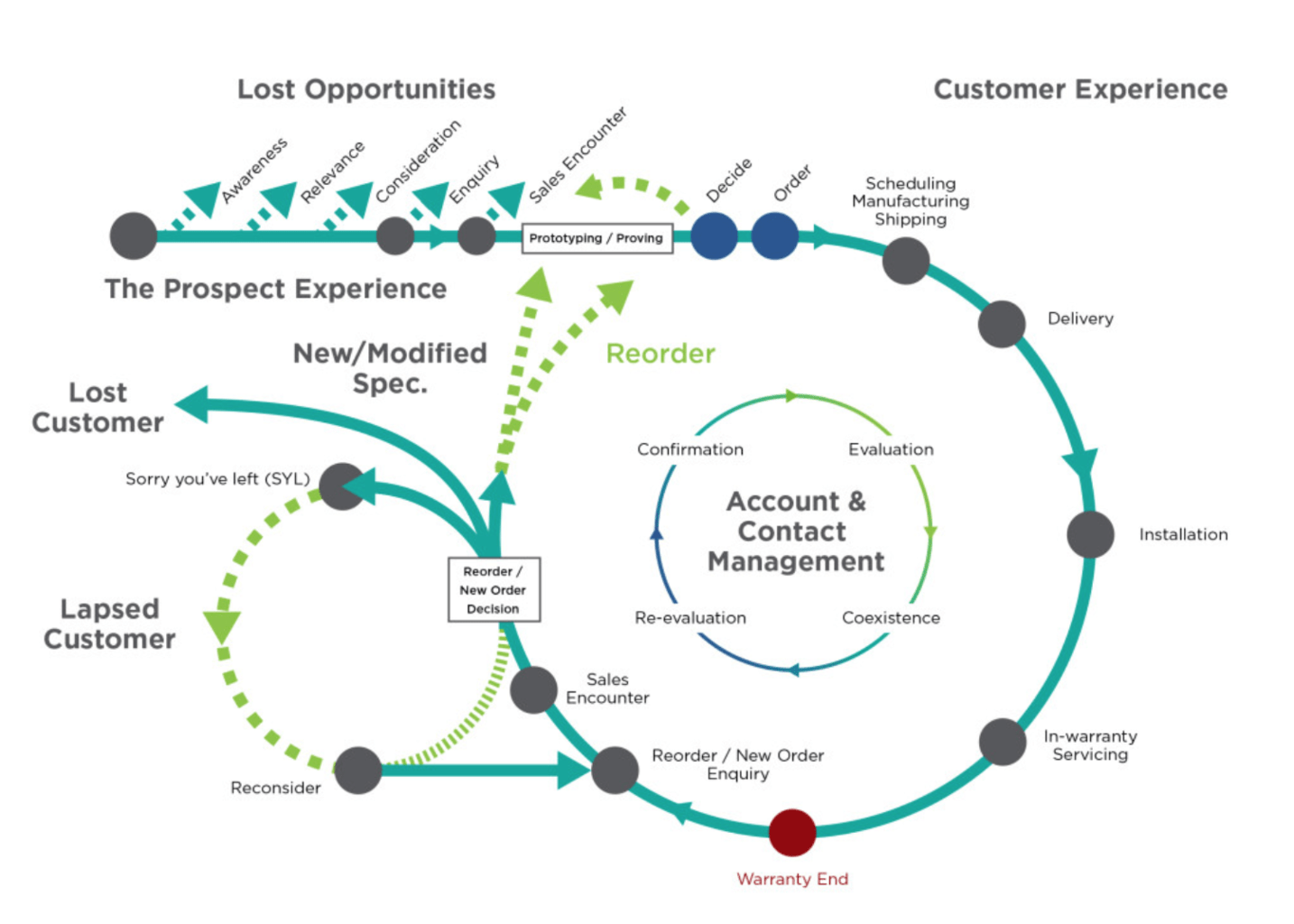
This next example doesn’t include details about the customer’s activities, thoughts, or feelings, but it is notable in that it accounts for many different outcomes—including churn and reevaluation. If these are important considerations for your team, you could adapt this format to provide more insights into the customer’s state of mind at each stage in their journey.
This customer journey map example from Zendesk accounts for customer churn and reconsideration.
Other types of UX maps
In addition to the five categories of customer journey maps covered above, there are two more types of UX maps worth mentioning here: empathy maps and customer experience maps.
An empathy map is a tool used to create a shared understanding around the wants, needs, thoughts, and actions of a certain type of user. While not strictly a prerequisite for creating a customer journey map, you may decide to create an empathy map as part of your journey mapping process.
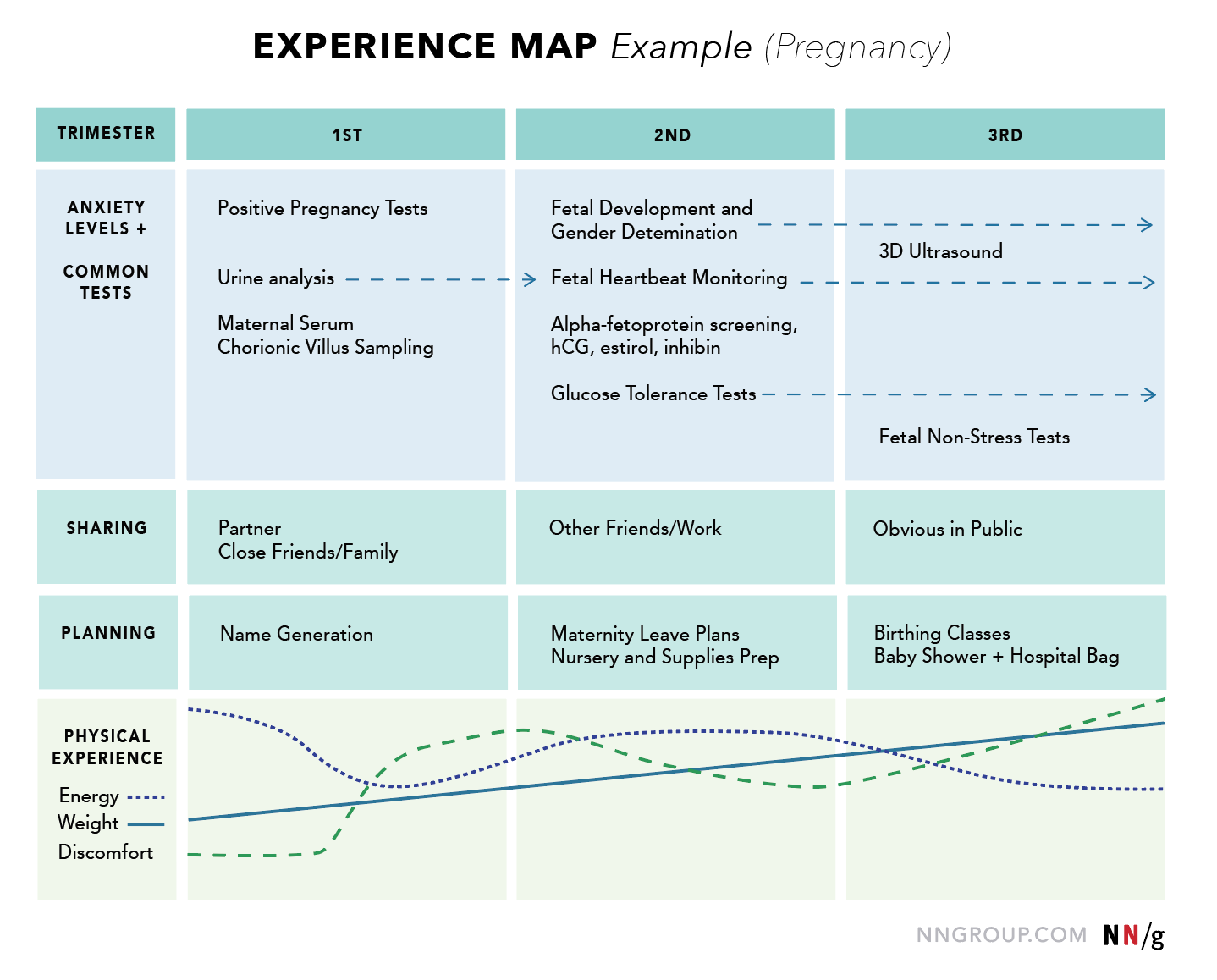
A customer experience map is used to understand human behavior as it relates to a certain topic or experience, but with no specific business or product in mind. Experience maps help visualize what the average person goes through in order to achieve a certain goal.
Like day in the life maps, customer experience maps provide contextual, anthropological insights that help you better understand your customers as people.
An experience map that visualizes the “generic” experience of pregnancy. From NN/g.
The good news: There are lots of tools available for creating customer journey maps, from popular prototyping software like Figma and Sketch, to dedicated CJM tools like UXPressia or Custellence, to good ol’ Powerpoint and Google Slides.
The better news: There are plenty of customer journey mapping templates available, regardless of the tools you choose.
Sure, you could create one from scratch. But why try to reinvent the wheel? You’ll save time and effort by finding a template that matches your needs and customizing it for a perfect fit.
We’ve rounded up some of the best customer journey map templates to make your search even easier. The simplest templates are listed first, followed by more intricate designs.
1. Current state customer journey map template
Sometimes, all you need is a nice, simple grid. Download this PDF and annotate in your tool of choice, or simply create your own table. You can also print this image out and fill it out with your team.
💾 This template is free to download.
2. Simple customer journey mapping PDF template
This is another ready-made customer journey map template from Nielsen Norman Group to print out, digitally markup, or replicate with your prototyping tool of choice. We like this template because it contains all the most important elements for an effective and actionable journey map.
💾 This template is free to download.
3. Minimalist customer journey grid template
Here is yet another simple journey mapping template that combines the fields from the two examples above in a clean grid format. This template offers a lot of flexibility—you could add visual elements, create a line graph in the feelings row, or keep it text-only, depending on the needs of your team.
💾 This template is free to download.
4. Day in the life customer journey mapping template
This template from HubSpot is another simple grid, made especially for a day in the life journey map. Instead of different journey stages, the columns represent times in the day. HubSpot also offers similar templates for current state, future state, service blueprint, and buyer’s journey mapping.
💾 This template is free to download.
5. Customer journey map template for PowerPoint or Slides
This is an easy-to-edit template for a more visual customer journey map. The centerpiece of this template is the emotional state line graph, but there are also sections for user needs and expectations and customer quotes. What’s great about this template is that you can edit it in PowerPoint or Slides—no design skills needed.
💾 This template is free to download.
6. Flexible customer journey map template for Figma
If Figma is your prototyping tool of choice, you can jumpstart your journey mapping with this editable template. The template is flexible, so you can keep the linear design or use the elements in conjunction with one of the simple grid templates above.
💾 This template is free to download. Figma comes with a free Starter plan, and paid plans start at $12 per editor per month.
FlowMapp offers dedicated tools for several UX deliverables, including customer journey maps. This template, which you can preview here, has pre-built blocks for each section of the customer journey map. We like this template because of the emphasis it places on the voice of the customer, but there are several other options to choose from as well.
💾 Your first FlowMapp project is free. Pricing for a single user starts at $15/month (currently discounted to $8.25/month, billed annually).
8. Circular customer journey map template
Depending on your business model or customers’ behavior, you may find it more useful to visualize the customer journey as a loop or flywheel. This persona-based template does a nice job of depicting both the customer’s fluctuating sentiments, as well as their cyclical journey from consideration to purchase and back again.
💾 This template is actually just a .jpg image, so you’ll need to replicate the layout with your design tool of choice.
9. Offline retail customer journey map template for Sketch
If you’re a Sketch user, we recommend checking out this tidy customer journey mapping template. It’s part of a bundle of four different journey maps, each of which allows for plenty of detail without becoming visually cumbersome.
💾 This template is free to download. Sketch pricing starts at $99 (one-time payment) for individuals, or $9/month per contributor seat for teams.
10. Service blueprint template for Lucidchart
If you want to create a service blueprint as a complement to your customer-focused journey map, we recommend checking out this template from Lucidchart. Like the service blueprint examples in the previous section, the template is divided into four layers, which are separated by lines of interaction and visibility.
💾 This template is free to use as part of Lucidchart’s Free plan, which includes three editable documents and 100+ templates. Individual plans start at $7.95/month.
11. Customer journey layer map template for PowerPoint
This customer journey map format emphasizes the organizational layers responsible for each stage of the journey. This template is one of 36 editable PowerPoint slides included in this pack of CJM templates. There’s a ton of variety—if nothing else, we recommend checking out the slide previews for inspiration!
💾 This template is part of a 36-slide package that costs $15 to download.
12. UXPressia customer journey mapping template for multiple personas
UXPressia is a dedicated platform for creating and collaborating on customer journey maps, impact maps, and personas. They have dozens of templates in their library, organized by use case. This template will help you map out the customer journey as it’s experienced by multiple customer personas.
💾 Your first project with UXPressia is free. After that, pricing starts at $16/month per user, billed annually.
13. SaaS support customer journey map template
This is another template from UXPressia. This CJM template is tailored to a specific use case: the customer support journey of a SaaS customer. You could adapt this template to fit a similar use case, or see if UXPressia's library has a ready-made example for your exact scenario.
💾 Again, your first project with UXPressia is free. After that, pricing starts at $16/month per user, billed annually.
14. Editable customer journey map PDF template
This template is designed to help teams align their customer journey mapping exercise with business needs. There are rows for business goals, KPIs, roles responsible, etc. We love that this template is an editable PDF—it makes it super easy to fill out. Unfortunately, the column and row headers are fixed, so you’d need to make your own version of this template if you want to mix it up.
💾 This template is free to download.
15. Customer journey mapping stencil for Omnigraph, Visio
This one’s a doozy. Available as an Omnigraph stencil, Visio stencil, EPS, or SVG, this customer journey mapping template is best suited for complex journeys with many touchpoints, or for when you need to provide a lot of visual information to your stakeholders.
💾 This template costs $12 to download from the creator on Behance.