Tuesday, May 23, 2017

How to Create Personas and Map Content to the Buyer Journey

To succeed at content marketing, you must understand your audience.
Content starts and sustains conversations with customers. But in order to have a meaningful dialogue, you need to know to whom you’re speaking.
“Developing buyer personas” is what marketers call the process of figuring that out. 
But I’d argue that developing buyer personas is just one part of the content marketing equation – you need to research how your audience consumes content, as well.
Let me put it this way: Developing personas, understanding their buyer journeys, and mapping content to the different stages of the journeys all contribute to content marketing success. You can’t have one without the other.
Let’s analyze each step. 

Developing Buyer Personas

I love this description from Ardath Albee: “A marketing persona is a composite sketch of a key segment of your audience. For content marketing purposes, you need personas to help you deliver content that will be most relevant and useful to your audience.” 
Developing buyer personas is critical to determine:
  • What content to create
  • What tone, style, and delivery strategies to develop
  • What topics and targets you should focus on to grow your business
  • Who needs to be in-the-know on your projects, now and in the future
How many personas do you need to create? I recommended three to five. That number is large enough to cover the majority of your customers, yet small enough to be specific. Plus, more than five personas may bring serious cost challenges. 
When I led content marketing strategy for the IT Division of Schneider Electric, we selected five personas. They covered most of our customers: Data Center Professionals, IT Professionals, IT Resellers, Facility/Plant Managers, and C-Level Executives. They also accommodated our existing content, campaigns, and budget.
Personas commonly include:
  • Demographic information (age, income, location)
  • Background (job, career path, family)
  • Key responsibilities 
  • Pain points
  • Key purchase drivers
  • Places they’re most likely to find information
  • Preferred content formats (blog posts, videos, social media posts, e-books)
  • Role in making purchases (influencer, purchaser, final decision-maker)
However, your personas may cover less. Not all B2B personas will need everything mentioned above. Since the average B2B buying decision involves three or four different departments, usually led by IT and finance, B2B brands can focus on segmenting personas by company role to address specific departments. 
It’s important to invest time and resources to get your personas right. Content marketing can actually fail when built upon faulty buyer personas that, in turn, create a weak strategic foundation. This happens when marketers develop personas based on a wrong hunch or guesswork. 
Where do you get the information to create accurate personas? There are many sources, from the details logged in your site statistics, to actual conversations with real-life customers. Here are some important sources to consider:
  • Direct questions to your audience: Interviews, surveys, or quick polls are good ways to get insights. Craft your inquiry to gather data most essential and relevant to your persona development. 
  • Search Engine Optimization (SEO) data: This can be a great source, but you have to know what to look for – otherwise, you risk being flooded with data and no actionable insights. Jey Pandian’s 10-step guide to create precise buyer personas with SEO data is an amazing resource to walk you through the process.
  • Tools like Google Analytics: Use your analytics systems to compile demographic information about your audience and the topics that resonate with them.
  • Internal knowledge: Your sales, marketing, and customer teams will have insights on who your target audience is and what content interests them.
  • Social media: Tap into online conversations to learn what information people seek.

Understanding the Buyer Journey

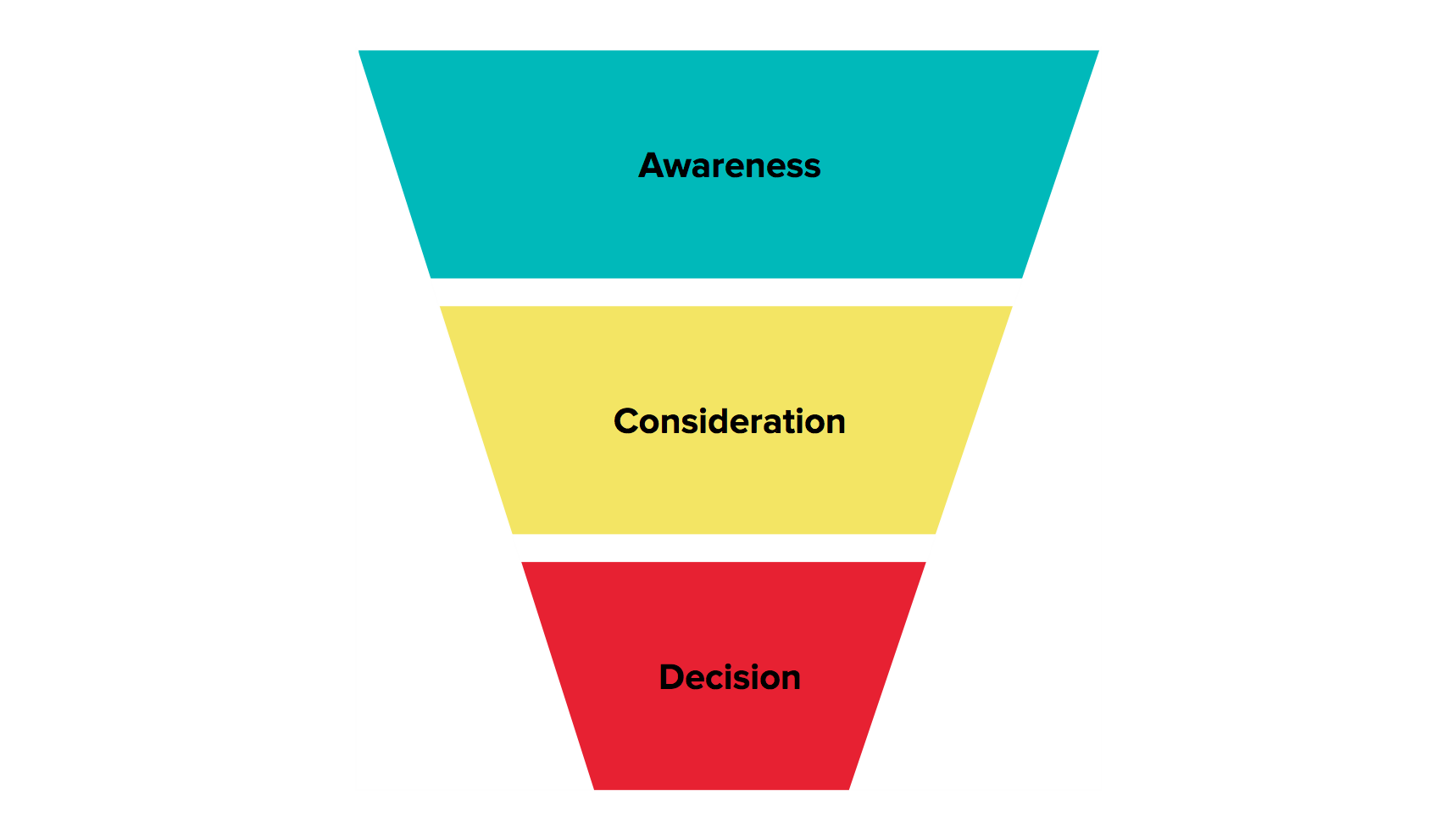
The buyer journey is the process people go through to gain awareness, evaluate, and purchase a product or service.
Since that journey can be extremely complex, we tend to simplify it to a few stages, which are generally valid for both B2C and B2B environments. Let’s not forget that within each stage, there are multiple, non-linear steps: 
  1. Awareness Stage: The buyer realizes he/she has a problem and starts searching for solutions.
  2. Consideration Stage: The buyer evaluates different options to solve it.
  3. Decision Stage: The buyer selects a solution.
Buyer Journey.png 
In some situations, you might find two additional stages:
  • Retention Stage: The buyer starts using the product/service and seeks guidance from the vendor or a user community.
  • Advocacy Stage: The buyer spreads the word about the product – regardless of his/her opinion being positive or negative.
Content marketing can influence each stage. To simplify our content analysis, we will focus on the first three stages, but you should not forget about the last two. 

Mapping Content to the Buyer Journey

Once you have identified your personas and defined which stages of their buyer journeys are relevant for your content marketing model, the natural next question is: How do they prefer to consume content? And which channels will they use?
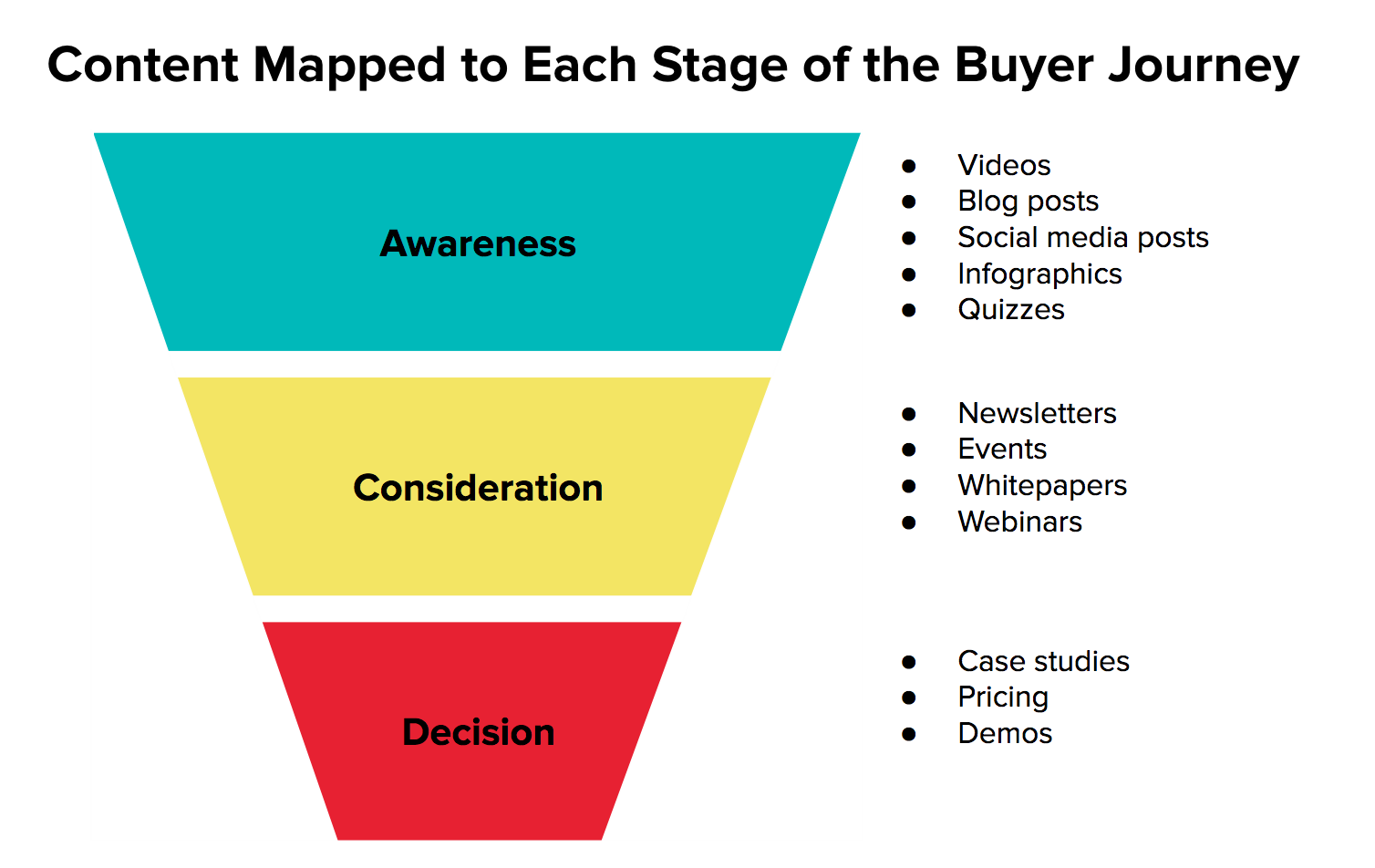
It’s time to map the content you can deliver throughout the journeys to move people closer to your goals. Your messaging for each stage will vary. You might also want to associate content distribution channels (social media, search, email newsletter) to each stage. That way, you’ll define “where” in addition to “what” content is consumed.
A few tips for each stage:
  • Awareness Stage: Focus content on buyers’ pain points – not your product or brand. Educational and inspirational content like blog posts, guides, and industry reports are going to be critical. Also, prioritize SEO: Once your buyers realize that they have a particular problem, they’ll turn to Google to research.
  • Consideration Stage: When creating content for this stage, I recommend that B2B brands speak the language of the C-suite. This is the stage where executives will need to approve business cases and budget. The amount of time B2C buyers will spend in this stage will vary, depending on the business. Some products, like packaged food or inexpensive clothing, require little consideration. Others, like cars and pricey vacations, demand more time. Either way, B2C brands can benefit on nurturing consumers with engaging content.
  • Decision Stage: It’s time to get brand-specific with your content: Product features and demos, customer testimonials. Also, you might want to simplify payment methods for prospects ready to buy.
 Content Mapped to Buyer Journey.png

Conclusion

A few additional tips to keep in mind: Be consistent with your messaging and content over time. Don’t go with more than one message per audience type. And refresh your personas from time to time.
According to Anna Ritchie, “Whether your content marketing program is targeted to B2B or B2C audiences, one thing will ring true when it comes to old assumptions: your audience, like your strategy, could be undergoing its own continual shifts, evolutions, and transformations, as well. This can certainly affect the buy personas you have created in the past.” 

Monday, May 15, 2017

#SocialSkim: Facebook's Netflix-Like Shows, Algo Change; Snapchat's Scary Slump

This week's 'Skim is all about global growth: Facebook eyes high-quality, original, TV-like shows for as early as this summer; Snapchat's earning report ghost scares investors with growth concerns, and the company releases a suite of new features to combat Instagram; Facebook's latest algorithm change will affect how you share links; Instagram eyes global markets with a brand-new Web sharing feature; the upcoming trend of niche social media platforms; and much more...
Skim for this week's social media digest!
1. Facebook reportedly planning TV-like shows for June
The social network is getting serious about its original-content offering. It's reportedly preparing to premiere up to two dozen TV-like shows in June, and has already greenlit production for several of them.
Facebook is apparently interested in not only in shorter, 5-10-minute shows that would refresh on a daily basis but also longer, more expensive productions (like "House of Cards") made for a home viewing experience—such as via the new Facebook app that brings its video platform to a TV screen near you.

Click Here!
Multiple people briefed on Facebook's latest endeavor say the company has tapped several A-list celebrities to join the shows, so it's clear that the social network's becoming serious about taking on the likes of Netflix, Amazon, YouTube, and Snapchat.
2. Facebook's latest algorithm change means you need to watch what links you share
Facebook is reducing exposure for what it considers low-quality websites in users' News Feeds. Accordingly, Web pages with lots of spammy and shocking ads, or little substantive content, will be devalued in the social network's algorithm and rendered ineligible to become an ad.
The move comes as Facebook continues its fight against fake news and aims to decrease the economic incentive of financially motivated spammers. Brands that don't share low-quality links should see a slight bump in traffic, whereas targets of the algorithm change will see their posts demoted.
3. Snapchat growth disappoints, investors worry
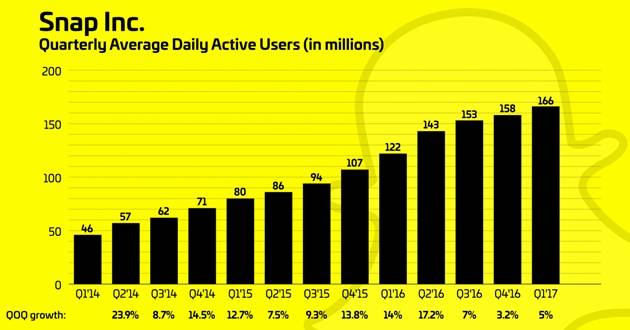
Snapchat's first earning report since going public didn't exactly inspire confidence in investors, who saw that the company's first quarter growth rate jumped only slightly, and that its year-over-year growth continued to decelerate.
Snap Inc. shares plummeted 24% following the news as details shed light on lackluster growth outside of the United States, and expanded fears that Snapchat could become the next Twitter.
The news could partly explain why the app unveiled a suite of new camera features we've outlined in story No. 7, below, so keep reading to see what's changed!
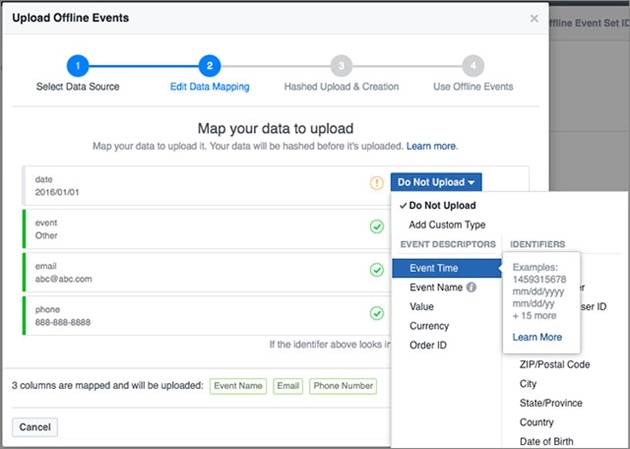
4. Facebook brings offline conversation data to Lead Ads
The social network's new Offline Conversion solution allows companies to connect their customer relationship management (CRM) systems, point of sale (POS) systems, and call center technology to Facebook's Ad Manager: You can now upload the physical-world outcomes of leads generated by Facebook campaigns into its Ads Manager.
Using the new capability, brands can evaluate the effectiveness of, and optimize the efficiency of, existing campaigns as well as create Custom Audiences based on that performance data to retarget lead customers or upsell based on where consumers are in the sales cycle.
To see how to use Facebook's new Offline Conversation solution, get startedhere.
5. Eyeing global growth, Instagram enables Web sharing
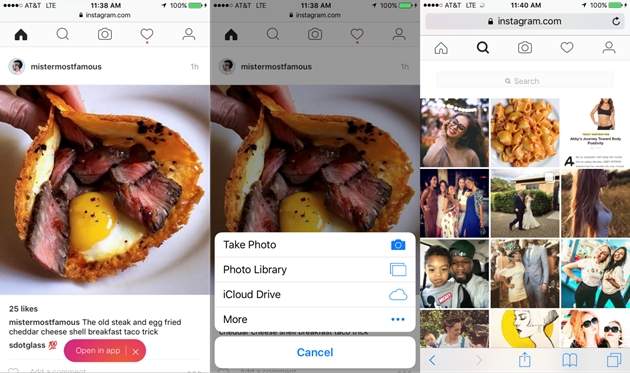
Instagram wants to grow faster, so the social network built features that will allow users with data limitations to upload and share photos on their Instagram accounts via its mobile website.
Users in international markets, where networks are slow and data is expensive, now don't have to download the app to take part in the fun. Until now, users could access the mobile Site but were only capable of viewing photos, liking posts, following users, searching for content, and seeing notifications.
Instagram's Web sharing move is aimed at the 80% of its users who live outside the United States, and looks as if it will help the app expand as it reaches saturation in top Western markets.
6. Facebook rolls out Chat Extensions on Messenger
Messenger users now have a few new tools at their disposal to make their group conversations with friends a bit more interesting. Facebook began rolling out Chat Extensions, a new way for members in a group chat to include services from the likes of Spotify, OpenTable, The Wall Street Journal, and more, in their group conversations.
Users can simply click the plus sign at the bottom left corner of their Messenger app to unveil the businesses and make a selection. Want to share a song from Spotify so all in the group can listen? Done. Need to share the latest updates from the big game? Select theScore's Chat Extension to pull content directly from their website into your conversation.
Chat Extensions appear to be Facebook's way to bring its Messenger platform closer to the likes of WeChat, with tons of tools and applications in one, and we like what we see so far.
7. Snapchat unleashes new camera tools in continuing race to the top against Instagram
Long for the days when Instagram and Snapchat were two distinct social media platforms? Well, get over it. Snapchat this week introduced a few new video features meant to keep it competitive in today's cutthroat, Snapchat-copying social media world.
The camera app introduced Limitless Snaps, Looping Video, and a new magic eraser tool, for starters:
  • Limitless Snaps lets users send images to friends without a countdown clock, meaning they won't disappear until the recipient decides to click away.
  • Looping Video gives users a way to give their Snaps a Vine-style makeover.
  • The eraser tool enables Snapchat users to erase parts of their images by simply brushing over them.
We're sure Facebook's Instagram is already at work in development.
8. Facebook emulates Twitter with new "Latest Conversations" feature
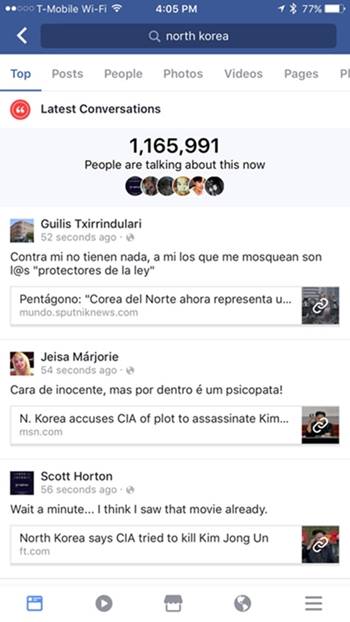
Search results on Facebook just became a whole lot more Twitter-like, with a new section called Latest Conversations showing public posts about trending topics.
The ability to see public posts isn't new, but the new design and section includes a counter that updates in real-time and displays how many people are discussing buzzing topics.
Latest Conversations seems to be another attempt by Facebook to expose users to views outside of their social circle, hopefully helping the social network evade further criticism about serving as an echo chamber for users whose News Feeds merely reinforce the viewpoints they already hold.
9. Are niche social media platforms a new trend?
Are Facebook, Twitter, Instagram, Pinterest, and Snapchat just too big to stay interesting, or to generate the type of passionate connections brands hope for among their customers? Major League Baseball (MLB) and Tumblr think so, and have thus developed niche social media apps Infield Chatter and Cabana to fix that problem.
MLB's Infield Chatter provides a platform for true baseball fans to gather and share, and boasts a team of human workers who monitor the platform for trolls and spam—something the sheer size of Facebook doesn't let it do effectively. Tumblr's Cabana encourages users to watch videos together—not the first app of its kind, but much more specific in scope than Facebook.
Niche social media apps could be a way for brands to capitalize on their most avid fans and advocates, and we think it's a space to keep an eye on as more begin to make the rounds.
10. We'll wrap with the incredible connections social media can build
You may know Nicki Minaj as a rapper, but what about as a godsend for those who can't afford their college tuition? The singer took to Twitter last weekend pledging to help fans pay their bills if they can prove straight A's, an incredible act for her fans and proof that social media can do more good than we sometimes give it credit for.
The starlet spent an evening verifying roughly 30 users' requests with their colleges, offering to pay off thousands of dollars in tuition fees or loans. Tweets rolled in from across the world, and Minaj responded to some requesting contact and bank information via direct message on the platform.

Amid all of turmoil between fake news and livestreamed shootings, it's nice to occasionally reflect on the positive effects social media can have.

Thursday, May 11, 2017

Why Company Culture is MVP of adidas’ Content Strategy: Q+A with Frank Thomas

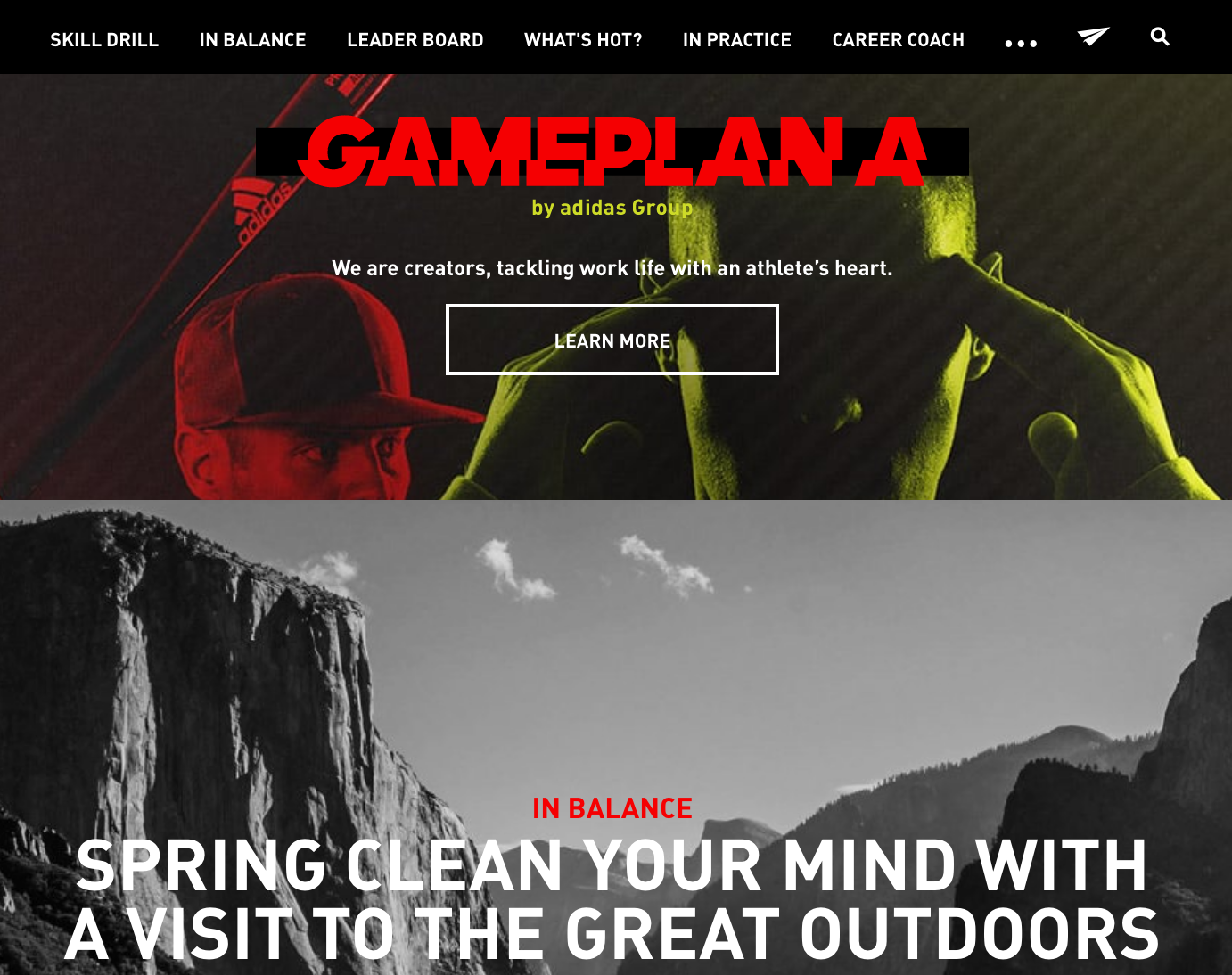
For the past several months, adidas has built up GamePlan A, its digital magazine focusing on the intersection of sports, business, and lifestyle. 
The goal of GamePlan A is not, however, to drive readers to eventually purchase running shoes or track jackets. 
Rather, it’s to engage and retain employees, and build a unifying company culture through content that “tackles work-life with an athlete’s heart,” according to Director of Content Strategy and Content Marketing, Frank Thomas.
 frank-thomas (1).png
Frank Thomas, adidas’ Director of Content Strategy and Content Marketing
We connected with Thomas for a pre-game chat (before his upcoming talk at #ThinkContent Summit) about GamePlan A’s content strategy as it approaches its one-year anniversary.
Most content marketing is geared toward the consumer. What was behind adidas’ decision to focus inward?
Adidas also has content that is consumer-facing, but what our team deals with is the company behind the brands. We’re focused on a very different, but just as important, target audience.
In the past, we tried to serve all target audiences through content marketing, from investors to journalists, employees, and potential candidates. But we realized we were all over the place. We rethought the entire setup and who we needed to address, and decided it is the employees, potential candidates, and, in general, like-minded people who can become advocates for the brand.
We had to figure out the link between all of these groups, and we identified it’s the culture that unites them. We’re lucky to have a culture where people from all around the world come together, inspired by sports. Even outside of the company, there’s definitely a target audience of people like us, and nobody was really addressing them. 
We’re not defined by demographics. What’s more important is the audience’s values and the convictions they live by. We can create pride internally for our employees, address the culture we want to foster even more, and at the same time, speak to an external audience.
And that’s how we came up with GamePlan A – if you are an athlete, you don’t stop being an athlete at the office. It’s an approach to how you work, and that’s the community we want to build.
Screen Shot 2017-05-02 at 6.42.20 PM.png
What are your goals since you’re not directly trying to drive sales or conversions like many other content marketers?
We are genuinely interested in driving relationships with like-minded people who have a culture that is compatible to ours. The ultimate goal is to build advocacy. That’s also a key goal of our strategic business plan, “Creating the New.”
The other thing that plays into that is our core belief that through sports, we have the power to change lives. We can express that belief by focusing on working life. It’s had an effect on our own culture and built the basis for long-lasting relationships outside the company. It opens up the advocacy funnel.
So how can you measure success when you’re talking about advocacy?
Overall, advocacy is tough to measure. We just launched in May last year, so we want traffic, but more importantly, quality traffic.
We care most right now about on-site engagement – so things like time on site, achieving a good bounce rate. Community growth, on-site behavior, and attention, in general, are the main metrics we are measuring.
What kind of buy-in did you get for this strategy, and were there challenges?
It was both a challenge and an opportunity for us. Our ambition was to live up to a strategic business plan that was still fairly new when we were in the development phase of our content marketing strategy (in 2015). By documenting our strategy, it created more clarity for our work as a corporate communications department. The alignment with the business plan also created more buy-in for the work we do.
For instance, a key pillar of the “Creating the New” plan is the people and the culture. This is clearly something we speak to.
As for challenges, as a big organization, it’s not always easy to make it all work and it was important to us, to not only re-work our strategy but to also reflect this change in our department’s processes. It requires a continuous dialogue to explain all of this and why we are actually making the shift from branded content to content marketing­ – that we may not necessarily talk about adidas at all, as long as it’s related to the idea and culture we want to promote.
What’s your distribution strategy?
On social media, our most important channel is LinkedIn for the moment, and the company pages that we have.
The second most important is Twitter. We try to use our resources efficiently so we stick to a few channels and try not to be all over the place.
We’re working on improving our email marketing, and are also doing paid, like sponsored content on LinkedIn, as well as a bit of native advertising. There are a lot of tactics we use, but those are the main ones. We’re currently testing and looking into working with content discovery partners as well.
What advice do you have for other content marketers?
What was really important for us was to take a step back and rethink how we do things and what we want to stand for, and to document the strategy. That’s not new advice, but not many people are doing it.
I strongly believe that if we as content marketers make culture the driving force of strategy, we will be rewarded with longer-lasting relationships. The most efficient way of doing it is to connect your target audience to your organization’s culture.
In content marketing, we always try to create short moments of relevance, but relevance is fleeting. When my favorite soccer team scores a goal, it is only exciting until the other team scores. In other words, relevance comes in waves – all short moments. But if you don’t want to lose the audience in between, give them something to hang on to. The best way to do that is to connect your target audience to your organization’s culture – your values, ideas, convictions, and behaviors.