Monday, July 17, 2017

#SocialSkim: LinkedIn Custom Notifications, Facebook Monetizes Messenger:

This week's 'Skim: LinkedIn released a suite of new tools to help brands and other users customize notifications and keep their focus on only the important bits; Facebook rolls out ads globally within its Messenger app, and it moves another step closer to publisher Instant Article subscriptions; why marketers should pay attention to Snapchat's new Snap Map; how to generate B2B leads with LinkedIn's Sponsored InMail; why your business should prepare for emoji search; how social media is changing our eating habits; and much more...
Skim for the latest and craziest bits of the social media world!
1. LinkedIn notifications get new features, customization
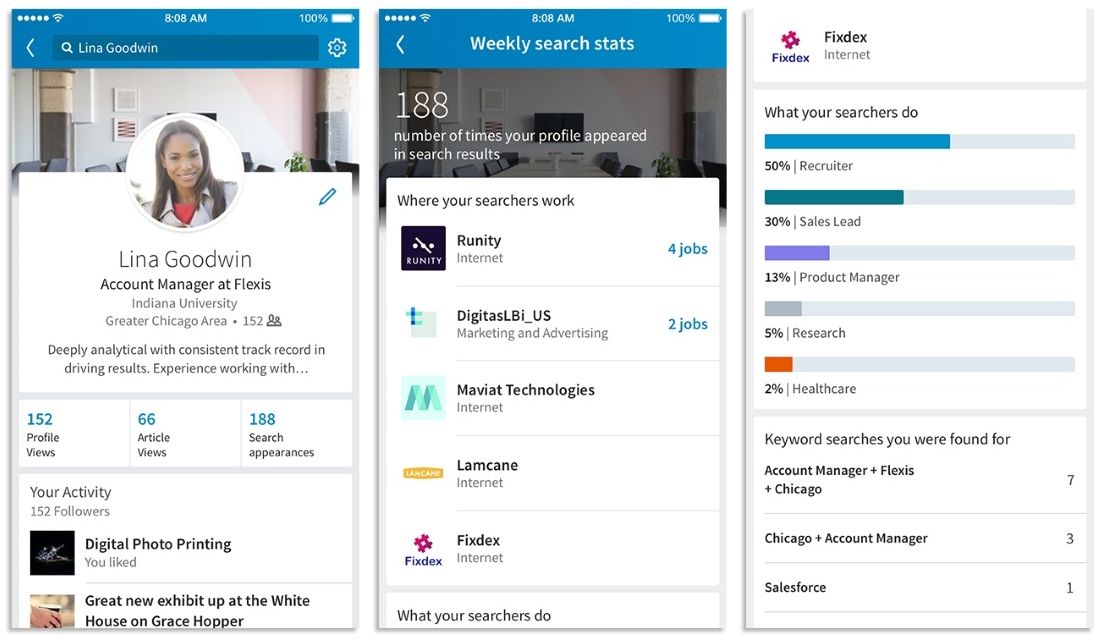
Marketers will be happy to see a suite of new customization options and features for notifications on LinkedIn, starting with the ability to mute or turn off notifications and unfollow specific connections' notifications without those connections knowing you've done so.
A new Daily Rundown notification will compile the day's most important headlines, and a new weekly notification will let users gain insights into how many people came across their profile via LinkedIn search.

All these additions should help your brand stay on top of its most important leads, and reduce the background noise your social media marketers might have to deal with.
2. Facebook rolls out ads in Messenger globally
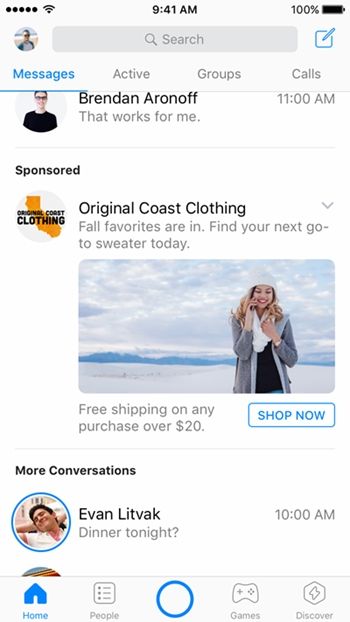
The world's biggest social network announced on Tuesday that it's globally expanding what it calls Home Tab Ads within the Messenger mobile application, a new ad format that places sponsored ads between the conversations listed on users' Messenger home screens.
Facebook tested the new product in Australia and Thailand in January, and it now appears to be pleased enough with the results to move forward with worldwide expansion. The move comes as the social network continues to grow its revenues, which hit $7.9 billion in the first quarter of 2017.
3. Emoji search is coming, and here's why you shouldn't ignore it
Why type "restaurants" into Yelp and then scan through the list to find a BBQ joint that serves pork when one can search for an eatery nearby that serves it simply by using the pig emoji? With 96% of 18-34-year-old smartphone users in the US using emojis, more brands are jumping on emoji search, and it'll probably only get bigger.
Twitter, Instagram, Google, YouTube, and WhatsApp have all added the ability for users to search via emoji.
Although the technology to provide highly accurate results is still a work in progress, brands are likely to continue playing to give users a fun new way to express themselves.
Looking for inspiration? Check out how Kayak and other brands have already ventured into the emoji-search abyss.
4. Facebook plans publisher-led Instant Articles subscriptions
Facebook readies to shake up the publishing world once again: By the end of the year, users should be able to pay Facebook to subscribe to a batch of publishers' Instant Articles content.
Though publisher pay models differ, Facebook's plan seems to support metered paywall and freemium ones, meaning users will either be forced to subscribe after viewing a certain number of Instant Articles from a given publisher or have free access only to a basic package.
What's still undecided, though? How payments will be handled, and whether Facebook will take a cut of the subscription revenue.
Publishers might be more keen to participate than before, because the social network is reportedly open to giving them access to all subscriber data and leave them in full control of pricing.
5. Why marketers should pay attention to Snapchat's new map feature
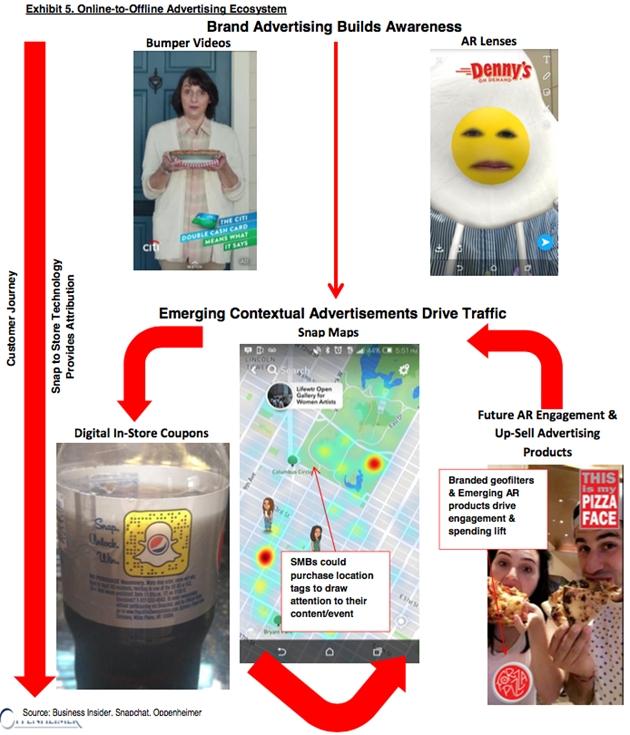
It's super-cool to play with, but that's not the only reason your social media marketing teams should be taking notice of Snapchat's new Snap Map. The new feature locates users on a worldwide map with instant access to their Stories, as well as crowdsourced content from anywhere on the planet.
To show just how effective it could be, Oppenheimer's chart of an online-to-offline advertising ecosystem (see image, below) portrays just how Snapchat could be on its way to to building a powerful marketing tool to enable brands to advertise to users based not only on time and location but also on places those users visited in the real world.
This should be one to watch, especially if Instagram comes up with a similar tool in the coming months. And we're pretty sure it will.
6. How to generate B2B leads with LinkedIn's Sponsored InMail
Sponsored InMail can spark immense benefits for your B2B brand and drive quality leads, but many organizations have yet to take advantage of this LinkedIn tool. By layering your targeting on LinkedIn, you can pin down the perfect audience that enables you to serve an ad, or InMail, to (for example) someone who works in a marketing capacity at an information technology company with less than 500 employees.
From establishing your targeting and segmenting to getting your messaging right and including the best calls to action, MarketingLand has a need-to-read piece on one of the most powerful social media tools you're not yet taking advantage of.
7. Facebook testing cover photo Page descriptions on desktop
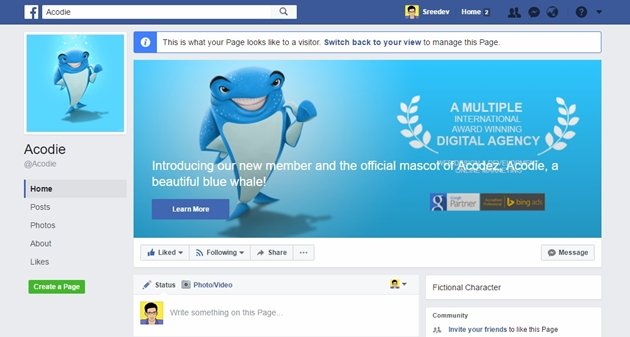
The social network is testing a way for page managers to add 100-character long descriptions to their cover photos, providing a new way for brands to communicate with followers on the platform.
The feature is only a test for now. Page administrators can edit the text using the Edit Information button on their cover images.
Although the idea is nice, the incredibly limited options in terms of font, color, size, and more keep the new page descriptions near the bottom of our list of exciting new Facebook features. Has your social media team given it a spin?
8. Instagram rules video engagement, it turns out
A recent report from benchmarking firm L2 Inc. shows Instagram killing the video engagement game, coming in at a 16% engagement rate in the first quarter of 2017 compared with Facebook's 1.5% and YouTube's 0.3%.
Despite those stats, Facebook still led the way in total views during the same period, with 18.8 million, on average, for the surveyed brands. YouTube's and Instagram's 14.8 million and 5.2 million views, respectively, were second and third.
The L2 report analyzed 60,000 videos and 293 video campaigns for 201 brands, surveying the videos deployed on social media, websites, mobile, and TV. It found that Facebook is the best platform to increase reach, while YouTube offers better organic view rates.
9. WhatsApp readies recall feature for primetime
If you're using WhatsApp to communicate with your customers, whether for customer service or special offers and deals, an important new capability is likely on the horizon. The social messaging app is reportedly ready to roll out a new message recall feature in its next major update. In other words, users will likely be able to edit or revoke a sent message.
Spotted on the Windows Phone beta version of the app, the new feature is said to work by pressing and holding on the sent message, and will probably only work if the recipient hasn't already opened and read the content. Any official updates or rollouts of such a capability are still unconfirmed.

10. We'll wrap with how social media is changing the way you eat
You probably never thought social media had the power to change what you eat for dinner, but experts say it's doing just that. From Starbucks #UnicornFrappuccino to gold-laden donuts for $100, social media is transforming consumers' preferences and making restaurant brands think twice about how they present their food and how they can get more bang out of their buck by making products go viral.

Some say social has become a more disruptive influence on the restaurant industry than global markets, and it seems consumers are now demanding new twists on old favorites due to the influence they've been exposed to online, from best friends' Snaps, to digital influencers' sponsored posts. What a time to be alive.

Tuesday, July 11, 2017

There is life beyond 30 Who has 30 seconds? Not today's consumers. Here's how to get them to engage.9

image: http://cached.imagescaler.hbpl.co.uk/resize/scaleWidth/743/offlinehbpl.hbpl.co.uk/news/OMC/red-bull-20170614104048666.png
Red Bull and Adidas partnered to bring audiences a live broadcast at the Primavera Sound festival
The marketer of today can only dream of the simplicity of bygone days when a 30-second TV ad was the ultimate panacea. Long boozy lunches with Mad Men have been replaced by meetings with data scientists and social media experts.
Life after the 30-second advert is a nebulous and confusing affair, but is also a hugely exciting time due to opportunities created by media channels and technology colliding.
Changing consumer habits have only accelerated the fragmentation of the media and made it harder to capture the attention of audiences and keep them engaged.
"There's been an explosion of video content choices, and so what is happening now more than ever is that we are not just competing against other platforms and networks, we are competing for what is arguably the most important asset – people’s time," says Turner Broadcasting chief executive John Martin.
However, the rewards are incalculable for the marketers that are prepared to embrace innovation.

The inexorable rise of social media has given birth to a generation of influencers, technological advancements have allowed ever more personalised messaging with consumers, while the explosion of data no longer needs to be overwhelming thanks to Artificial Intelligence (AI).

On the flip side, technology has helped propel a demand for off-line experiences that delight the senses, which are in danger of being dulled by digital immersion.

In this brave new world, brands are increasingly realising the potential of striking partnerships that a few years ago would have not been considered.
"There has never been a more intellectually challenging and stimulating time to be in our industry," says Martin. "That is why our ability to innovate will be the key to our future."
Campaign explores five ways brands can complement their traditional marketing methods to help them capture the attention of increasingly elusive consumers.

1. Personalisation

The fragmentation of media has thrown up its fair share of challenges but it also means marketers have never had as many tools to weave a story that resonates personally with a consumer.
Brands can deliver deeper and more targeted connections as new social media platforms burst on to the scene and technological innovations, such as AI chatbots, emerge.

This has led to an era where brands are building knowledge of their consumer that previously would have only been privy to their best friend.

This enables staggering levels of personalisation but the key is to avoid the "crap trap" tha marketers can fall into due to the growth of marketing technology, as described by P&G chief brand officer Mark Pritchard. "The issue with personalisation is that we don’t create a whole bunch of ads that are hyper targeted, hyper relevant but hyper boring or naff," says PHD worldwide strategy and planning director, Mark Holden. "We have to be really cognisant of that and make sure we don’t stray off brand in an effort to be too personalised."

Donna Speciale, president of ad sales at Turner, believes that to keep true to a core vision "experiences need to lend itself to the platform". She adds: "What we end up doing on mobile needs to be different to what we are doing on the big screen."
image: http://cached.offlinehbpl.hbpl.co.uk/news/OMC/richedit/conan.png
TBS’s late night talk show Conan and sponsor AT&T created an augmented reality campaign that piggy-backed off the Pokémon Go craze in a demonstration of how to effectively adapt messaging using the latest tech. The multi-faceted campaign was created to be "all about fun and the fan" to resonate with Conan’s audience, and was hosted on a digital landing page. It featured in-show integrations, all amplified by social. CNN’s Courageous has even hosted a conference on human augmentation – people turning themselves into cyborgs – to appeal to fans of a computer game (see boxout).

"What we end up doing on mobile needs to be different to what we are doing on the big screen" Donna Speciale, president of ad sales, Turner

2. Brand partnerships

The practice of advertisers treating their brand as a walled garden is lessening as they realise brand partnerships can be an effective weapon in the battle for consumer attention.
The power of the Red Bull brand means there is no shortage of marketers clamouring for access to its fans. Red Bull has taken a partnership with Adidas to a new level and, this year,the two brands put on a live broadcast of the Primavera Sound festival in Barcelona, while providing people with behind-the-scenes access to Adidas’ secret gigs.

Red Bull told Campaign: "Brands are starting to recognise the power of telling stories over shouting a message at the audience, which is why they’re increasingly looking for non traditional, strong storytelling opportunities and partnerships."

Holden believes there is a "lot of untapped potential" within the brand partnerships space. He highlights an Audi and Airbnb partnership as a very powerful example of the potential of brand tie-ups.

It involved offering fans the chance to book a luxury stay at a house in the middle of Death Valley in Nevada, with guests having an Audi R8 at their disposal during the stay.
Holden believes the unusual pairing of Audi and Airbnb was so effective because it "gives it more cognitive punch and also the association transference from the other partner".

Alongside the creative possibilities brand partnerships allow, they also have more practical benefits due to data sharing opportunities.

"Second party data is the big game in town and that involves going to non-competitive companies that you have some sort of synergy with and doing a deal," says Holden.
image: http://cached.offlinehbpl.hbpl.co.uk/news/OMC/richedit/audi.png
Audi and Airbnb’s co-branded experience was an instant success

3. Influencers

Much has been made of the democratising power of the internet and one facet of this is the rise of the influencer.
The use of influencers has become a media channel in its own right and individual influencers are now akin to a media network.

Katy Woodrow Hill, strategy director at youth-led creative network Livity, argues that despite this, influencers should be much more than just a distribution channel.

"Why start with the campaign idea forming originally from TV?" asks Woodrow Hill. "There’s some really interesting work with the idea and creative energy of the campaign starting online or with influencers."

Woodrow Hill highlights Adidas as an example of a brand rethinking the creative process by creating a music track starring influencers. The ‘Your Future is Not Mine’ video was then used as "cultural collateral" to build a wider campaign around it.

A growing trend is now to work with "micro-influencers". These are people that have followers in the thousands rather than hundreds of thousands or millions, but are being tapped up by advertisers because their passions and sphere of influence are more closely aligned to the brand. "The biggest impact we see is when we work with slightly smaller or more relevant influencers," says Woodrow Hill.
"Big macro-influencers definitely serve a role and get you reach, but perhaps does not get you relevance and accessibility or behaviour change. " Woodrow Hill concludes influencers are most effective when brands invite them to be part of the creative process "at the starting point rather than the end point".
image: http://cached.offlinehbpl.hbpl.co.uk/news/OMC/richedit/adidas3.png
Adidas enlisted lifestyle blogger and model Aleali May, singer and DJ Kyu Steed and artist Design Butler in their ‘Your Future is not Mine’ campaign

CNN’S COURAGEOUS & HUMAN BY DESIGN 
The partnership between video game developer Square Enix and CNN’s brand studio Courageous brought about an usual but highly successful campaign. Set in the year 2029, Square Enix’s Deus Ex: Mankind Divided game features a world split between people who have augmented their bodies with technology, and those who have not.
Courageous dug into the themes and realised human augmentation was already happening today and legislation has not kept up with scientific progress. To address this a ‘Human by Design’ one-day summit was put on featuring academics, ethicists and cyborgs discussing the future and ethics of human augmentation.
The event was teased by a 30-minute branded documentary that aired on Amazon Prime, streamed live on Twitch, and video content from the event was hosted across CNN’s digital and social properties. Week-on-week pre-sales of the game increased by 35% during the weeks of the documentary and conference, led by a 53% increase on Amazon. More than 50 articles were written about Human by Design, helping place Deus Ex: Mankind Divided in the middle of a larger cultural conversation.
image: http://cached.offlinehbpl.hbpl.co.uk/news/OMC/richedit/human-by-design.png
CNN’s Courageous explores the future and ethics of human augmentation
"Human augmentation was already happening today, but legislation hasn’t kept up"

4. Artificial Intelligence

Most brands are overwhelmed with first and third party data, let alone third party data, but help is on hand.
The rise of Artificial Intelligence (AI) has meant that Big Data can finally be put to effective use. One of the most interesting examples of this within the marketing world has been through McCann Japan using an AI creative director to help create a campaign for Clorets Mint Tab.
image: http://cached.offlinehbpl.hbpl.co.uk/news/OMC/richedit/ai-cd1.png
McCann Japan tells powerful stories through machine learning The AI CD mined databases of award-winning campaigns to help its human counterparts create the Clorets ad. "AI will enable human to process huge data instantly which was not possible in the past," says Shun Matsuzaka, founder and leader of McCann Millennials and creative planner at McCann Japan. "It won’t have any bias that humans would have, and it will provide a perspective that hasn’t been thought of before."

Matsuzaka believes the marketing industry is lagging behind the film and music industries when leveraging artificial intelligence to inform creativity. AI within marketing is currently being predominantly used for media planning and buying, but

Holden agrees with Matsuzaka that it will play an ever-increasing role in creativity. At the moment, Matsuzaka highlights how AI is more about machine learning rather than deep learning, which means it is unable to invent ideas. Nevertheless, machine learning is a powerful enough technology as discovered by lingerie brand Cosabella, which dropped its ad agency in favour of investing in AI technology.

The move is already paying off because Cosabella has increased web conversion rates by 38% after AI tech Ascend optimised the appearance and messaging on its website through a form of always-on A/B testing.

5. Experiential

With all the technological innovations it must not be forgotten that people still yearn for real-life experiences.
image: http://cached.offlinehbpl.hbpl.co.uk/news/OMC/richedit/waterfall.png
Westfield’s ‘Beyond  the Waterfall’ creates  real-life momentsCulinary events firm Bompas & Parr is a specialist in experiential marketing and co-founder Sam Bompas believes it is such a powerful medium because the experiences created "si deeply in people’s memories".
The ideas created can also form the basis of above-the-line activity – Westfield shopping centre based its Christmas campaign on the Beyond the Waterfall experiential campaign.

Real life experiences are now propelled to another level due to the rise of social media and influencers. "In an age where everyone is documenting their travels and amazing adventures, the likes of Instagram and other forms of social media became a really good tool for spreading a message," says Bompas.

This has reached such an extent that every design decision for Bompas & Parr’s ‘My Extraordinary Life’ project for Haagen Dazs was "predicated on allowing you to take Instagram images so you are undoubtedly having a more wonderful time than any of your friends." All visuals were based on the focal depth of smartphone cameras, and lighting levels were set so flashes do not go off.

Experiential can be used to create other creative assets that snowball to form a fully-fledged campaign. "You are doing experiential to get online content and then you share that further and get influencers involved so it becomes this building campaign," says Livity’s Woodrow Hill. "The question is always, how do you create something that is of a unit of culture in and of its own right?"

"The 30-second ad is still relevant, and is still a powerful medium," concludes Martin. "But what we are going to see is the evolution of the ad experience based on the emergence new platforms and devices. We are going to see more storytelling opportunities because what our data tells us is that quality content of any type will get viewers."

Television just got personal

image: http://cached.offlinehbpl.hbpl.co.uk/news/OMC/richedit/legg.png

Jeremy Legg, chief technology officer, Turner
"We’re developing technologies to reimagine TV and deliver more relevant and meaningful networks and ads, all with data-driven personalisation. We’re changing our entire broadcast technology stack to an IP infrastructure, migrating content to the cloud and infusing online and television data to deliver new fan capabilities.

"Once complete, we can create custom content that is tailor-made for every environment with quality, measurable audiences. In other words, instead of one network for all fans, we will offer personalised networks, ads and promos to build premium fan experiences across every screen.

"We’ve implemented audience-based targeting across linear and digital platforms, so we can sell audience targets instead of just Nielsen demographics, supporting an entirely new ad sales method with provable ROI.

"The shift to broadcast-over-IP will help guarantee outcomes to advertisers and predict future audience delivery to optimise campaigns. All this is designed to move the media and ad industries forward."
Topics

Read more at http://www.campaignlive.co.uk/article/life-beyond-30/1436426?utm_source=FB&utm_medium=cpc&utm_campaign=FBcpc#zdaKtXA9U06g71GT.99

Monday, July 10, 2017

#SocialSkim: Snapchat's Business-Friendly Features, Facebook's Transparency Metrics

This week's 'Skim: Snapchat adds key new business-friendly features in a bid to keep Instagram at bay, also makes On-Demand Geofilters easy; Facebook successfully completes drone test meant to bring Internet access to rural populations, and it launches new transparency metrics to increase brands' trust; boosting traffic the right way with Instagram Story Ads; how Instagram is driving sales for publishers and could for you, too; how teens use social media and what it means for the future; and much more...
Skim for the latest tips and tricks!
1. Snapchat adds links, voice filters, backdrops to Snaps
swarm of new Snapchat features was released in the app's latest iOS and Android update to help keep it one step ahead—or at least even—with Instagram.
The new Paperclip tool lets all users add links to their Snaps for followers to swipe up and open them in the platform's internal browser. Backdrops enable users to cut out a part of their Snap and place a colorful, artsy background behind it to make it stand out. And voice filters, previously only a part of certain augmented reality filters, let users remix the audio in any of their Snaps. The battle rages on.

2. Facebook successfully completes second drone test
The social media giant has officially completed the second test of its Internet beaming drone, Aquila. And this time it did it without crashing.
Facebook plans to develop a line of solar-powered drones like Aquila to provide Internet access to people in remote parts of the world. The successful test occurred in May in Arizona. It seems to push the social network closer to achieving its goal of connecting people everywhere. Via Facebook, of course.
3. How to boost conversions and traffic with Instagram Stories Ads
Instagram has expanded the capabilities of Stories Ads to meet four specific objectives for marketers, including not only video views and mobile app installs but also conversions and traffic. That's right, if it's done skillfully, you can actually send traffic to your website, optimizing for conversions and possibly boosting sales.
New calls to action and direct links to brand websites and apps mean businesses no longer have to hope that users track down their pages based on a fun Story they've posted, but that doesn't mean the new tools make getting them to the site foolproof. From selecting the right objective, to best-practices from those who've been there already and done that, Social Media Examiner has a great piece to give you a jump start.
4. Facebook rolls out Find Wi-Fi feature worldwide
Trouble connecting to Facebook out in the countryside? Data plan too limited? Facebook wants to help you stay connected to its platform, and so it's rolling out its new Find Wi-Fi feature worldwide on Android and iOS.
The new option, discoverable in the "More" tab at the bottom of the mobile app, alerts users as to the closest public Wi-Fi access points, and thus also helps them discover new local businesses. To appear on the map, businesses must first claim their Wi-Fi networks within the "Edit Page Info" tab on their Facebook pages.
5. Facebook aims to earn advertisers' trust with new transparency metrics
A series of mismeasurements exposed on Facebook eroded some marketers' trust in the reliability of performance metrics on the platform, and so it has announced additional metrics to increase transparency.
The first measures how ads increase website traffic by reporting how many people visit a landing page after having clicked on an ad, and another new feature, dubbed "pre-impression activity breakdown," will compare new visitors to old ones. Three other metrics: how many follows a page gets overtime, how many people reviewed a page without clicking on it, and how many times a user recommends a page to friends.
6. Snapchat wants everyone to create their own geofilters
In February introduced On-Demand Geofilters, which allow users to create their own Snapchat overlays and define a location and date range to run them. Now, the company wants to make it even easier for US users to make and purchase them, and lets users do so without ever having to leave the app .
Accessible via the settings section within Snapchat, the new section lets Snapchatters select from a list of preset occasions, customize their filters from a template, specify a time and location, and submit them to the company for approval.
Prices for On-Demand Geofilters start at $5.99, meaning it could be a great mechanism for your brand to include for its next B2B event or conference, or even that next office party you'll use to showcase your company culture on your blog or Instagram feed.
7. How teens really use social media, and what can it tell us about its future
Sometimes we might get so caught up in our own business-centric social media world that we forget to keep a finger on the pulse of the people who'll change it in the future. Recode's podcast "Too Embarrassed to Ask" did just just the opposite, and exposed some habits that could shift the social media landscape we're familiar with.
The podcast's approach, although not scientific, found not only that Facebook Messenger might be only a forced choice of teens because not all their friends have an iPhone with iMessage, but also that teens would likely delete Snapchat before Instagram. Music.ly and Houseparty are seen as short-term apps doomed to stagnate, and a "finstagram", or "finsta," is a second account created by teens on Instagram where they can feel free to share more intimate or silly posts behind the shadow of a more secret account. These insights might just help us predict the future of social, so you should keep watching.
8. That's right: Instagram is helping drive sales
Many publishers are finding that Instagram is taking the second most important slot in its social media strategy behind Facebook. For example, Thought Catalogue is generating upwards of 60% of its sales by pushing users from Instagram to its e-commerce site. That might also be why Nike announced plans to sell its products on the platform.
The key for brands is getting their Instagram account verified, indicated by a little blue check mark, which enables them to add links to their Instagram Stories that bring users directly to the brands' own Web properties. Doing so can jumpstart app downloads or website visits, and brands can narrow their objectives to meet their business goals.
9. Facebook reportedly working on group video chat
Facebook is reportedly working on a way to get its two billion users to connect more often, via video. Its standalone app, codenamed Bonfire, was recently demonstrated for employees, and takes features directly from Facebook's Houseparty app, which encourages its users to hang out together via group video chat.
Facebook is no stranger to trying out new apps; and although it's seen mixed results, the company's obsession with video and new mission statement that emphasizes building tight-knit communities seem to foreshadow what will come next.
Bonfire could be the next big thing in social media, but we'll have to wait to see just how it plays out.
10. We'll wrap with President Trump's latest tweet to stun the media
Retweeted over 300,000 times and liked roughly 500,000 times, President Trump's latest statement to stun Capitol Hill and the media alike came in the form of a tweet. The video, portraying an old clip of a real Trump cameo on WWE Wrestlemania with the CNN logo superimposed over the head of his opponent, shows Trump taking CNN down... literally.
The president's retweet from his personal Twitter account, accompanied with "FraudNewsCNN" and "FNN," is one of his most shared and retweeted pieces of Twitter content to date, and cements the social media platform as the president's preferred medium of communication directly with the public. Many, however, didn't take it lightly.